


LACONIA — An unusual calm has settled over Lakes Region General Hospital as employees prepare for an expected surge of COVID-19 patients.
“The most fascinating thing is how it feels — it’s so quiet,” Kevin Donovan, LRGHealthcare president and chief executive officer, said in a telephone conference call interview Tuesday. “This is normally a bustling campus.”
Now, elective surgeries have been canceled.
Another change is that employees take their temperature when they report to work.
Concern about staff members is front and center after two LRGH workers tested positive for the disease. They contracted it in the community and there’s no indication they spread it within the organization, Donovan said.
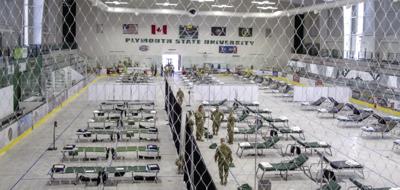
The current focus is on training and preparedness, including plans to use space at New Hampshire Technical Institute in Concord and possibly even an ice arena in Plymouth for spare capacity, should it be needed.
The Plymouth State University Ice Arena will primarily handle any overflow from Speare Memorial Hospital, but could also be used for treatment of other patients from north of Laconia, Donovan said.
Dr. Joshua Morrison, medical director for the LRGH emergency department, said he has treated several patients with symptoms of COVID-19.
“This has been a very challenging illness, most of all being able to identify it,” he said. “The myriad symptoms that present can be baffling.”
Since there is no immediate test yet available, those presenting with typical symptoms of fever and cough have to be assumed to have the disease in order to keep health care workers safe.
Morrison said he’s also cognizant that a patient who may seem to have a mild case of the disease can go through a relatively quick decline.
Another challenge arises from the highly communicable nature of COVID-19.
“We’re used to dealing with infectious diseases,” Morrison said. “We’re trained and prepared, just not at this magnitude. This is very different and can cause increased anxiety and fatigue. So we’re trying to take care of each other and our own well being.”
Doctors and nurses also must think of their own families.
“Many of our health care workers have young children at home and they are already struggling because of lack of child care,” he said. “As we see the anticipated cases coming to the Lakes Region, everybody is coming up with their own plans of how best they can keep their families protected.”
In some regions where the pandemic is intense, health care workers have stayed away from their families.
While a surge of patients is anticipated here, models that suggest patient numbers vary widely. Some of the estimates are based on conditions in urban environments, not the more rural nature of the Lakes Region.
The timing of the surge is also a question mark.
“If you look at some of the larger academic sites, it could be anywhere from the next few days, or even by the end of the month,” Morrison said. “As a department, we’re ready for any day.”
Having the tools
Meanwhile, the hospital marshals its resources, including personal protective equipment such as masks, Donovan said.
“We are greatly concerned as are all hospitals about limited resources and availability of PPE,” he said. “Every morning we do an incident command count of inventory and tools.”
He said the hospital has access to from 10 to 15 ventilators, machines that take over the breathing process for patients whose lungs have failed as can occur in the most severe COVID-19 cases.
“We feel like we are equipped OK here, but if you look at some of the projections, there won’t be enough ventilators in the state of New Hampshire,” Donovan said. “That’s a statewide problem.”
Chief Nursing Officer Terri Champagne said many institutions wish they had more nurses.
“We were short staffed before the pandemic,” she said. “There is a nursing shortage nationwide.
“If we actually get patient volumes that some of the predictions indicate, that will be another challenge and some of our staff could contract the virus as well.”
Another concern will be working out arrangements for family to visit sick patients.
Visitors have been limited for a few weeks now. Special allowances are made for end-of-life visitations.
“We take every case on an individual basis,” she said. “We’ve had a low volume of COVID-19 patients, so we haven’t been challenged with that yet.”
So far, five people have tested positive for the virus at LRGH, and 173 tests have come back negative. Results are pending on 22 other tests.
Donovan said the No. 1 thing the public can do to help LRGH is to practice appropriate social distancing and isolation recommendations.
He said the public has been generous in stepping up to provide homemade cloth masks should the hospital run out of supplies.
Donovan said LRGH is now putting up on its website directions to make caps for healthcare workers.
“It’s extremely appreciated and I hope we don’t get to a point where we need them.”


(0) comments
Welcome to the discussion.
Log In
Keep it Clean. Please avoid obscene, vulgar, lewd, racist or sexually-oriented language.
PLEASE TURN OFF YOUR CAPS LOCK.
Don't Threaten. Threats of harming another person will not be tolerated.
Be Truthful. Don't knowingly lie about anyone or anything.
Be Nice. No racism, sexism or any sort of -ism that is degrading to another person.
Be Proactive. Use the 'Report' link on each comment to let us know of abusive posts.
Share with Us. We'd love to hear eyewitness accounts, the history behind an article.