


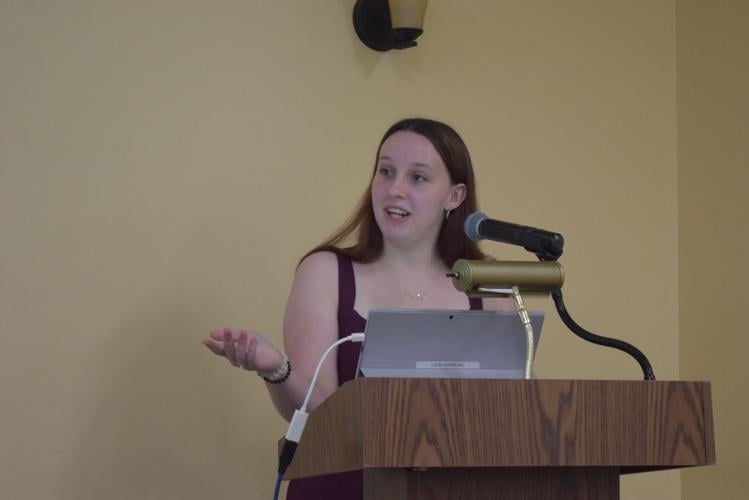
LACONIA — Lily Lescarbeau has been digging deep into city history dating back to when she was in high school. Now, the former Sachem is working on gathering information about the former Laconia State School, with hopes it will become part of her senior thesis at Saint Anselm College.
“I like to highlight Laconia’s history,” Lescarbeau said. “I’ve lived here my whole life. I just think it is really important to understand what happened, what might not be talked about as much, and just understand what happened at the State School.”
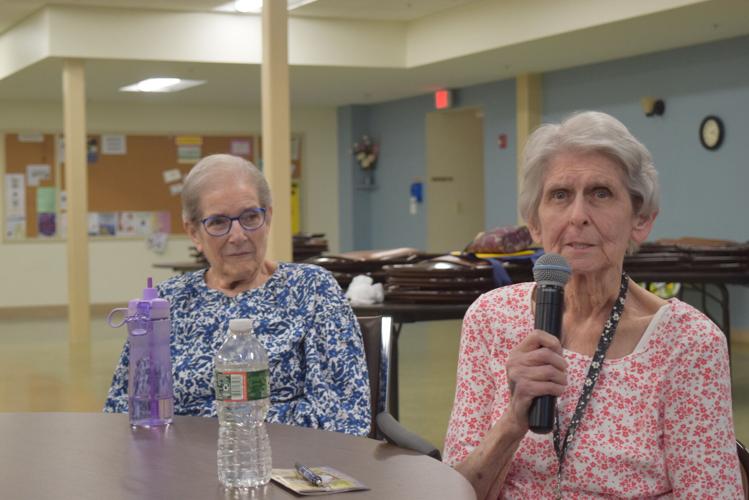
Lescarbeau just finished her second year of college, and was asked to present her findings to the Laconia Friendship Club on Wednesday. She shared what she'd gathered with a group of 15 people there, including two former employees, who were able to provide elusive insight about how things changed for the better in the later history of the controversial school.
A history buff through and through, for Lescarbeau's Diploma of Distinction project leading up to her 2024 Laconia High School graduation, she researched the history of the school in honor of its 100th year in the current building. Since then, she has continued her research into her home city.
Lescarbeau said most of her research has been from the State School's opening in 1901 to the 1950s, so hearing from former employees, like Eleanor Leclerc and Tylaine Guarriello, was of great interest.
“A lot of my information is pre-1950, but I’m currently working on talking to people on the property to get a better idea of after that,” said Lescarbeau, who has been researching the State School since she was in high school. “Otherwise, records have been spotty.”
A controversial history
Lescarbeau started the presentation with a quote that shows the school's origins.
“The state shall establish and maintain a School for the care and instruction of the feebleminded and idiotic which shall be known as The New Hampshire School for Feebleminded Children.”
This is the exact wording from the Legislature in March 1901, after the NH Federation of Women’s Clubs petitioned the House of Representatives to open a school for children with physical and mental disabilities.
“I think it is important to see these things, on how the State School has changed since it opened and closed,” Lescarbeau said.
The school officially opened in 1903, and was originally named the NH School for Feeble-Minded Children, consisting of three buildings on 250 acres of land. In 1910, Benjamin Ward Baker became the superintendent, and introduced ideas about eugenics and sterilization. Lescarbeau noted there were more than 400 sterilizations documented through 1958, mostly of women.
In 1924, the school was renamed the Laconia State School, and during the Great Depression and World War II, enrollment increased. Lescarbeau said this led to overcrowding and underfunding.
She said by 1950, the conditions of the dormitories were “inhumane.” Beds were too close together, and cleaning just involved the walls being hosed down. Lescarbeau said there was a dormitory with only one toilet for 80 people, and because residents didn’t have clothes of their own, many walked around barefoot, or even naked.
Lescarbeau said staff worked 52 hours a week on two shifts, and one staff member was responsible for 30 to 50 people at a time. She also said residents were once referred to as “inmates,” who would need to be sterilized, before they were allowed back into the community.
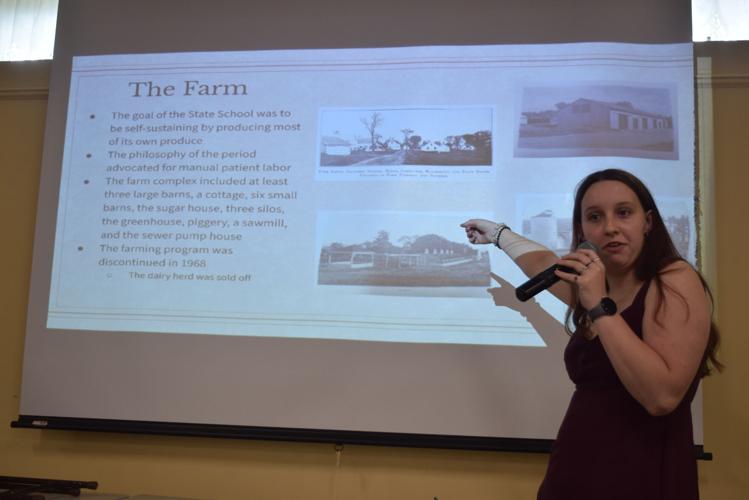
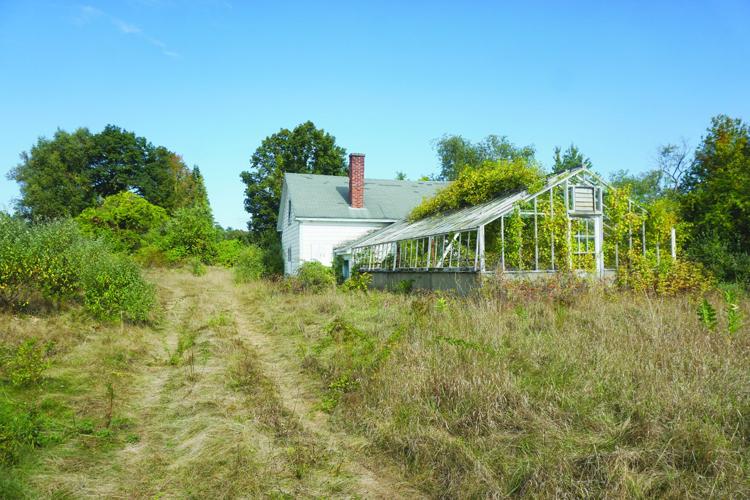
Lescarbeau also discussed aspects of the campus like the farm, saying the goal was to be self-sustaining by growing its own produce. She said there was a philosophy of implementing manual labor, and there were at least three large and six small barns, a cottage, a sugar house, three silos, a greenhouse, a piggery, a sawmill and a sewer pump house onsite. The farming program ended in 1968, when the state passed a law prohibiting residents from working without being paid.
The Laconia State School Cemetery was created in 1941, and until 1976, there were only unmarked graves. Parents asked for name plates, but stakes with names were taken out of the ground for mowing. The cemetery was off Chemung Road.
The Seldom Crockett Farm and Residence served as the administrative building. It housed the superintendent and his family, as well as the administrative offices. A kitchen, dining room and sewing area were added in 1902. The building was safely burned down in 1961, as it was aging and not of use to the school.
The Charles Sanborn property was willed to the State School by Jacob Sanborn in 1920, and included a house, barn and a shed on 100 acres of land. This is where 18 boys who Lescarbeau said were called “trainable” would live, tasked with hard labor and maintenance. It was safely burned in 1971, after standing for between 125 and 150 years.
The original dormitory burned in a boiler fire in 1904, with no injuries reported. The schoolhouse opened after the fire, and housed residents while a new dormitory was built. It was demolished in the early 1970s, to clear a spot for the Toll Building, in 1974. Named after Superintendent Arthur Toll, the building had a gymnasium, auditorium, pool, kitchen, eating area and library.
The only building named after a woman was Speare, named after Eva Speare. It opened in 1954, and one of two cottage-style buildings used for dorms, Lescarbeau explained. They housed the “highly functioning people” who could learn to live on their own. These were smaller rooms, with two to three people per room, and were more private.
There was no hospital onsite until 1935, when Murphy was opened. The building, named after Gov. Francis Murphy, became the infirmary and included a dentist’s office, pharmacy, an X-ray space, drug storage and examination rooms. Another section called Murphy Wing opened in 1963, connecting the two buildings underground, and served as a specialized residential space.
Other buildings on the property were Little Hall, Floyd, McClane, Felker, Keyes, Baker, Blood, Rice, Dwinnell, Powell, King, Peterson, Quinby, Spaulding, Dube Training Center, the boiler room, laundry and the carpentry shop.
Changes, a lawsuit, and closure
A sign of positive change came in 1952, when Richard Hungerford became superintendent. Lescarbeau said Hungerford thought parents were the best advocates for change, and invited them into the school to fight for reforms.
Lescarbeau said by using film, the parents spoke out against the “horrors” of what was going on at the school. This led to parents raising money themselves to improve conditions.
A class action lawsuit — Garrity vs. Gallen — was filed by parents of Laconia State School students against the state, with Gov. Hugh J. Gallen named first in the suit. The lead plaintiff was Sandra Garrity, a student with developmental disabilities, and her parents, Melton and Arlene Garrity.
There were 1,000 residents at the State School by 1970, with an original capacity of 40 beds. While buildings were added over time, Lescarbeau said there still weren’t enough dormitories.
“That is what Garrity helped combat.”
The lawsuit led to a 1981 court order to reduce the size of the school by 235 residents, and in 1991, the school closed its doors for the last time. Residents were subsequently transferred to other institutions.
After it closed, the property was used in a number of ways, including by the Belknap County House of Corrections, Marine Patrol and as a 911 call center.
“Otherwise, the other buildings have sat empty since the early 2000s, at least,” to decay and crumble, she said.
Lescarbeau said it's known there is a pending sale of the property, and there is a good chance it will be completely demolished to make way for future endeavors.
“There is a real possibility that the buildings won’t be there much longer, and I think it is important to talk about them.”
Former employees' experiences
Leclerc worked at the State School from 1962 to 1968, hired as a recreational therapist because of her knowledge of various sports. The area had beach frontage, now known as Ahern State Park, but back then, she could take a bus full of female residents for swimming lessons.
“It was my job as a recreational therapist to take people out of the buildings,” Leclerc said. “I did not work inside, I was outside, totally.”
She recalls interest in an ice-skating program, but students didn’t know how to skate. The state sent her to Burlington, Vermont, to learn how to teach disabled people to ice skate. Leclerc spoke of parades, baseball games, and other activities she led. She said it was an interesting place to work.
“They had a lot of advantages people never heard about or knew about,” Leclerc said.
Guarriello said she was the absolute last person to leave the property when it closed, after working there since 1971. Her initial job was working in the Toll Building, and was also the administrative assistant in the recreation department.
“I had offices in Toll, offices in Speare, I had offices in the laundry room,” Guarriello said.
Guarriello said she came in at a pivotal time, when they were making the spaces larger. Like Leclerc, she recalled parades, and said she went to Massachusetts, and brought back a “bus load” of Disney characters. During spring vacation, they had a number of activities, and also had a meal for Christmas. There were open houses in all the buildings, with house displays and a large meal for about 400 people.
Despite the reported horrors of the first half of the school’s existence, Guarriello said there was no indication of mistreatment while she was there.
“I never saw any misuse of anyone,” she said. “I never saw anyone hurt in any manner.”
Lescarbeau said she wants to hear from others who worked at the school, because otherwise, all she is finding is information from administrators. Talking to staff allows her to find out more about the people who lived there.
While the goal is to complete her senior thesis, Lescarbeau thinks it's important for the history to be shared.
“I just think it is important to continue doing the research, and I can share my work with the Laconia Historical Society, and just share it, so we have an archive of what happened.”


(0) comments
Welcome to the discussion.
Log In
Keep it Clean. Please avoid obscene, vulgar, lewd, racist or sexually-oriented language.
PLEASE TURN OFF YOUR CAPS LOCK.
Don't Threaten. Threats of harming another person will not be tolerated.
Be Truthful. Don't knowingly lie about anyone or anything.
Be Nice. No racism, sexism or any sort of -ism that is degrading to another person.
Be Proactive. Use the 'Report' link on each comment to let us know of abusive posts.
Share with Us. We'd love to hear eyewitness accounts, the history behind an article.