


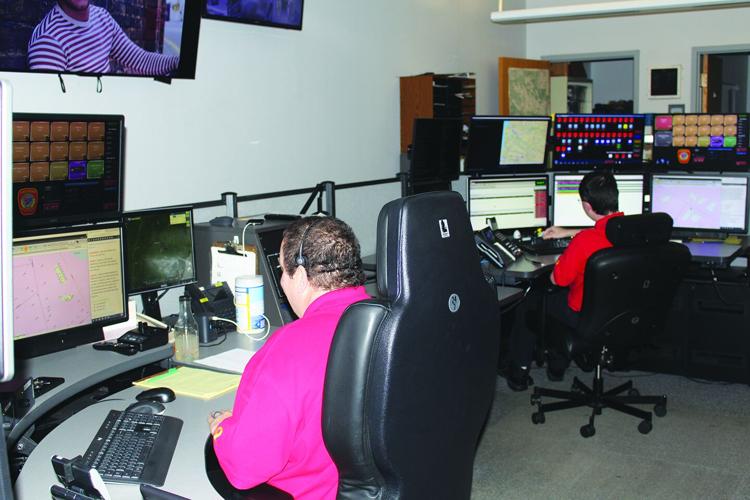
Average response time for emergencies today, like a fire at a Lakes Region home, is mere minutes, and has come a long way from firefighting capabilities 75 years ago. With more than 30 towns and cities in the area, many rural, it wasn’t always so easy.
Some fire departments were volunteer, with many more lacking the proper equipment to safely respond to a blaze in a timely manner, if at all.
“Way back in the day, 75 years ago, mutual aid was not only a necessity, it was needed, because some communities didn’t even have fire departments,” said Jonathan M. Goldman, chief coordinator of Lakes Region Mutual Fire Aid in Laconia. “There were stories of fire engines, of their time being loaded on trains in Manchester, to be taken to Derry, or Dover, to be used for fires.”
From using paper maps, even sometimes sketching them from scratch, and phone tree lists to respond to scenes to today’s modern digital technology, LRMFA has been keeping watch for residents of Central New Hampshire for 75 years.
Leaders are celebrating the milestone with pride.
“Seventy-five years is a long time. There’s a lot of people who came before us to do the work, make the hard decisions, and do the right things to set the organization up perpetually for success,” Goldman said, a career dispatcher. “Back in the day, communities said, ‘We need to get together and help each other.’ That grew into what we have today.”
On March 28, 1951, at the Winnisquam Fire Department — later absorbed by Belmont in 2006 — the first meeting of what would become Lakes Region Mutual Fire Aid Association was held. The group set to work creating bylaws and building a networking system from the ground up.
It only expanded from there, and today LRMFA is one of a few major dispatch centers in the Granite State.
“We are one of the big three for mutual aid districts and the resources we bring to bear,” Goldman said. “I think we do a great job at what we do. It works for this area, and it makes complete sense.”
Framework
When Lakes Region Mutual Fire Aid Association was originally founded, donations were accepted from volunteers — dropping spare change and dollars into a hat — to be put toward the general operating fund. Eventually, that grew into annual dues.
Those dues for member communities, in 1951, were $16.
Those days are long gone.
Today, member communities enter into a contract agreement. Costs are assessed through an equation, which calculates items like call volume.
“Each community is assessed their annual assessment based on their formula, which includes a fixed factor, population, call volume and their assessed value,” Goldman said, adding the formula is constantly scrutinized for equitability. “Over the last three years, we’ve gone to change the formula to be more realistic. The Town of Moultonborough used to be the top contributor, but they aren’t our top 10%.”
Lakes Region members include Alton, Ashland, Barnstead, Belmont, Bristol, Center Harbor, Franklin, Gilford, Gilmanton, Holderness, Laconia, Meredith, Moultonborough, New Hampton, Plymouth, Sanbornton, Sandwich and Tilton-Northfield. The contract allows for the reallocation of resources amongst member communities as needed.
Each selectboard or city council is then presented that contract for approval, and selectboards send it voters at Town Meeting. Member communities are pleased with the arrangement.
“We’re pretty fortunate to be part of LRMFA, which consists of numerous towns, going from Strafford to Rumney. All of them are different sizes with different skillsets,” said Laconia Fire Chief Tim Joubert. “Say Alexandria needs help, they can call for Laconia, no questions asked, and vice versa. That’s all done with coordination.”
LRMFA handles fire dispatch. While there is value to agencies serving both police and fire dispatch, concentrating efforts on one discipline provides efficiency.
“You can’t serve two masters. When [dispatch’s] only responsibility is only to meet fire and EMS needs for their communities, they can do that so much better. It’s a better product for everybody,” Goldman said. “You can concentrate on your responders.”
Each member community has their own unique plan for mutual aid fire response. For example, a major incident in Laconia will automatically receive mutual aid from Gilford and Belmont fire companies.
In mid-October, Moultonborough Fire Department was called to a house fire on Hanson Drive. As the lead department on the call, they got lucky: Center Harbor showed up first, called through LRMFA as part of their normal response, without Moultonborough even having to ask for help.
That turned out to be a good thing, as the call escalated, requesting more resources from Sandwich.
At LRMFA, mutual aid deployment is governed by pre-planned run cards designed in coordination with each local fire chief. Every geographic section of every town has a specific matrix outlining which neighboring departments respond first, second, or third.
It sounds complicated given all the moving parts, but the agency has it down to a science.
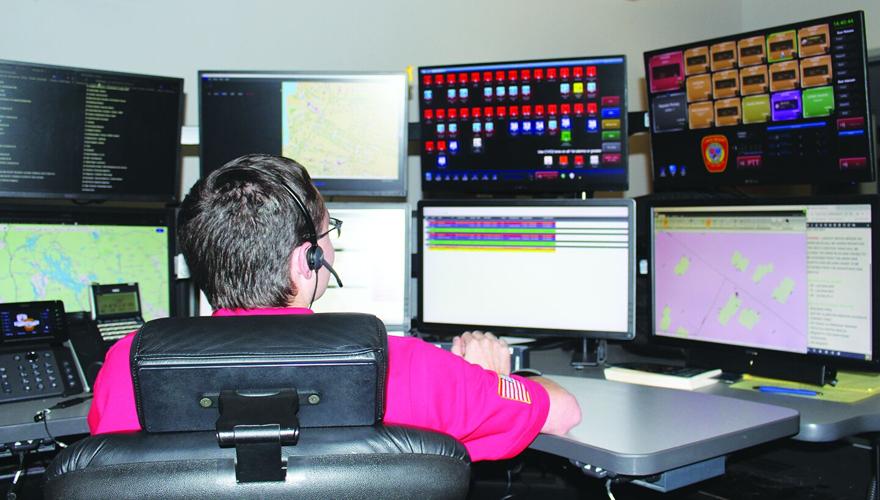
“It is done by our computer system. It’s pre-planned and worked out,” Goldman said. “Dispatchers are able to work on the fly, and make decisions.”
Deputy Chief Coordinator Erin Hannafin, who has been with LRMFA for 13 years, said ongoing work is done to keep the Lakes Region safe.
“The behind-the-scenes moving parts at all times is constant. We're constantly changing and updating the [computer-aided design system] to what's better for the responders, what's a better picture and working with the private sector partners,” she said. “We're working with the Red Cross to figure out ways to dispatch them earlier to incidents, and be able to help the citizens have Red Cross handle rehab, so we can free up providers and and they can do other things. We just approved a contract and notifications with the National Weather Service. So now, instead of them calling us at the tail end of a storm or the next day, [dispatchers are] going to get notified when we have trees and wires down.”
In addition to mutual aid, LRMFA also provides training opportunities for first responders.
From bucket brigade to top-notch tech
It’s no joke firefighters used to carry maps in their trucks, but thanks to major technology improvements, navigating Lakes Region geography in a tractor-trailer size vehicle with lights and sirens has never been easier.
LRMFA’s major assets have remained the same since Day 1: its building, radio network, and employees. With a constant focus on top-notch communications and dedicated employees to see its maintenance, improvement and future expansion, the agency delivers.
It wasn’t always that way.
“We started out dispatching via radios. The chief or chief coordinator bought a car. The chief would respond to these fires or incidents, open up huge binders of paper to show what the resources were,” Goldman said. “Fast forward to today, our radio network has expanded. Super huge, largest network of its type east of the Mississippi.”
Geographically speaking, the radio network covers a lot of terrain.
The network "spans 1,800 miles, with 14 individual radio sites. They hold a minimum of two actual radios, if not more. The majority of that is on radio towers on the mountaintop, which is why we can do such a larger area with such few sites ... because of where our equipment is placed,” Goldman said, giving credit to the organization’s founders. “Lots of really good forward thinking projects have helped put us where we are today.”
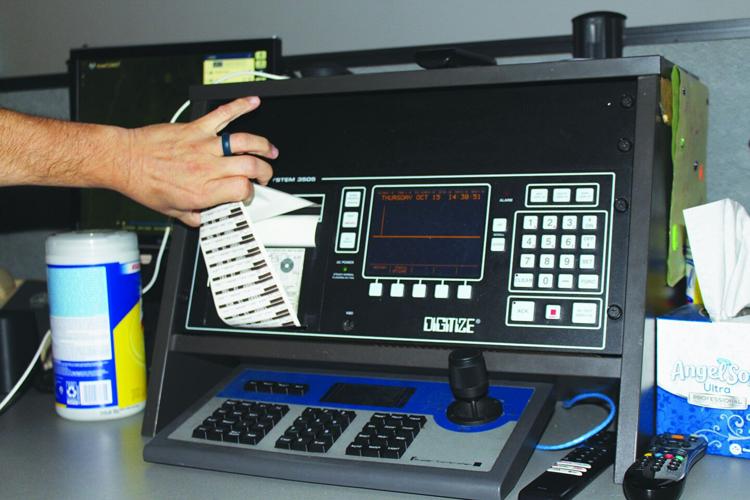
Recently, the Laconia Fire Department decommissioned a piece of dispatch equipment from 1876: a Gamewell master box system. In laymen’s terms, the black, rectangular box spits out receipt paper (like a fax machine) with emergency call details. For years, dispatchers would use the slips to report back with additional resources as needed.
On Oct. 13, Laconia Fire officially retired that box alarm, 150 years to the day of the first box alarm in the city.
“For 150 years, that system stood watch over Laconia’s mills, storefronts, schools, and neighborhoods. Fire Chief Tim Joubert and the Laconia Fire Department extend their gratitude to the firefighters, dispatchers, and fire alarm superintendents whose careful stewardship kept the network running for decades," reads a press release from Deputy Chief Louis Loutrel. "With the final box removed from service, the city closes the book on one of the longest-running pieces of public safety infrastructure in its history.”
With all that technology comes training and mandatory recertifications, and the agency maintains strict adherence to quality monitoring and assurance programs boasting robust international accreditation standards.
Following these guidelines to ensure the best dispatch service they can provide, Goldman and Hannafin play a pivotal role in analyzing their calls for improvement and best practices.
“The QAQI program, the chief developed it, and then I've expanded and adjusted it as our needs have grown. We went from an Excel document to a state-of-the-art program that runs it for us. Two lieutenants and I do all the quality assurance of the calls,” Hannafin said. “We're able to go in, and we're able to look at each other's notes, and we're able to see everything. We're able to see that over 90% of our calls are answered and dispatched in under 60 seconds.”
Unsung heroes answer phones
Seasoned dispatchers remember the days before the profession became its own entity. They’ve worked hard to leave their mark on emergency services, proving to be the backbone of emergency communications.
It’s important work often unseen — and unrecognized — by society.
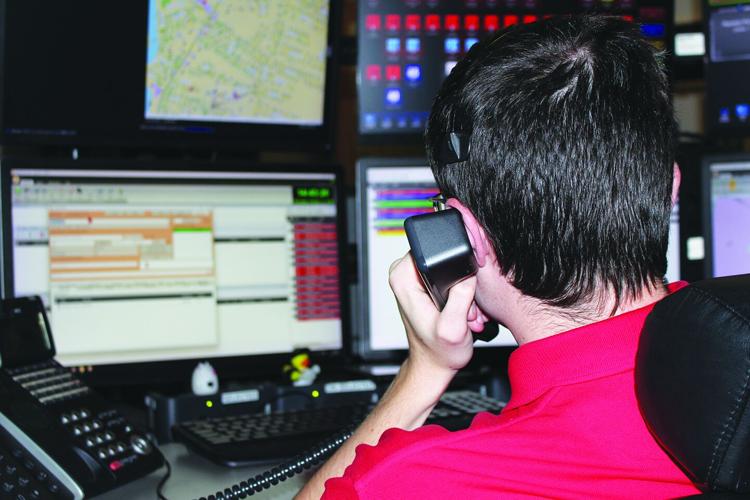
"It's a whole adrenaline rush. We get the same adrenaline rush that responders in the field do in the same dump, but we have to sit still in the chair, whereas these guys get to burn off the energy from the adrenaline," Hannafin said, adding calls are just as difficult even if dispatchers aren't extra boots on the ground. "It is the mental toll of being able to compartmentalize, especially those harder calls like pediatric cardiac arrest calls or somebody significantly injured. In the moment we have to just focus on what's in front of us on our screens and we have to process it afterward."
The team at LRMFA makes sure to check in on each other as often as possible, but especially after a difficult call. Hannafin said while not being on scene is somewhat easier, phone calls often aren't.
Future of LRMFA
Seventy-five years later, Lakes Region Mutual Fire Aid is about to embark on one of its biggest endeavors yet: its relocation to a new 21,000-square-foot, state-of-the-art facility on Meredith Center Road.
From front to back, the project — totaling $18.587 million — is funded through the American Rescue Plan Act, as well as a grant from the Department of Homeland Security for $1 million.
In November 2025, Gilford Fire Chief Stephen Carrier told the town’s selectboard about the project, saying he was pleased no costs would come back to any LRMFA communities.
Once the relocation is done, Goldman and Hannafin will continue to lead the charge. That will encompass some serious thinking about the next big plan.
“We’re sitting here today, trying to figure out what we’re going to do in the next 25 years. The whole landscape of emergency communications is changing,” said Goldman about tech evolutions. “Our radio system is tough and resilient, built not to fail, but I don’t know what the next ideation looks like.”
He said some of the ideas — like biometric firefighting suits and body cameras that automatically turn on at a certain temperature — aren’t too far off.
“They’re doing it. It’s happening in fire service today. We’ve had all these leaps and bounds,” Goldman said.” What’s it going to look like in 20 years?”
•••
Katlyn Proctor can be reached at katlyn@laconiadailysun.com or by calling 603-524-0150. Bob Martin contributed to this article.


(0) comments
Welcome to the discussion.
Log In
Keep it Clean. Please avoid obscene, vulgar, lewd, racist or sexually-oriented language.
PLEASE TURN OFF YOUR CAPS LOCK.
Don't Threaten. Threats of harming another person will not be tolerated.
Be Truthful. Don't knowingly lie about anyone or anything.
Be Nice. No racism, sexism or any sort of -ism that is degrading to another person.
Be Proactive. Use the 'Report' link on each comment to let us know of abusive posts.
Share with Us. We'd love to hear eyewitness accounts, the history behind an article.