


LACONIA — Warnings for cyanobacteria blooms on Lake Winnipesaukee were lifted Wednesday, according to the New Hampshire Department of Environmental Services.
As of Thursday, the entirety of Lake Winnipesaukee is clear of cyanobacteria, a substance often referred to as blue-green algae. If circumstances do not change, residents and visitors to the lake might expect good conditions on the water around the Independence Day holiday.
Numerous areas around the lake were hit with blue-green algae warnings and advisories last week during a particularly hot couple of days when temperatures ranged in the mid-90s. Those warnings included most of Lake Winnipesaukee but have since been removed following another round of water quality testing.
Mill Pond, in Alton, is the only waterbody in the Lakes Region with an active cyanobacteria warning. That warning was issued on June 14 after water samples taken the day before indicated a density of 334,000 cells/mL.
Cyanobacteria can be harmful to pets and animals. Toxins can cause skin or eye irritation, negative health effects or even death in rare cases. Anyone who falls ill after exposure to cyanobacteria should seek advice from a physician.
Areas tested on Wednesday include Carry Beach; Jockey Cove; Brewster Beach; 19 Mile Bay; 20 Mile Bay; Tuftonboro Neck; the area between Ragged and Cow islands; Cow Island West Cove; the southern end of Long Island; Moultonborough Neck near Nineacre Island; Meredith Town Docks; Ellacoya State Park; Gilford Town Beach; the Broads; Moultonborough Town Beach; Bear Island; Center Harbor Town Beach; Leavitt Beach; Governor’s Island; and in Alton at the town beach and near Dewitt Drive.
Cyanobacteria was not detected in any of the samples.
NHDES issues warnings if water samples indicate cyanobacteria density greater than 70,000 cells/mL. Watches are issued for areas where water samples test for a density less than 70,000 cells/mL.
The notice came down through NHDES communications on Wednesday.
“We have not received any reported sightings since last week,” Bree Rossiter, Lake Winnipesaukee Association conservation program manager, said Thursday.
Cooler air and water temperatures following a regional heatwave that broiled New England probably contributed to clearer waters. Cloudy skies may have also contributed to reduced water temperatures, Rossiter noted.
The water temperature noted by the LWA’s “Lake Winnipesaukee Report Card” indicated 69 degrees on Thursday afternoon, down from around 72 degrees less than one week ago.
When the Lakes Region experienced several days of heavy rains and even a tornado watch, those conditions may have contributed to cooling and helped dissipate cyanobacteria present in the lakes’ waters as well. But the rain is a double-edged sword, hampering algal growth but also contributing to it in the longterm as lawns, roads, coastline and drainage system runoff introduce greater quantities of nutrients to the lake.
NHDES scientists were busy on the lake this week, testing each of the aforementioned sites for the presence of cyanobacteria.
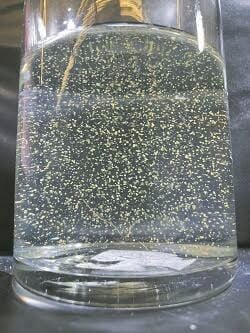
Workers first take dispersed samples and survey water columns and the shoreline visually, looking for the distinctive signs of cyanobacteria growth. Blue-green algae blooms look a lot like scum on the top of the water, but are also masked by pollen that finds its way onto the lake.
In the area of the Broads, one of the sections of the lake where a warning expired this week, the previous warning was issued at the end of June 2022. That warning lasted approximately two days and waters there contained over 199,000 cells/mL of cyanobacteria. The area around Governor’s Island has experienced frequent blooms and subsequent warnings, most recently for over a week in September, 2022, when tests found waters contained around 117,000 cells/mL there.
If it’s suspected that cyanobacteria is present in a given area, scientists collect more water samples which are later reviewed under a microscope. Then, the density of cyanobacteria in each sample is recorded and may result in a warning, watch or could be given the all-clear.
“There was no cyanobacteria found,” Rossiter said. “If we have another three- or four-day stretch of hot temperatures in the 90s, then we could see more.”
Conservationists pay attention to weather forecasts in order to anticipate when conditions may be right to contribute to new blooms, but that isn’t an exact science. Rossiter asked local residents to report suspected algal blooms to the Lake Winnipesaukee Association.
Algal blooms are more frequent later in the summer, Rossiter noted, when hot water at the surface mixes with cooler waters below.
Individuals can take action to prevent exacerbating the problem, she added. Checking to make sure septic systems are working properly and diverting stormwater runoff and other drainage systems from entering the lake are good places to start. Municipal ordinances to that effect could be useful in preventing future blooms.
Residents who wish to report a suspected algal bloom can share the information with NHDES at.des.nh.gov/water/healthy-swimming/harmful-algal-blooms, and with the Lake Winnipesaukee Association at 603-581-6632 or mail@winnipesaukee.org.
Future advisories are expected to be updated at des.nh.gov/water/healthy-swimming/healthy-swimming-mapper.


(0) comments
Welcome to the discussion.
Log In
Keep it Clean. Please avoid obscene, vulgar, lewd, racist or sexually-oriented language.
PLEASE TURN OFF YOUR CAPS LOCK.
Don't Threaten. Threats of harming another person will not be tolerated.
Be Truthful. Don't knowingly lie about anyone or anything.
Be Nice. No racism, sexism or any sort of -ism that is degrading to another person.
Be Proactive. Use the 'Report' link on each comment to let us know of abusive posts.
Share with Us. We'd love to hear eyewitness accounts, the history behind an article.