


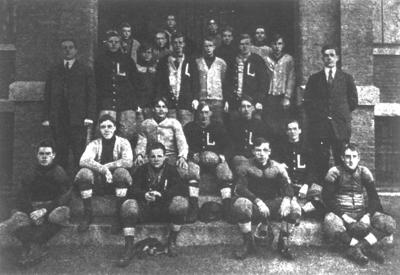
LACONIA — Prior to 1908, Laconia High School, which was then located on Academy Street, was not known for fielding competitive football teams. In fact, the school had yet to win a state championship in any sport. That changed when Walter “Balky” Boyson was hired as the football coach.
Such is the story discovered by Alan Wool, an LHS alum and retired educator who has put about 200 hours into studying the history of athletics at his alma mater. As a result of his research, the 1908 state championship football team will be inducted into the Laconia High School Athletic Hall of Fame during a ceremony at the Huot Technical Center on Friday, Nov. 29, which will start with a social hour at 5 p.m. Also being inducted on Friday will be BJ Fowler, class of ‘77; Richard Steady, ‘79; Martha Kidder-McIntire, ‘88, and; David Rea, voice of the Sachems.
Wool, who was a three-sport athlete at LHS, said he started his research after attending last year’s Hall of Fame ceremony, at which he and a former teammate noted that there wasn’t a record board for track and field events. Wool then asked for, and was granted, the blessing of Athletic Director Craig Kozens to see if he could find out which Laconia track athletes set event records, and when, so that they could be displayed at the school.
“I went to Laconia Public Library, I started going through microfilm,” Wool said. “I put in between 150 and 200 hours of research.”
While he was able to find some track and field results, the reports were inconsistent over the years. But it led him to another thread, which started with the 1958 homecoming football game, when the team of 50 years prior was given a parade, treated to a dinner and honored at halftime. James Noucas, athletic director at the time, was able to identify all surviving team members. During the halftime ceremony, the team members – who flew in from all over the country – presented the school with a plaque honoring their coach, with the wish that it be awarded each year to a football player who had exhibited excellent sportsmanship on and off the field. Wool had been a recipient of the Boyson award when he was at LHS, and it occurred to him that he didn’t really understand the history behind the award. Also, his curiosity was piqued: who else had received the honor?
“It was amazing, the history involved in this award. What I like about it is the flavor of the local people who are recipients of this award,” Wool said.
Boyson, a Massachusetts native who coached at Holderness School before coming to Laconia, is credited with transforming the Sachem squad from doormats to champions. An article published in the Nov. 1, 1958 Laconia Citizen draws from an account of the championship run, and its effect on the city, recorded by Andrew Childs.
“The explosive effect on the townspeople was all the more atomic because practically since the dawn of civilization the local high school had never produced a winning football team, in fact had seldom scored to say nothing of winning a ball game,” Childs wrote.
But Boyson had a recipe for success. Childs’ account spoke of exhaustive drills on the Pearl Street field, and, once the body was worn out, “skull” practice followed to exercise the matter between the ears.
The results were profound. The Sachems won their first game, played on Sept. 26 against Penacook, by the score of 76-0. That was the first of six shutouts. Over the course of the 10-game season, LHS scored a total of 194 points, and allowed opponents to score just 17. They only lost one game.
Wool said that, after doing his research, he understood why the 1908 team was honored a half-century later. And, why that team chose to, in turn, honor their coach.
“It set a tradition, something that you should strive for,” Wool explained. “It shows you what could be done if you put your heart and soul into something. It also shows you what one person can do as a coach, because they didn’t win a championship for a long time after that… If Walter hadn’t shown up at the school, this wouldn’t have happened this soon. It’s so important to have good role models, especially in today’s society.”
Through microfilm of newspaper archives, phone calls with former players, and looking through old yearbooks, Wool has identified all recipients of the Boyson award, 1958 to present, except for the year 1998. Also missing is the original plaque, though Ken Martin from the LHS Engineering Department is designing and creating a new plaque for the Walter L. Boyson Award. Still, Wool welcomes a phone call from anyone who might be able to help with any of those mysteries, he can be reached at 603-455-4479.
Kozens said that the school will benefit from the hours that Wool has poured into his research.
“Alan Wool has worked tirelessly and passionately to research much of our sports history. He has reconnected and reunified many Sachem alumni through this process. He is a good man and a true Sachem that wears his pride on his sleeve. He has been a pleasure to work with in this process,” Kozens said.


(0) comments
Welcome to the discussion.
Log In
Keep it Clean. Please avoid obscene, vulgar, lewd, racist or sexually-oriented language.
PLEASE TURN OFF YOUR CAPS LOCK.
Don't Threaten. Threats of harming another person will not be tolerated.
Be Truthful. Don't knowingly lie about anyone or anything.
Be Nice. No racism, sexism or any sort of -ism that is degrading to another person.
Be Proactive. Use the 'Report' link on each comment to let us know of abusive posts.
Share with Us. We'd love to hear eyewitness accounts, the history behind an article.