


HILL — In the fall of 2023, students at the Jennie D. Blake School held a book release party for their historical fiction project, "Jennie’s Story," based on the life of Jennie Lind Dickerson Blake, the teacher for whom the school was named. This year, on June 11, students at the school — including three who were part of the book project last year — presented a play based on that story.
Brian Connelly, school principal and superintendent, was the catalyst for both the book and play, although he attributed the original idea to members of the Hill Historical Society, who have been active in making sure students are grounded in town history. The historical society helped to create “OUR”Story panels in the cafeteria, depicting Hill’s history from the 17th century to modern times.
Teachers Megan Kwapiszeski and Alicia Schaefer, along with artist-in-residence Kimberly Valpey, assisted the students in writing and illustrating the book, which covered the period from Blake’s birth on July 16, 1878, to the opening of the Jennie D. Blake School on Sept. 4, 1941, and her retirement in 1945.
Staging the play
When Melanie Perkins applied for a job as art teacher a year ago, she found the school had already filled the position. Connelly, however, noticed her resume included theater experience, and he suggested staging a play based on "Jennie’s Story."
“I love New Hampshire history,” Perkins said, “and it’s such a unique story about her that I was like, 'Yes, definitely.'”
Using Elementary and Secondary School Emergency Relief funds, School Administrative Unit 103 was able to hire Perkins to work with the students on the play.
It was Perkins’ first time directing or converting a book into a play, and she said, “My aim was to make it fun for them and get them hooked into the theater thing; to show students how there’s a job for everybody in the theater. You don’t have to be a performer; there’s so many different ways to get involved: with costumes, makeup, the props — because I didn’t have props, some of the younger kids helped with the papier-mache apples. So our goal is to start to really have more of the students at different grade levels involved for this go-around. It just made sense to do.”
Perkins said she “tried to stay very true to the story, using the exact words students used” in the book. The speaking parts used the dialogue quoted in the book, and she had students narrate the rest of the story.
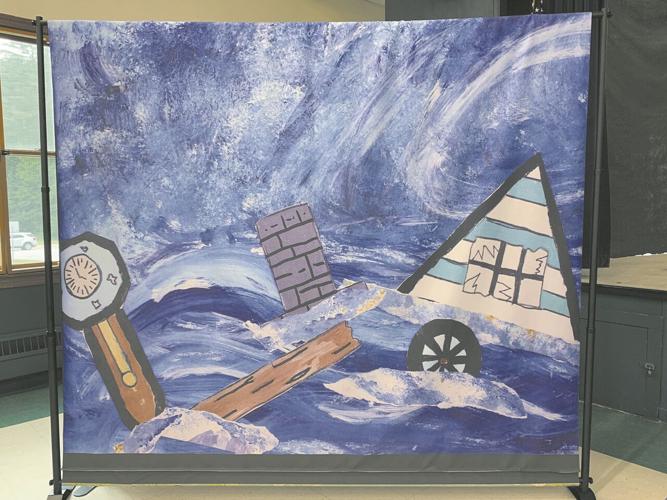
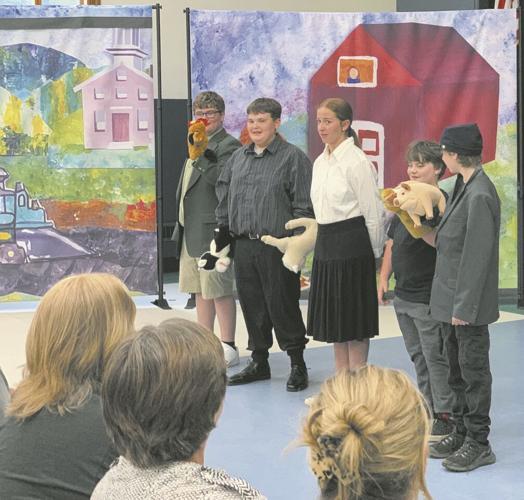
Instead of trying to build sets, Perkins came up with the idea of using banners, and MegaPrint of Holderness blew up the students’ book illustrations to serve as backdrops for the performance.
“I wanted to also make it so that, if we want to take the show outside, and do it in different environments, that this would be something that packs up,” Perkins said.
The project also was Perkins’ first time doing sound design, and she chose royalty-free music and sound effects that added a little humor. During the marriage scene, she said, “The kids were embarrassed, and I wanted to make sure they had fun, because sometimes with theater, it gets to that point where things get stressful ... so that’s why I incorporated the puppets.”
During a farm scene, students held puppets of cows, pigs, and chickens, with the appropriate animal sounds.
Performers included Avarie as Young Jennie and Marin as Older Jennie, along with an ensemble cast of students taking on many roles — narrators, train conductor, puppeteers, teacher, friends, students, townspeople, and school board members.
Avarie, Marin, and Connor were involved in both the book and the play. (Others who helped create the book had gone on to sixth grade in the Newfound Area School District.)
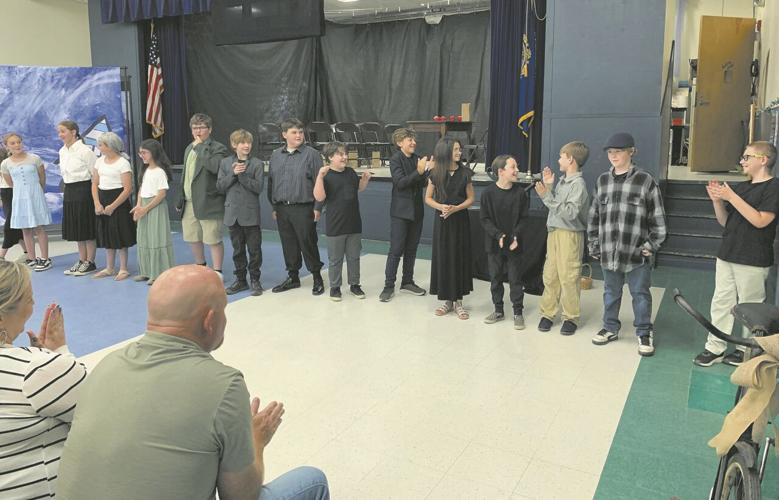
During the “curtain call” at the end of the performance, each student had a chance to discuss their roles and what they enjoyed the most. When Connelly asked what was the most challenging part of the process, Avarie responded, “Trying to get everyone under control.”
Kayson said the experience made him want to go on and be a performer.
Connelly said a couple of the students have talked about doing a spinoff to "Jennie’s Story" about the flood of 1936 that led to the building of the Franklin flood control dam whose impoundment area would put the town under water. Residents had a choice of having the government purchase their property in the floodplain so they could leave, or to relocate the village to higher ground, and they chose the latter. The “new” Hill Village was the first town in the state to be designed by state planners.
“It’s another exciting opportunity for our kids to learn about their history, learn about their communities, and do schoolwork,” Connelly said.
Perkins will be returning as an art teacher next fall, and she expects to lead a theater program after school, “because we’d like to be able to invite like the middle school kids to join in as well ... and that means the sixth graders that are graduating can come back and still be involved.”
She added, “I would like to take a little chunk of the art class and do some of the rehearsing and hopefully, we’ll get more older kids and all kinds of things. Because it’d be nice to see them doing some of the directing roles as well.”


(0) comments
Welcome to the discussion.
Log In
Keep it Clean. Please avoid obscene, vulgar, lewd, racist or sexually-oriented language.
PLEASE TURN OFF YOUR CAPS LOCK.
Don't Threaten. Threats of harming another person will not be tolerated.
Be Truthful. Don't knowingly lie about anyone or anything.
Be Nice. No racism, sexism or any sort of -ism that is degrading to another person.
Be Proactive. Use the 'Report' link on each comment to let us know of abusive posts.
Share with Us. We'd love to hear eyewitness accounts, the history behind an article.