


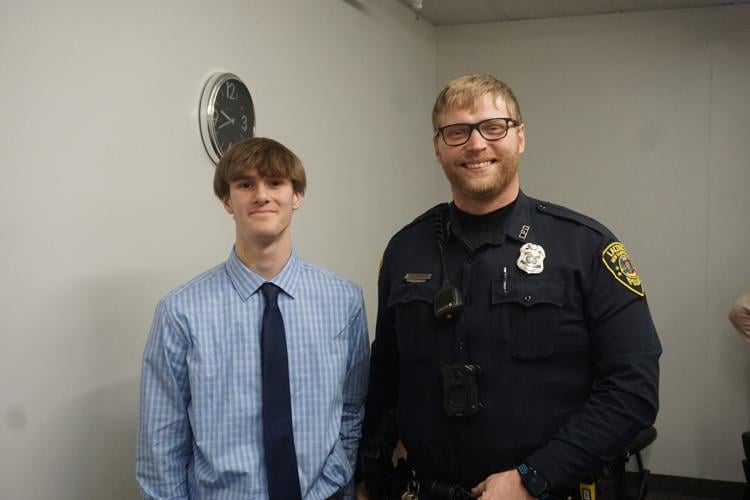
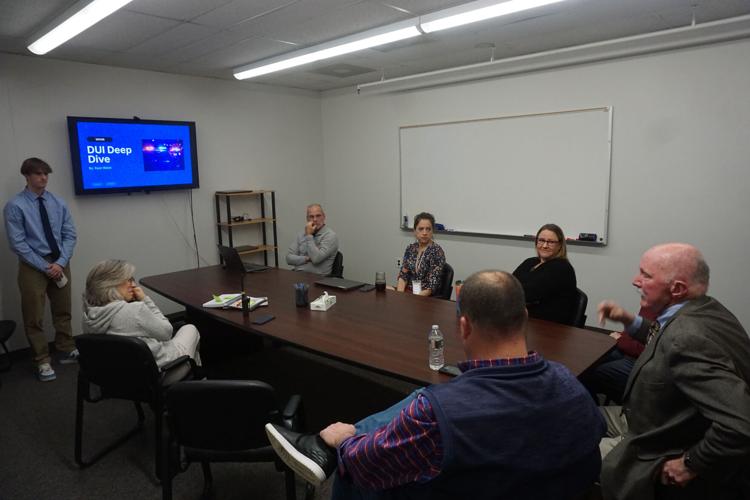
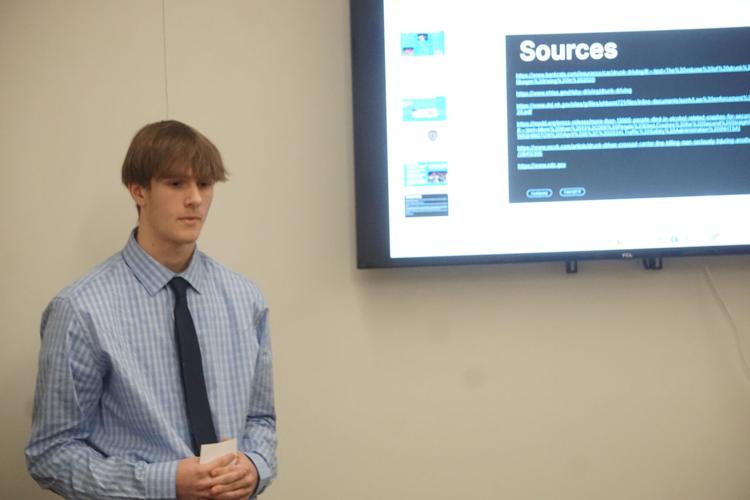

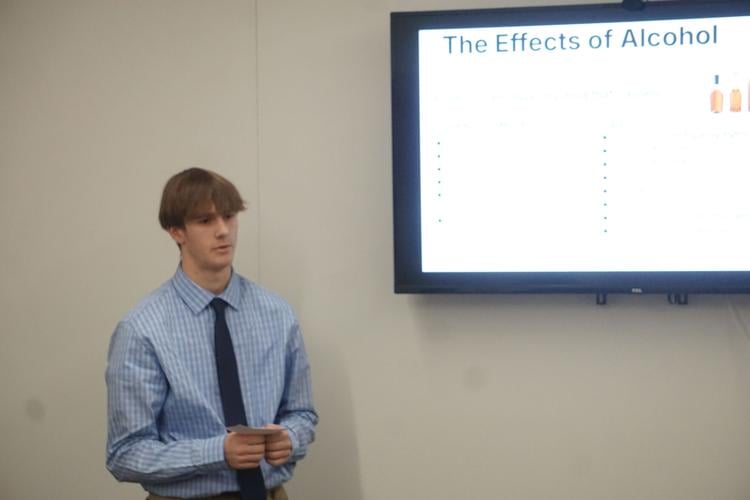
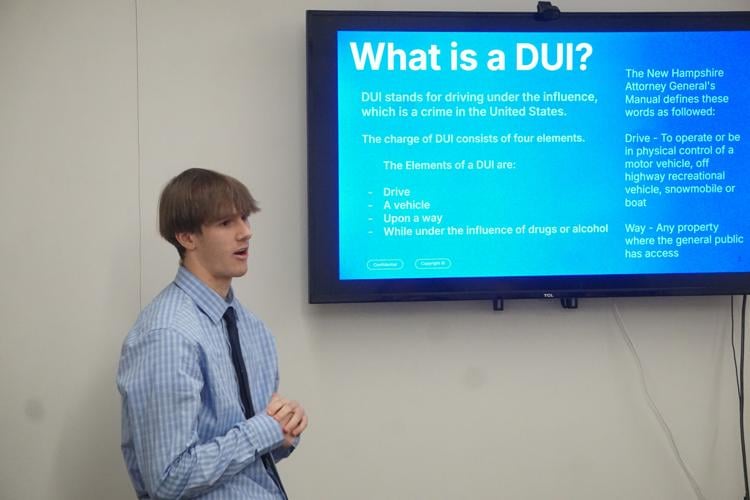
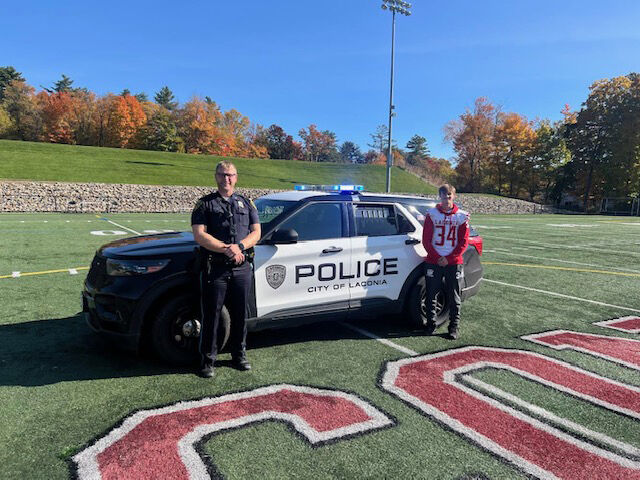
LACONIA — Laconia high school junior Ryan Walsh recently completed an extended learning opportunity with the police department. He presented his findings on drunk driving policy and procedure to a group of educators and family members Monday morning.
Walsh, 16, grew up proud of his grandfather, Tom Walsh, who was himself a distinguished Granite State member of law enforcement. There’s even a mural at a state training facility named after him.
Now Ryan is entertaining his own potential career in law enforcement, but he’s college-bound first. He said Monday he’d like to study aerospace engineering and would consider entering law enforcement after earning a degree.
Extended learning opportunities at Laconia High School are something akin to internships or job shadows. Ryan completed his with Laconia Police Officer Tyler Rouse, who’s also the school resource officer at the high school.
He chose to focus on enforcement of driving under the influence laws and policies over the course of his experience, and considered how the same had changed over the years.
“DUIs really intrigued me because of how many deaths” they cause, Ryan said Monday morning. “The [statistics] were really what drove me for research.”
Throughout his experience, Ryan worked with Rouse to learn the details of basic police procedure, fundamentals of officer discretion, and he interviewed local police officers about favorite stories from their careers. Later on, he began focusing intensely on the ways DUIs are handled on the road and at the station.
His favorite experiences in learning more about the work of the officers in the police department were during rides along with Rouse. Ryan said he found it particularly interesting to see what officers do on a day-to-day basis, responding to calls and conducting patrol, and he looks forward to a taser demonstration that’s to be done at a later date.
He was also able to visit the police academy, where his grandfather works part-time, and saw the tactical room, where officers train on realistic scenarios.
“I got to see the tac room, which was very cool — it’s set up like a city,” Ryan said. “They were redoing the floor, but normally the floor is black and it has city lines painted on it. They bring cars in there and they practice their traffic stops and everything. There’s murals on the wall of stores, which we have Walsh’s Drug Store on the wall because of how long he was working there.”
One thing Ryan learned and didn’t particularly like: officers must complete lots of administrative duties.
“There’s a lot of paperwork,” he said.
But the biggest takeaway from his experience, Ryan said, is noticing the ways officers are treated by members of the public. Some individuals “put them on a pedestal,” he explained, while others maintain negative views of their work.
“It’s a very two-sided job,” he said.
During his presentation, Ryan went over the four main steps of DUI enforcement: questioning a driver following a traffic stop, taking care to ask open-ended questions such as “how much have you had to drink tonight?”; conducting field sobriety tests, of which there are three considered standard to test a motorist's ability to safely navigate a vehicle on New Hampshire’s roadways; have a driver sign a form, giving the officer permission to test their blood alcohol level — if a driver refuses to sign, their drivers license is immediately suspended; and finally, transport the suspect to the police station to undergo booking procedures.
“These have always been the three main field sobriety tests, and I do believe it will remain that way for a long time,” Ryan said.
The legal limit for a driver's blood alcohol content in New Hampshire is 0.08. A BAC of 0.16 or over is considered “aggravated”. Even if an officer stops someone they believe to be intoxicated, and that driver admits to imbibing alcohol, they’ve still got to run them through the tests to gather enough evidence to build a case.
In Laconia, a suspected DUI is always a two-officer call, Ryan explained. He also noted DUIs aren’t always divorced from other driving infractions, such as using a handheld device or being otherwise distracted.
“Drunk drivers do the same things as everyone else,” he said.


(0) comments
Welcome to the discussion.
Log In
Keep it Clean. Please avoid obscene, vulgar, lewd, racist or sexually-oriented language.
PLEASE TURN OFF YOUR CAPS LOCK.
Don't Threaten. Threats of harming another person will not be tolerated.
Be Truthful. Don't knowingly lie about anyone or anything.
Be Nice. No racism, sexism or any sort of -ism that is degrading to another person.
Be Proactive. Use the 'Report' link on each comment to let us know of abusive posts.
Share with Us. We'd love to hear eyewitness accounts, the history behind an article.