


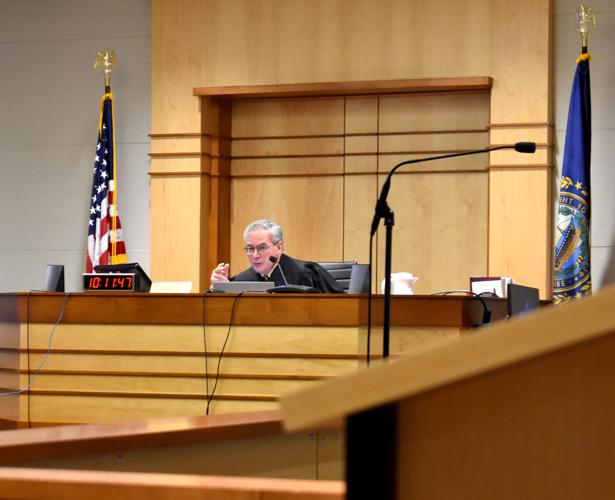
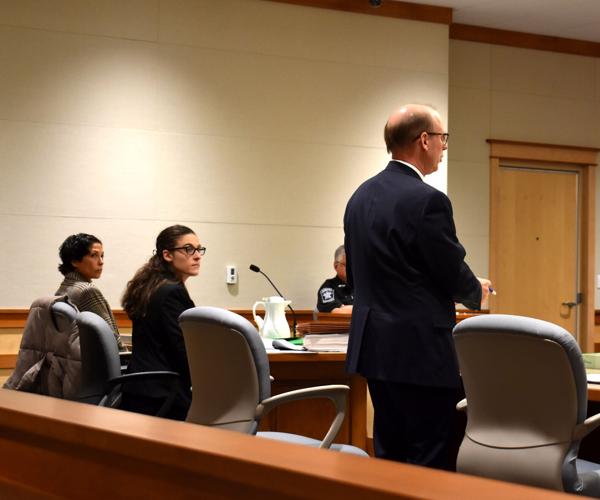
CONCORD — In a hearing held last month in the case of a business owner who is suing several past and present Franklin city leaders for, in part, failing to produce documentation, a Merrimack Superior Court Judge ruled that one of the defendants must pay a penalty for deleting emails she had been ordered to preserve as evidence.
However, the judge stopped short of ordering an additional financial award, which would have indicated the destruction of evidence prevented the plaintiff from being able to prove her case.
The decisions were the latest development in the lawsuit brought against city leaders by Miriam Kovacs, who alleges the city discriminated against her business, then failed to comply with requests for information.
“It’s important to realize the backdrop of this case is ultimately accountable government,” Cassandra Moran, representing Kovacs, told Judge Martin Honigberg during a hearing in Merrimack Superior Court on Oct. 25. The hearing was called to address concerns, brought by the plaintiff, that one of the defendants had apparently deleted emails she would have been compelled to preserve as evidence in the case.
The suit was brought by Kovacs in August 2023, in an attempt to respond to what she considers discriminatory and retaliatory treatment. Kovacs and her business, eatery The Broken Spoon, became targeted both online and in person by white nationalist groups. Kovacs, who is Jewish, asked for protection from local police, but she says her requests were not adequately met. Instead, she alleges she and her business were defamed by city officials, and she and her lawyers claim her subsequent requests for public documents that would prove her claim were not fully honored. Kovacs has requested a jury trial.
Defendants named in the suit include the City of Franklin and its police department, as well as its former Police Chief David Goldstein and Sgt. David Ball, City Manager Judie Milner, current and former city councilors Jay Chandler, Valerie Blake, Vince Ribas and April Bunker, as well as former mayor Jo Brown.
During the discovery phase of the suit, Kovacs asked for emails regarding her and her business, exchanged between defendants, to be shared with her legal counsel. According to documents filed with the court by Moran, they initially received only one email, from Brown’s personal address, but batches of documents sent from other defendants included other emails Brown had sent them from her personal account having to do with official city business.
When following up on this discrepancy, Kovacs and her counsel were told by James Soucy, who is currently representing defendants, that Brown had deleted all emails from her personal account relating to city managers at the conclusion of her term in January 2024 — months after being served notice such emails should be preserved as evidence.
Moran requested that Honigberg order Brown to pay financial penalties for destroying evidence — “spoliation” in legal terms — both to cover the additional legal fees the evidentiary confusion caused, and as penalty to reflect the damage to the plaintiff’s case.
“We would like monetary sanctions from defendant Brown ... calculated based on the time to review discovery, and second, based on the gross violation of the discovery rules and the seriousness of the spoliation, especially in light of the allegations and complaints,” Moran said.
Countering the motion, Soucy said Brown was acting “in good faith” and “not in any nefarious attempt” when she, according to her explanation to him after the fact, forwarded emails to the city, thinking the emails would be preserved on the municipal server, before deleting them from her personal AOL.com account.
“That is the information that has been conveyed to us by the client,” Soucy said. He also characterized the time spent by Moran in trying to understand the discrepancies as a normal part of the discovery process.
Honigberg’s decision showed he wasn’t swayed by Soucy’s explanation.
“It’s not normal to discover that one client was deleting things,” Honigberg said. “That’s work they shouldn’t have to do, I would not characterize that as normal discovery.”
The judge told Moran to itemize the time and expense spent on trying to untangle the situation, and submit that to the court. Yet he assented to only part of Moran’s request — on the question of additional penalty to reflect damage to her case, he said the jury could consider that during trial.
“Certainly there is the basis for spoliation, but we don’t know” if there is or not, Honigberg said.
Honigberg ordered attorneys for both sides to continue working together to iron out the discovery process, and either schedule a status conference or submit a progress report to the court every 60 days.
The judge noted the initial schedule anticipated a trial starting in May, though he doubted that was still likely, given the confusion experienced so far.
“Based on what I’ve heard, my gut tells me 90 days is what’s been lost here,” Honigberg told Moran and Soucy. “Put your heads together and come up with a new schedule.”
Soucy didn’t provide a comment after the meeting.
In an email sent after Honigberg’s decision, Moran wrote, “The Court’s order imposing sanctions speaks for itself.”


(0) comments
Welcome to the discussion.
Log In
Keep it Clean. Please avoid obscene, vulgar, lewd, racist or sexually-oriented language.
PLEASE TURN OFF YOUR CAPS LOCK.
Don't Threaten. Threats of harming another person will not be tolerated.
Be Truthful. Don't knowingly lie about anyone or anything.
Be Nice. No racism, sexism or any sort of -ism that is degrading to another person.
Be Proactive. Use the 'Report' link on each comment to let us know of abusive posts.
Share with Us. We'd love to hear eyewitness accounts, the history behind an article.