


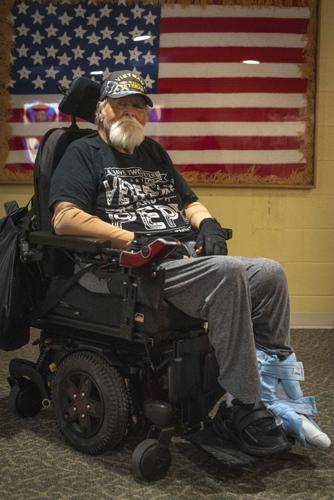
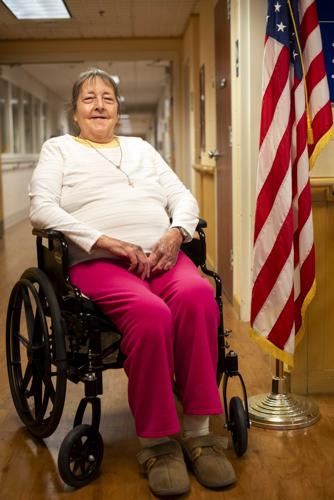
TILTON — One of the big selling points for people interested in joining the military is the benefits and support available during and after their service. The U.S. Department of Veterans Affairs offers a variety of benefits to veterans including disability compensation, pension, education and training, health care, home loans, insurance, veteran readiness and employment and burial. But while receiving these benefits seems simple — serve and you’re all set — veterans' experiences are often much more complex. Gary Asimard and Kathleen Pippin, both residents of the New Hampshire Veterans Home, have had varying experiences receiving these benefits.
Prior to moving into the veterans home, Pippin, 63, experienced homelessness in Manchester. After her husband died a little over a decade ago, she wasn’t able to pay for the Alabama home they were living in, and in 2012 decided to move back to New Hampshire to be closer to family. Pippin began to experience homelessness nine months ago when she decided to leave an apartment she believed to be too dangerous to stay in.
“The apartment building, there were drugs and loud noises like people had guns,” Pippin said. “I just got tired of it because I was afraid to go outside. So, I just left.”
While unsheltered, Pippin primarily stayed in motels with her veteran's pension, but was unable to find housing. According to the National Coalition for Homeless Veterans, 11% of the total homeless population are veterans.
During this time, she also had health problems and underwent five surgeries, including for a hernia. Her health continued to be a challenge as she later fell and broke her leg and ankle. For most veterans, according to the Veterans Help Group, a disability services and support organization, disability claims can take months or even years to get approved. That is often why veterans cannot rely on these services for health care.
“The old saying goes, ‘Join the military, hurry up and wait,’” Pippin said.
These issues seemed to be solved when Pippin was accepted to live at the New Hampshire Veterans Home. After nine months of homelessness, she finally received the help she needed to recover from her injuries with a safe and stable place to live.
Asimard, 80, who also resides in the veterans home, has a complication with his heel that prevents him from walking. This has put him in a mobile chair, but he hasn’t given up hope in his ability to walk again.
“I can't walk right now, and they take such good care of me,” Asimard said. “I'm also going to rehab ... to start walking again. And they helped me get my legs stronger.”
Asimard also noted that while he is lucky enough to reside in the veterans home, not all who served have that option. The biggest problem he believes is that “a lot of veterans aren’t getting the health care that they should,” including mental health care. According to the National Institute of Health, medical records of veterans show that one in three veterans was diagnosed with at least one mental health disorder.
The New Hampshire Veterans Home has a small list of requirements to become a resident: being a resident of the state for at least a year or have New Hampshire listed as their "home of record" on military discharge papers, be honorably discharged, and not present a potential harm to themselves or other residents, among a few more. However, because not all veterans meet these requirements, Pippin suggests the best solution is to provide more affordable housing for veterans across the country.
There is currently construction of a new, 15-acre veterans campus by the nonprofit Easterseals NH in Franklin. The campus aims to provide, according to their website, “enhanced support for military community members and their families through access to a variety of services and recreation activities in one location.”
Other ways to support veterans in their time of need, according to Asimard, are to donate to veteran-specific organizations such as Veterans of Foreign Wars or the American Legion.
“They turn that money around and get to places like [New Hampshire Veterans Home] that can really help people. And that's what they're going to do for us now,” he said.
But Pippin feels like she is finally finding comfort and stability after moving into the New Hampshire Veterans Home. Because of her pension, she can have more disposable income, not just for herself, but for her family as well. This includes her three grandchildren.
“My 3-year-old granddaughter, she comes to visit me with my with my daughter. And every time she comes here, it’s like Christmas. I [can] spoil rotten my little one.”




(0) comments
Welcome to the discussion.
Log In
Keep it Clean. Please avoid obscene, vulgar, lewd, racist or sexually-oriented language.
PLEASE TURN OFF YOUR CAPS LOCK.
Don't Threaten. Threats of harming another person will not be tolerated.
Be Truthful. Don't knowingly lie about anyone or anything.
Be Nice. No racism, sexism or any sort of -ism that is degrading to another person.
Be Proactive. Use the 'Report' link on each comment to let us know of abusive posts.
Share with Us. We'd love to hear eyewitness accounts, the history behind an article.