


GILMANTON — The gatherings in a barn in the center of town started as a way to bring people together in a stimulating, friendly environment. The most recent event at the barn was nearly three years ago and, now that the public health landscape seems safe enough for their return, the series founder said the get-togethers offer as much value, if not more, than they ever did.
The Scriven Arts Center, a title which hints at the loftier goals of the talks in the barn, will resume on July 8, featuring a filmmaker turned local chicken farmer.
“The whole point is to be a friendly gathering of neighbors in a physical space. It’s an old-time New England tradition,” said Bill Donahue, a writer who launched the series in 2015 and named it in honor of his grandmother, Jane Scriven Cumming.
“Our last thing was 2019, now we’re [in] 2022, we’ve had the pandemic, but we’ve also had George Floyd, the 2020 election, Jan. 6 insurrection. Divisiveness is the theme of the day. We’ve experienced that in Gilmanton, it’s important to affirm those values of coming together,” Donahue said.
“Local food keeps us alive, local culture keeps the communal spirit alive,” Donahue said. His first guest for 2022 provides both.
Filmmaker, farmer, father
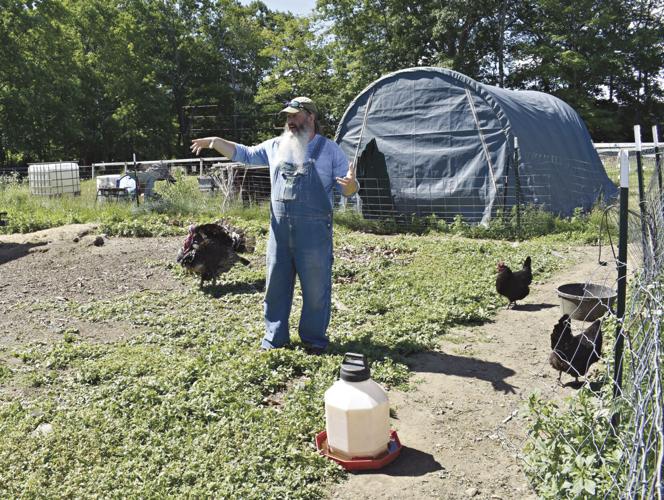
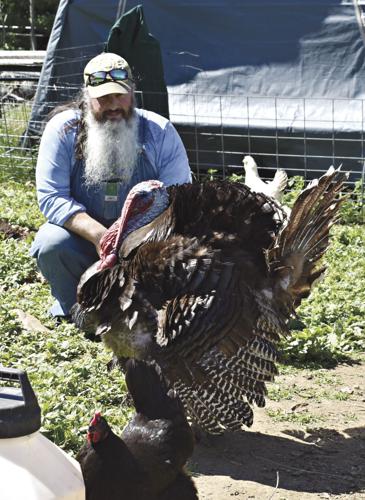
Marc Dole, a contemplative man who wears overalls, a baseball cap and a billy-goat beard and raises chickens and other livestock up the road from the Scriven Arts Center, will take the stage at 7 p.m on Friday, July 8.
Dole grew up in Newmarket, then pursued his first career as a filmmaker and animator working in a studio in downtown Portsmouth. He started farming when one of his daughters, who left home for college, found that she couldn’t stomach eggs anymore, no matter how “organic” or “free range” the packaging promised. He, his wife Wanda and their other daughters, were living in Nottingham at the time, and he started with a half-dozen hens.
“Good water, being out on the grass, being able to eat all the bugs,” was the recipe he found for chickens that produced eggs that could nourish his daughter better than any that her money could buy in Washington, D.C. And so began Dole’s travels into the world of sustainable, small-scale agriculture. He’s a hobby farmer, he declared, and proud of it.
At his busiest, his farming resulted in many meals for many friends and neighbors. He foresaw the supply chain issues that the pandemic would bring, and so in one year he raised 100 chickens for meat, five pigs and 30 turkeys.
By that point, farming had become a vibrant side gig for Dole, a kind of vocational therapy to clear and refresh his mind from his primary duty. His daughters all have an inherited mitochondrial disease, and two of them require full-time care, which he provides.
Farmer, filmmaker and father, those three roles braid together to make Dole’s life these days. Films and animation used to demand nearly all of his time, when he would spend his waking hours in his studio to cut dull films for corporate clients, while also creating state-of-the-art animation to try and lure creative contracts from Hollywood. Now, the filming and editing takes place mostly in his imagination, acted on only in those moments when his farm chores are done and someone else can attend to his daughters.
Dole’s filming has a close focus lately. He is recording his farm activity to edit into a documentary, and a recently completed film documents his domestic life.
That documentary, “Mito Kids,” brings viewers into the Dole home, including moments both sweet and challenging. It’s been viewed thousands of times on YouTube, and has achieved its goal of spreading understanding of living with people with chronic health disorders.
Because of his daughters’ vulnerabilities, Dole was among the first to wear a mask due to the coronavirus. This wasn’t always a popular choice, particularly once masking was seen by some as a political statement, however inaccurately so.
“It isn’t a political thing for me, it never was,” Dole said. He couldn’t convince one of his more conservative farmer friends of that, though, until he sent him a link to view “Mito Kids.” After watching it, the friend showed up with a gift of N95 masks.
Dole expects his Scriven presentation to last about an hour and a half. The evening will include the showing of several clips. He will show “Mito Kids,” as well as some of his lighter works, such as “The Toll,” an animated mockumentary about a bridge troll whose career has been affected by the development of automated toll systems. Dole will talk about filmmaking, animation, and some of the projects he’s worked on — music videos, scripted comedies, and writing, shooting and editing a movie all inside of two days for a 48-hour film festival.
'Rooted' in Gilmanton
Donahue said it was mostly circumstance that led to Dole being the first on the list this year — but he’s pleased that it worked out this way.
“I think he’s very fitting,” Donahue said. Dole is “rooted” in Gilmanton, Donahue continued, and is involved in the Gilmanton’s Own agricultural cooperative. “He has a mind toward community.”
Later in the year, Donahue’s series includes: filmmaker Chris Sessions on Aug. 17; naturalist Susie Spikol on Aug. 26, and; journalist and true crime writer Dave Howard on Sept. 2.
“We’re really lucky to get the people we do,” Donahue said. “Anybody that comes in, it feels very special. They’re in a very homey space, it’s the slanted and splintery floor of my barn, with the makeshift sound system, it makes me very happy.”
The Scriven Arts Center is at 425 Route 140. Visit scrivenartscenter.com for more information.
Editor's note: This story has been updated to correct name spellings, event dates, and family relationships.


(0) comments
Welcome to the discussion.
Log In
Keep it Clean. Please avoid obscene, vulgar, lewd, racist or sexually-oriented language.
PLEASE TURN OFF YOUR CAPS LOCK.
Don't Threaten. Threats of harming another person will not be tolerated.
Be Truthful. Don't knowingly lie about anyone or anything.
Be Nice. No racism, sexism or any sort of -ism that is degrading to another person.
Be Proactive. Use the 'Report' link on each comment to let us know of abusive posts.
Share with Us. We'd love to hear eyewitness accounts, the history behind an article.