


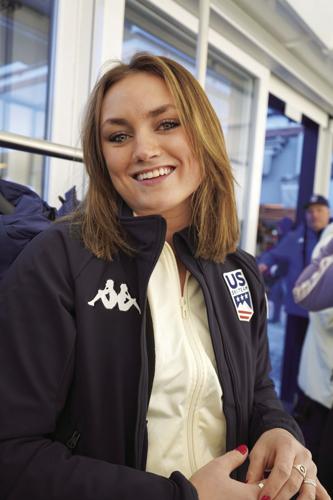
GILFORD — The sport of ski racing changed a lot between 1960, when Penny Pitou won two silver medals in alpine skiing at the Winter Olympics, and now, when her granddaughter Zoe Zimmermann is rising through the ranks of the U.S. Ski Team.
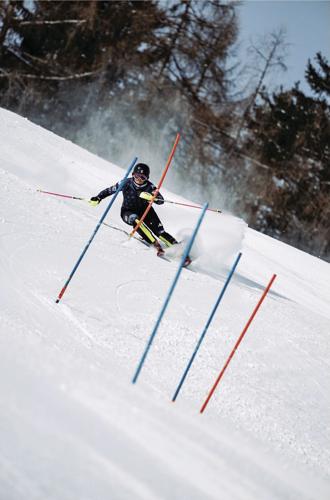
Now, skiers wear helmets instead of hats and knife their way over a water-injected ice sheet instead of natural snow. The technology has changed, average speeds have skyrocketed and the sport's profile has gone primetime. What hasn’t changed are the makings of great skiers: physical and mental strength, a deep love of moving fast on snow and a thirst to keep setting higher and higher goals for oneself.
In December, 20-year-old Gilford native Zimmermann scored her first points on the World Cup skiing circuit — a major step toward reaching the sport’s highest ranks. Having broken through this threshold, she has her sights set on the top.
“It proved to myself that all this work I'm putting in and all of the good feelings I'm having in training are good and are paying off,” she said in an interview.
In international alpine ski racing, racers compete in four disciplines: slalom, giant slalom, super G and downhill. Those who finish in the top 30 spots receive points — ranging from 100 for first and one for 30th. The skier with the most total points across disciplines at the end of the season wins the overall title and takes home a 9-kilogram Crystal Globe.
With a 27th-place finish at the slalom in Sestriere, Italy, Zimmermann, who specializes in that event, received her first four World Cup points.
“My biggest long-term goal is to be consistently getting top 15 or maybe even top 10 on the World Cup circuit,” Zimmermann said. “And also, you know, to go to the Olympics.”
Zimmermann is the granddaughter of Pitou, the first American to win an Olympic medal in the downhill discipline and one of the first four American alpine skiing medalists — all of whom are women. A legacy echoed by Zimmermann, Pitou grew up in the Lakes Region, got hooked on skiing at a young age and quickly made a name for herself at the top levels of the sport.
Zimmermann made her first tracks at Gunstock Mountain Resort as a toddler and had a hunger for the sport from the start.
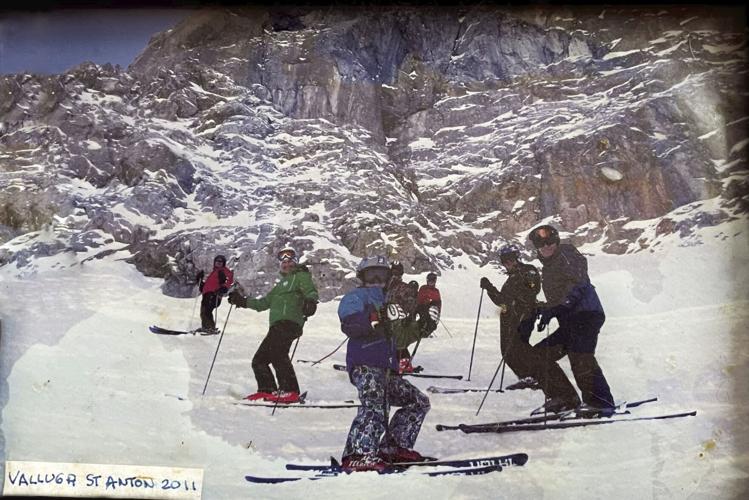
“She's been feisty from the beginning,” Pitou said. She reflected on times she took her family skiing in Europe — Pitou’s travel agency features ski trips with the medalist — when Zoe was quick on the heels of her father in snow that was as deep as she was tall.
Zimmermann and her older brother, Zane, got their racing start at the Gunstock Ski Club when she was 6. In middle school, Zimmermann joined the alpine academy at Waterville Valley, where young athletes leave their local schools during winter months to train and receive tutoring that covers a curriculum prepared by their school.
In high school, Zoe joined Burke Mountain Academy, a ski school in Vermont’s Northeast Kingdom known for producing top shredders — including the sport’s current superstar, Mikaela Shiffrin.
It was at Burke that Zoe's ski career took off. She joined the U.S. Ski Team roster for the first time at age 16.
Despite making the team, it wasn’t until recently that Zimmermann realized her career might have legs.
“Even then, like when I first made the U.S. Ski Team, I didn't really think that I would make it as far as I now think I can,” Zimmermann said. “Just because I feel like it seems so unattainable when you're that age.”
Zimmermann will continue to compete at the World Cup level in addition to competing in Europa Cup races, the next tier below. She is also a student at Dartmouth College.
Both Zoe and her grandmother were first selected for the U.S. team in high school. Pitou was 21 when she earned two silver medals, one in downhill and one in giant slalom, at the 1960 Olympics in Squaw Valley, California, renamed Palisades Tahoe last year. Zimmermann is 20 now, and her next shot at a Winter Olympics in 2026 will be hosted in Milan and Cortina d’Ampezzo — the same location where Pitou made her Olympic debut in 1956.
Zoe's grandfather, Egon Zimmermann, also built an impressive resume on the slopes. A standout on the Austrian team in the late 1950s, he and Pitou married in 1961 and settled in Gilford.
At first, Zoe’s familial roots in the ski world made her eager to chart a different path.
“When I was younger I didn't take it as a negative thing, but I just wanted to do something different,” Zimmermann said. “For a long time there actually, when I was younger, I really wanted to pursue soccer.”
As she grew older — and faster — Zimmermann found her own passion for the sport.
“Zoe’s proud of Omi”— Zimmermann’s nickname for Pitou — “but she’s doing her own thing,” said Zoe’s father, Christian. “It’s a cool storyline, but it doesn’t change anything about her skiing.”
Now, Pitou is a part of her granddaughter’s support system, able to relate to the mental pressures elite athletes face.
“She's always said to me and my brother that, when you get to the top level in any sport, but especially in ski racing, that 90% of it is from the neck up,” Zimmermann said. “So I've always been aware of how important the mental side of ski racing is.”
Zimmermann joins a vibrant women's team with a deep roster. Training with the top dogs, Zimmermann said, is a supportive but competitive environment.
“I've really realized how lucky I am to have such a strong training group,” she said. “I really do believe that we're pushing each other so much, and I don't think that I would be skiing as well as I am if not for them.”
In addition to an array of younger skiers rising through its ranks, the women's team has relatively strong New England representation. Paula Moltzan, a UVM alumna now living in Charlemont, Massachusetts, and Mikaela Shiffrin, who joined the Upper Valley’s Ford Sayre Ski Club at 8 years old, also bring East Coast experience to the circuit.
“The opportunity to compete at that level in ski racing, let alone to find success, is very, very small,” said Gunstock Ski Club Program Director Josh Bedard. The men's and women's teams have fewer than 50 athletes combined. “For our Gunstock athletes to get to see someone homegrown at that level ... it gives them hope and makes them excited about the sport.”
“It’s good for the state of New Hampshire as well,” Bedard continued. “East Coast skiing has struggled in recent years getting skiers on the team, so it’s good to see Zoe help bring that back.”
Zimmermann thinks her local ties give her an extra edge. Even if the mountains here are smaller, she said, the firmer snow replicates the water-injected, rock-hard surface World Cup skiers compete on.
“I definitely love the area and credit a lot of my success to Gunstock and the Lakes Region,” she said.
Bedard complimented Zimmermann for being available to the club over the years.
"There's so much to learn from spending time and watching that caliber skier. They love when she visits," he said.
Zimmermann’s family will continue to look on with pride — and nerves — as she strides up her own peaks.
“It’s really fun” seeing his daughter at the top level of the sport, Christian said, “except on race day, when it’s nerve-wracking.”
“I guess I'm living vicariously — only I'm really glad I don't have to get into the starting gate anymore,” Pitou said. “I watch her and my mouth dries up ... I just can't believe she can move that fast.”
Editor's note: this article was updated to reflect the correct ski racing accomplishments of Egon Zimmermann.


(0) comments
Welcome to the discussion.
Log In
Keep it Clean. Please avoid obscene, vulgar, lewd, racist or sexually-oriented language.
PLEASE TURN OFF YOUR CAPS LOCK.
Don't Threaten. Threats of harming another person will not be tolerated.
Be Truthful. Don't knowingly lie about anyone or anything.
Be Nice. No racism, sexism or any sort of -ism that is degrading to another person.
Be Proactive. Use the 'Report' link on each comment to let us know of abusive posts.
Share with Us. We'd love to hear eyewitness accounts, the history behind an article.