


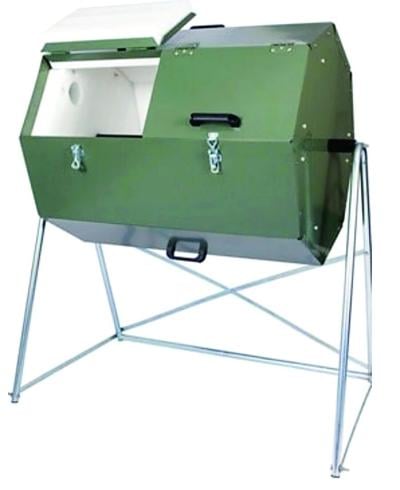
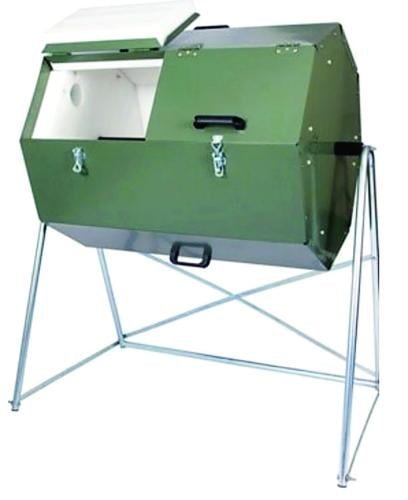
The Lakes Region Planning Commission is using an $87,300 grant from the U.S. Department of Agriculture to promote food waste composting to reduce materials going into solid waste landfills. The program, which includes providing Jora compost tumblers for home use, is being rolled out in Ashland, Bristol, Gilford, Moultonborough, and Wolfeboro.
The pilot program encourages people to remove food from the solid waste stream, and to grow more of their own food with the natural fertilizer produced by composting.
Matt Rose, an environmental planner with the LRPC, along with Paige Wilson, a waste reduction and diversion planner with the New Hampshire Department of Environmental Services, led a training session on home composting in Bristol on April 23, distributing 32 composting bins to the first registrants who signed up.
“Unfortunately, we only had 32 tumblers to purchase per community,” Rose said.
The training, which covered the benefits of composting and suitable materials, will be followed up by data collection through monthly surveys to measure the project’s success.
The planning commission learned of the food waste and composting grant in 2014.
“The whole point of it is to start pilot programs across the United States to teach people how to compost, to reduce our food waste that’s going into the landfills and into the transfer station, [and] help reduce costs for municipalities, because anything that goes into a Dumpster has to get paid for, to be removed and brought to a landfill," Rose said.
"The other purpose of composting our food waste is to create some really organic fertilizer that we can use for growing plants.”
He noted much of the pollution that goes into the lakes comes from unnatural fertilizers that contain harmful chemicals. “This is a much more organic and friendly thing to use in our gardens.”
Each participating town signed a partnership agreement to qualify for the pilot program.
A portion of the grant also pays for a community garden and a composting location serving low-income housing. LRPC found a location in Ashland, next to the Community Action Partnership Program, for the community garden.
The grant also covers the cost of the Lakes Region’s first food waste composting sites at transfer stations, with Gilford and Wolfeboro volunteering to serve as those sites once they obtain the necessary DES permits.
Wilson, who composts her own food waste, presented information on the practical side of composting, beginning with an explanation of its importance.
“A third of the food that we produce in the United States every year is never eaten,” she said. “It doesn’t ever reach our plate, lost along the food system, either on the farm or manufacturing, producing, transporting to grocery stores, as well as households.
“Food waste makes up about a quarter of our trash, and it’s very heavy. You’ll find that when you guys start to collect your food scraps, it’s a lot, and my trash is a lot lighter.”
Additionally, food waste accounts for 58% of methane gas emissions, contributing to global warming and climate change. Composting, on the other hand, is an aerobic process involving organic material, bacteria, mold and insects.
“It’s really a whole chain of organisms,” Wilson said. “It’s just decomposition, but we are involved in the process a bit more. So we’re the ones that are turning the pile and making sure that there’s enough air flow to break things down.
"So microorganisms are key in the compost system.”
That process produces heat during the active composting phase, and rotating the bin to introduce more oxygen reactivates the process until a dark compost eventually remains.
“This process happens every time you turn your compost pile. You’re adding material, and stuff is going to break down,” she said, “regardless of the external weather.”
Composting requires carbon, nitrogen, moisture and oxygen. Carbon is in brown material such as sawdust, shavings and leaves. It is combined with green material providing nitrogen through food scraps. Generally, one gallon of food waste would be combined with three gallons of brown material. Then, it if it should be too wet, add more dry material, and if it is too dry, add more wet material.
Food waste, such as egg shells, rice, breads, quinoa, coffee grounds and filters, and tea bags (without staples) are good for composting, while stringy and hard things like tomato stems and corn cob husks can take much longer to break down, and might best be thrown away.
Dry plant waste, sawdust, newspaper, and straw make good brown material to mix with wet food waste.
Having a sealed food waste container in the kitchen will make it easy to separate it from regular trash, and when the container is full, it can be transferred to the compost bin. Wilson recommended cutting the top off gallon jugs to take waste from the kitchen to the composter.
The composting bins provided through the program are models that cost between $450 and $1,000 retail. They are insulated with two chambers, so one can be composting while the other is filled. The doors can be padlocked to prevent bears from accessing them, but Wilson said she has never had to do that.
“There was a bear that came to our Dumpster and ripped our trash bags out almost every day. Never touched my composter.”
The other part of the training session was a demonstration of how to assemble the composters, which arrive in cartons. Bill Corliss, a Bristol solid waste attendant, assisted by Solid Waste Manager Chuck Collins and attendant Mark Bucklin, went through the steps, explaining the importance of following the instructions to make sure it all comes together properly.
Other upcoming trainings are:
- Gilford: 6-8 p.m., Thursday, May 7, Town Hall
- Ashland: 6-8 p.m., Tuesday, May 12, Town Conference Room
- Moultonborough: 5:30-7:30 p.m., Thursday, May 21, public library
- Wolfeboro: 5-7 p.m., Thursday, May 28, Town Hall
For more information, visit lakesrpc.nh.gov/food-waste-composting-pilot-program.


(0) comments
Welcome to the discussion.
Log In
Keep it Clean. Please avoid obscene, vulgar, lewd, racist or sexually-oriented language.
PLEASE TURN OFF YOUR CAPS LOCK.
Don't Threaten. Threats of harming another person will not be tolerated.
Be Truthful. Don't knowingly lie about anyone or anything.
Be Nice. No racism, sexism or any sort of -ism that is degrading to another person.
Be Proactive. Use the 'Report' link on each comment to let us know of abusive posts.
Share with Us. We'd love to hear eyewitness accounts, the history behind an article.