


LACONIA — Emergency services, especially fire departments, are suffering a shortage of recruits both in the Lakes Region and beyond.
“Today it's a nationwide problem. We currently do not see individuals stepping forward to support the volunteer call fire departments as well as a lull in interest in career positions,” explained Meredith Fire Chief Ken Jones.
“It was very common that if you wanted to be a career firefighter, you started out as a call or volunteer firefighter,” recalled Laconia Fire Chief Kirk Beattie. “As we see the call and volunteer numbers significantly decrease, you don't have that same number of people that are interested in it.”
Career firefighting departments have traditionally drawn many of their applicants from volunteer and call departments, which allow candidates to get a feel for the job before they decide to invest all the time and money it takes to turn firefighting into a career.
“We're seeing it across the state at every type of department that is out there, call, career, volunteer, doesn't matter,” said Beattie, who stated that his station currently has five openings, and received a trickle of applicants. “I don't know if there is one magic thing that says this is the reason why. I think there's a lot of smaller things.”
One of those smaller things, according to both Beattie and Jones, is the time commitment and cost required to becoming certified.
“To be a professional career firefighter, you're looking at one to two years of training,” Beattie said. “That will give you your firefighter 1(certification), firefighter 2, and some form of EMT. There are three levels of EMT in the state. There's basic, advanced and paramedic. The majority of career departments in the state require advanced EMT.”
A basic EMT course alone can take four months. Those that want to pass the advanced EMT course may have to invest up to six additional months of study. This also increases the upfront cost to anyone looking to enter the field.
“An advanced EMT class is $2,000,” Beattie said. As for the firefighter certifications, recent state efforts have helped reduced the cost, and some departments can pay for a candidate's training once they are hired.
“Now, they're (firefighter certifications) within the $200 to $300 range,” Beattie said. “They used to be well over a thousand dollars. It's great they were able to do that. That's going to make a big difference.”
Some candidates can fast track their firefighter certifications by attending the state's firefighting school, but there is a trade off.
“That's a nice way, but it's 10 weeks full time school, so you gotta take 10 weeks off your private job or get hired somewhere to let them send you and that's difficult as well,” Beattie said.
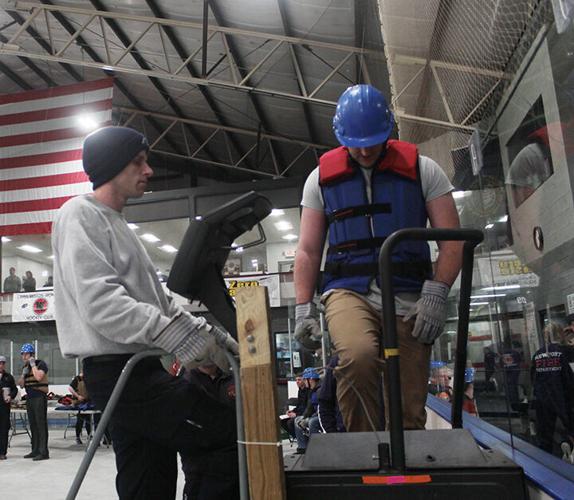
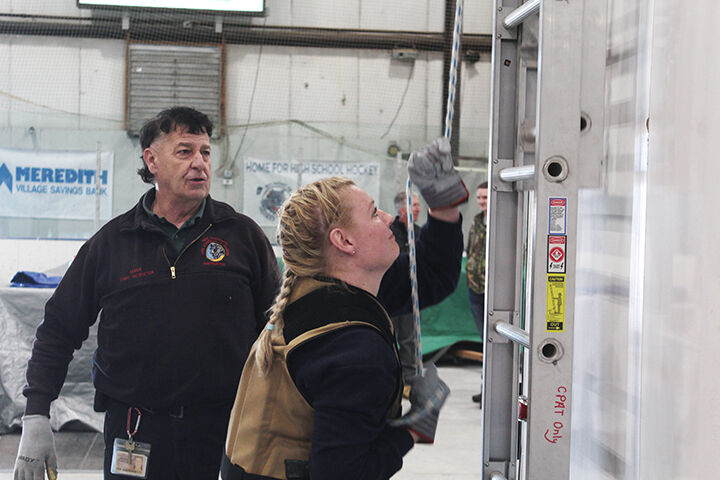
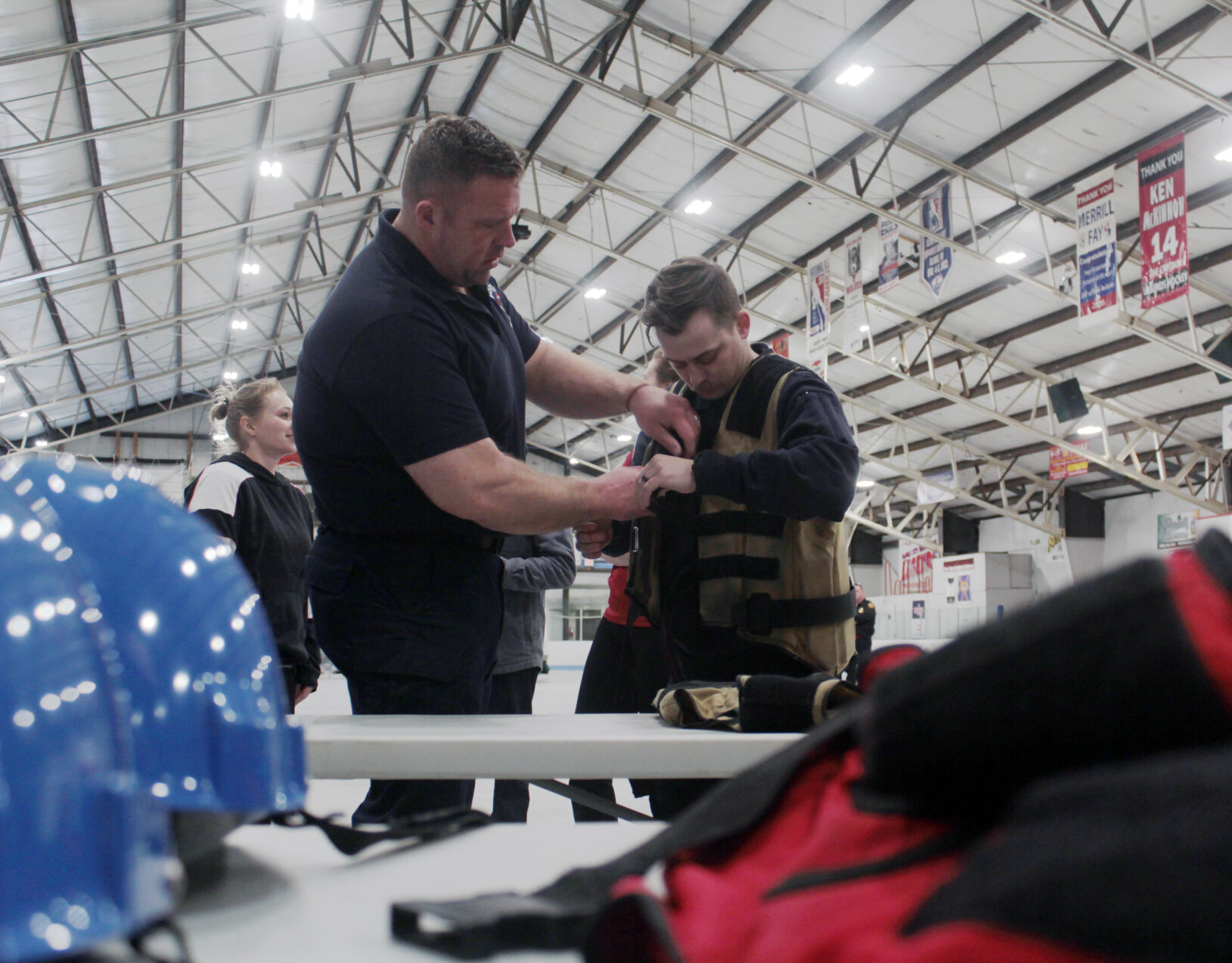
In addition to a set of long and sometimes expensive certifications, firefighters must also pass a candidate physical ability test, or CPAT to be considered eligible for career positions.
The timed test consists of eight events, all of which must be completed wearing a 50-pound weight vest. Candidates must climb stairs for three minutes, safely lower and raise ladders, navigate claustrophobic spaces, carry heavy tools, drag a simulated injured person, properly move and wind hoses, swing sledge hammers and simulate breaching and pulling on ceiling structures with weighted hooks.
“They have to do all this in 10 minutes and 20 seconds,” said CPAT's program coordinator Scott Merrill during Monday's CPAT test conducted at the Laconia Merrill Faye Arena. When asked about the drop in volunteer departments, Merrill guessed it might be due to a lack of time.“My opinion is people may be busy with their lives and not putting as much time into a public social system,” Merrill said. “Also maybe the draw of being a firefighter isn't as strong as it was for some of us when we were younger.” As for the cause for this dip in interest, Merrill wasn't sure.
“There's less of a desire to do public service work. We see it in police, we see it in military,” Jones said. “There's less of a push for public service type work.”
Jones has a few theories, some specific to more rural communities, as to why the profession is dwindling.
“Between the calls, the training, the routine exposure that we have with higher cancer rates, we see within the fire service currently, I think that plays a major role,” Jones said. “Here in Meredith the lack of maintaining the younger generation with no immediate job opportunities and high housing cost, we don't see a lot of the young people sticking around.”
The issue has become large enough that the state recently put together a 90-day commission made up of a collection of emergency services stakeholders to find solutions to recruitment problems.
“It isn't the fire service trying to figure out the fire service problem, it's everybody coming together to figure out what we can do better,” Beattie, who is on the commission, explained.
“I think there's a lot of look at the police academy model where they hire you, they send you to the police academy, you come back, you're all trained an you're ready to go,” Beattie said of one potential solution. “The recruit school does this, but it's not a common thing where I hire someone off the street, send them down to recruit school and they come back and they're all trained and ready to go. New Hampshire fire service has never really done that. Usually you come in certified, or at least with the majority of your certifications and then we'll help you through the last of them.”
“One, I think we need to sell, to market ourselves better,” Jones suggested. “Two, I think we need to look at... especially the volunteer and call departments, in what we are offering for wages, and any benefits, I believe that money is certainly an issue and again, time away from the family.”
“I don't think the fire service has advertised itself as well,” Beattie admitted, stating that previously, the department got plenty of applicants after placing just a single ad. “Part of how to fix this is get out into the populations better at different age groups and interest groups and draw that way.”
“We're trying to reach out to the younger generation as well,” Jones said, citing recent efforts by Laconia High School's Huot Career and Technical Center.
“Three years ago we started having meetings with different fire departments, the community college wrapped up in it to see what we can do,” said Dave Warrender, Huot's director. “Right now what we're pursuing is we have a semester long intro to emergency services class. This is something we've never done before. This is specifically targeted at 10th graders. It's a broad overview of all the protective services but with a focus on fire and emergency medicine.”
There is a chance that the center may be able to put together a course that grants some kind of certification, but that appears to further down the road. It's also not likely the high school will offer a course that certifies students as level one firefighters.
“The department of education was kind of steering schools from firefighting,” Warrander said, citing that many of the specific firefighter requirements were considered to be “a bit much” for 17-year-olds.
“We'd like to do EMT basic, but to be candid, we're having a hard time trying to find an EMT basic instructor. It kind of speaks to that same job pipeline.”
Until the committee has completed its work, the exact causes, and potential solutions to the public service will remain murky.
“I don't know what that reason is. I think that part of it is the same workforce problems that a lot of other sectors are facing in terms of recruitment and retention of employees,” said Justin Cutting, director of The Division of Fire Standards and Training and Emergency Medical Services. “Clearly fire and EMS posts, there are some personal dangers to individuals both in the job and the risks in terms of mental health impact over time and cancer-causing agents they are exposed to. But the important thing to point out is that there are a lot things these departments are doing to protect these young men and women and they should still come to what is described by most of us as the best job in the world.”


(0) comments
Welcome to the discussion.
Log In
Keep it Clean. Please avoid obscene, vulgar, lewd, racist or sexually-oriented language.
PLEASE TURN OFF YOUR CAPS LOCK.
Don't Threaten. Threats of harming another person will not be tolerated.
Be Truthful. Don't knowingly lie about anyone or anything.
Be Nice. No racism, sexism or any sort of -ism that is degrading to another person.
Be Proactive. Use the 'Report' link on each comment to let us know of abusive posts.
Share with Us. We'd love to hear eyewitness accounts, the history behind an article.