


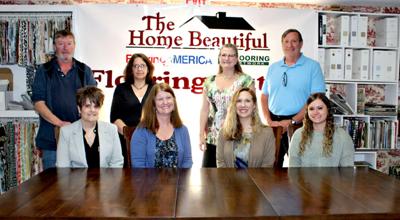
BELMONT — When Bruce Hamel purchased The Home Beautiful in 1986, it was known as “The Cottage Beautiful,” located in Laconia, and was limited to flooring sales.
“I hadn’t so much as purchased a bathmat,” Hamel said about his prior experience in the home decor business. But, he wanted to get out of corporate life and get back to the Lakes Region, and buying the small business was his chance to do just that.
His inexperience gave him the ability to do things differently, and he grew his business into one of central New Hampshire’s largest home decorating supply and service companies. Hamel, now 70, is retired, and when it came time for him to hand off his business, he decided to do that differently, too. The Home Beautiful is now owned by a cooperative managed by his former employees.
“It began with, how can I ensure this business has the best opportunity to survive, and surviving with the corporate morals and culture,” that he spent so many years building, Hamel said. During his prior career, in the energy services industry, Hamel saw what typically happened during a conventional business acquisition: The acquiring entity takes on debt to make the purchase, then slashes labor costs in order to pay off the loan. He asked himself, “How do I protect my employees? What came to me was, why not see if my employees have an interest in taking over.”
The answer was yes, they did, and that transition took place on April 1 of this year, after years of planning and preparing for the change. The business is now owned by the 10 employees that have been working there for at least a year and a half – new hires will become eligible to become owners once they’ve been there for the required amount of time. There’s a nominal fee to become vested as an owner, and that money is refunded when they leave the company.
The business is managed by a board of directors elected by the vested employees. They make strategic decisions about how to manage the business, including deciding at the end of the year how much profit to reinvest or reserve, and how much to distribute among the owners.
Tom DuBois, general manager, said the decision was made to give all owners equal shares of the company, whether they’ve been there for 34 years, like he has, or if they barely qualify for ownership.
“What we were striving for is that every employee was equally invested in the success of the business,” he said.
For DuBois, the opportunity to become an owner relieved a concern for him. In a conventional business sale, it would be jobs like his that would be vacated in order to maximize profitability.
“I had been here so long, there was a question as to whether I would be able to finish my career here,” DuBois said. “So when (Hamel) came out with the idea, I was really excited by it.”
Jacqueline Lemire, who manages the design department, is president of the board of directors. She said she had “a lot of concerns” when the concept was first presented to her. Such as, how could so many owners come together to make decisions? Would they be individually liable? As they went through the complex process of writing bylaws, she began to see how it could all work. Now, she said she’s glad that Hamel found a way to protect the organization he grew over nearly 40 years.
“I know so many people that are in a corporate culture,” said Lemire, who has worked for The Home Beautiful for 21 years. “It’s not like that here, and it’s never been like that. The people here are like a family. We always knew that Bruce cared about us.”
The unusual business structure will give them a recruiting edge, DuBois said he hopes. That was true at least in the case of Kim Young, assistant general manager, who applied for the job two years ago. She said she learned about the transition to employee ownership during the interview process, and, “That definitely sold it,” she said about the job. “It opened up all these opportunities that I hadn’t planned on. To come into the business, instead of being just an employee, your mindset changes. There’s a sense of pride.”
The Home Beautiful was guided through the process by the Cooperative Development Institute, founded in 1994 to promote cooperative businesses in the Northeast. Rob Brown, director of business ownership solutions for CDI, said it is an unusual ownership model in New Hampshire, though interest is spreading. He said that Warren Street Architects in Concord is the only other example he could think of in the state, though he is currently working with a handful of other businesses that are exploring the option.
One reason for its rarity is that it requires several existing factors for a business to lend itself to the cooperative ownership model.
“These are essentially leveraged buyouts, so there needs to be sufficient profitability to pay debt service and leave something left over to make it worth doing in the first place,” Brown said. There would need to be substantial leadership capabilities still present after the owner leaves. In other words, an established, stable and profitable business.
“What all cooperative transitions have in common is that they have a good track record — workforce, leadership, customer base, sales, profitability, et cetera. The same things any buyer of a business would be looking for,” Brown said.
Hamel is still available to advise his former employees, but for the most part, he’s spending his time developing his getaway in Littleton: Splitting firewood, gardening, volunteering for conservation and hunter education programs.
“I’m delighted to know that the people that helped me build it and make it what it is today are taking it over and keeping the same values and business model,” Hamel said.


(0) comments
Welcome to the discussion.
Log In
Keep it Clean. Please avoid obscene, vulgar, lewd, racist or sexually-oriented language.
PLEASE TURN OFF YOUR CAPS LOCK.
Don't Threaten. Threats of harming another person will not be tolerated.
Be Truthful. Don't knowingly lie about anyone or anything.
Be Nice. No racism, sexism or any sort of -ism that is degrading to another person.
Be Proactive. Use the 'Report' link on each comment to let us know of abusive posts.
Share with Us. We'd love to hear eyewitness accounts, the history behind an article.