


LACONIA — The first person to settle in what would become the the city of Laconia was Judge Ebenezer Smith, (1734-1807), who led the growth of the area from a wilderness into a prosperous community.
A selectman in Meredith for 36 years, he was also a judge, state legislator and senator. He served as a colonel in the militia and was First Major on Col. Welch's Regiment of Volunteers that marched to join the Continental Army at the crucial battle of Saratoga in New York in September 1777.
The owner at one time of 14 100-acre lots as well as nine smaller tracts of land, he became was known as ''the father of the poor man'' for his willingness to allow settlers to move in and build their own farms and not seek payment from them until they were able to make a living off the land.
He played a key role in Meredith and Laconia, as well as Gilford. Two of the communities marked major milestones in their history this year, with Meredith celebrating its 250th anniversary and Laconia marking its 125th year as a city.
Histories of both communities published by the Laconia Daily Sun this year credit Smith with being the leading force in their settlement and development of the area.
John Hopper, author of a third book of Lakes Region history published this year – about Bear Island in Meredith – says Smith was such a dominant force in the settlement of the area that he is surprised that there isn’t a book written about his accomplishments
“He was the most important person in the early history of Meredith and what would become Laconia and has such a fascinating story that deserves to be told,” says Hopper.
Merrill Fay, owner of Fay’s Boat Yard in Gilford, agrees.
Fay's family has deep roots in the area. His mother was a descendant of Judge Smith, who at one time owned the land in Smith Cove where Fay's Boat Yard is now located.
Fay said Smith played an important role in the 18th century settlement of both the section of Meredith, then known as New Salem, which would later become a part of Laconia, and of Gilford, which was then a part of Gilmanton and wouldn’t break away until 1812.
He says Smith was a prominent judge, legislator and landowner and during his life served as a town proprietor of Gilmanton, and represented Meredith in the state House and Senate. He was also president of the Senate for two years, judge of the County Court from 1784-87, and judge of the County Probate Court from 1797-1805. He was also a trustee of Gilmanton Academy and served as its treasurer for six years.
He was noted in his role as a judge for being able to persuade those with disputes to reach solutions without taking legal action. He was also praised for his fairness to the less fortunate, often assessing higher taxes on those most able to pay, rather than placing extra burdens on the poor.
Adair Mulligan's ''The Gunstock Parish: A History of Gilford, New Hampshire'', says that Smith first came to the area as a surveyor in 1761.
That was the same year that Smith posted bonds for several properties in Gilmanton that were granted by the Colonial Gov. Benning Wentworth.
He and his friend Jonathan Crockett set out from Exeter with five other men, all of whom gave up and turned back, to map the settlement and lay claims. Smith and Crockett doggedly continued their expedition and staked out claims, with Smith building a cabin for himself on the northwest shore of Lake Opechee, which was located in New Salem, which became Meredith in 1768.
Fay says Smith and Crockett actually came to the area several years earlier to explore the land but did not linger because they encountered Native Americans and that the French and Indian War, which resulted in England gaining control of Canada, was still undecided.
Smith returned to what would become Meredith and the log cabin in 1766. His wife was Sarah Spiller of Exeter. They had one child, Ebenezer Jr., when they moved to Meredith.
A Smith family genealogy has the following description of their trip.
“The journey was accomplished on horseback and that part of the way which lay through Gilmanton, was a path to be followed by spotted trees. Mrs. Smith, not being able to guide a horse herself, took a seat, as was common in those days, behind her husband, upon the same horse; and thus mounted with his child in his arms and a favorite little dog in his pocket, he arrived one evening just before sunsetting, at the camp which he had previously erected on the North West shore of one of the Bays in the Winnipissiogee River.”
Smith later brought all of the metal parts for a sawmill from Exeter to New Salem and was granted the rights, along with a partner, to operate a sawmill. It was first set up at the Weirs and later moved to the vicinity of what is now the Avery Dam in downtown Laconia.
The sawmill provided lumber for settlers' homes as well as for two meeting houses, one in what is now Gilford and one on Parade Road.
In 1767 the Smiths had the first male child born in Meredith, Daniel, who received 200 acres of land and half of the sum of money destined for the first child born in the town. Tamah Eaton, who was the first child born in the town, wasn't eligible for the money because she was a girl.
A pamphlet printed by the Meredith Historical Society has a drawing of the site of the second Ebenezer Smith House, which shows its location just above a field near the intersection of Parade Road and Elm Street, with a view of Lake Opechee.
For many years the home served as the site of town meetings but was torn down for some unknown reason between 1860 and 1875. It was described as a two-story Colonial house with a long ell which connected to a large barn. The home was wallpapered, which was unusual for that time.
Smith and David Lawrence signed a petition in 1768 which led to the charter for the town of Meredith being granted by Gov. John Wentworth. At that time there were only 17 families in the town
The Smiths had 10 children in all, five girls and five boys, with the youngest being Washington Smith, who was born in 1784.
Smith later acquired 23 parcels of land in what is now Gilford in a 1772 auction of Gilmanton properties to raise money for the construction of Province Road.
When war with England threatened, Smith signed the Association Test, which advocated self-rule for the colonies, and served as mustermaster and paymaster for the local militia, which held drills on what is now Parade Road, not far from Smith’s home.
He also represented Meredith and Sanbornton at a 1778 convention in Concord at which a plan for a new government was developed and in 1781 took part in a convention at which New Hampshire adopted the first constitution in the nation.
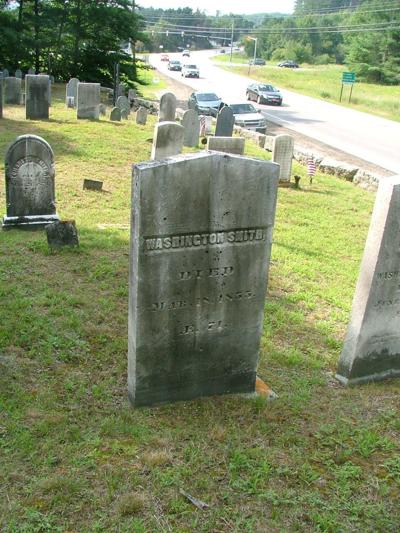
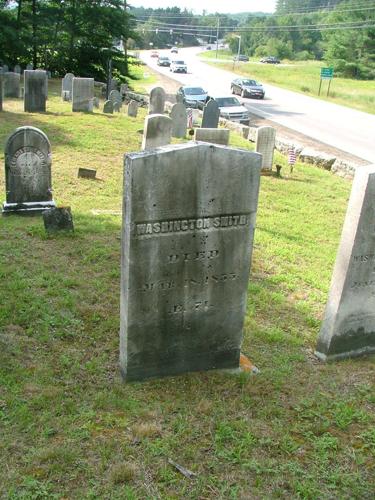
Smith, who died in 1807, and his wife, Sarah, who died that same year, are buried in the Washington Smith cemetery, which is on the east side of Parade Road just above where the Smith home was located.
The cemetery is named for Ebenezer's Smith youngest son, Washington, who was one of four people who died as a result of injuries suffered in the collapse of the yet unfinished town hall in Meredith village on March 18, 1855.
Some 600 to 800 people were present at that meeting in which the hotly contested issue of whether the town would be divided and a new town of Laconia formed was to be voted on. That change took place in June of that year.
One of the prized possessions of the Meredith Historical Society is a ledger written by Smith that was donated to the society six years ago by Elaine Townsley, who grew up at Lombardy Farm, just across Parade Road from the cemetery.
Townsley, who died in 2014, said the ledger, whose last entries are around 1840, must have been left at the farm by one of Ebenezer Smith's descendants and remained with the property until it was sold to John McIntyre in the 1960s. Townsley said the farmhouse, which still had Indian shutters, was dismantled sometime in the 1970s and taken to Connecticut.
The very first page of the ledger notes that it is ''the second ledger of Col. Ebenezer Smith'' and the first entry on April 16, 1793 states ''this day we compared, settled and balanced all former book accounting between and within our hand'' and was signed by Jacob Eaton and Ebenezer Smith.
The entry was made only a month after Smith was elected to the state legislature by a vote of 84-1 at town meeting.
Fay said that Smith’s extensive land holdings in Gilford were passed along to his sons, John and Ebenezer. Smith Cove was named named for the Smith family, which at one time owned four of the six large farms on the Intervale and whose lands included the peninsula now known as Varney Point, which was until 1915 known as Smith Point.
Fay said a 1798 deed indicates that Esquire John Smith was deeded land by Judge Smith that he was already in possession of, including Smith Cove and Smith Point and the property where the Lakes Region Playhouse and B. Mae Denny's would later stand.
Fay says that Smith is described in state papers as a man of sound and practical judgment who was “honest, frank and benevolent” and was eminent for his “frugality and economy, but without avarice.”
He says that it is hard to imagine the area developing as it did without Judge Smith and that it is important to preserve the memory of his achievements.



(0) comments
Welcome to the discussion.
Log In
Keep it Clean. Please avoid obscene, vulgar, lewd, racist or sexually-oriented language.
PLEASE TURN OFF YOUR CAPS LOCK.
Don't Threaten. Threats of harming another person will not be tolerated.
Be Truthful. Don't knowingly lie about anyone or anything.
Be Nice. No racism, sexism or any sort of -ism that is degrading to another person.
Be Proactive. Use the 'Report' link on each comment to let us know of abusive posts.
Share with Us. We'd love to hear eyewitness accounts, the history behind an article.