


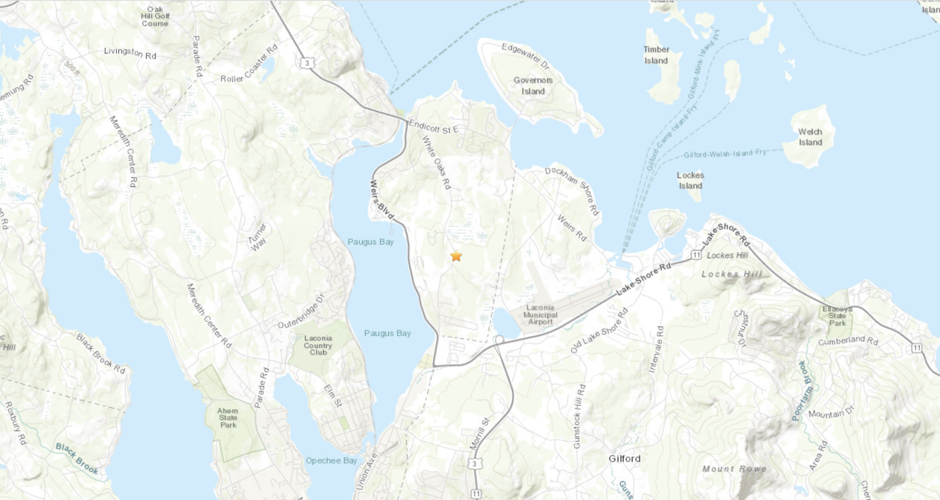
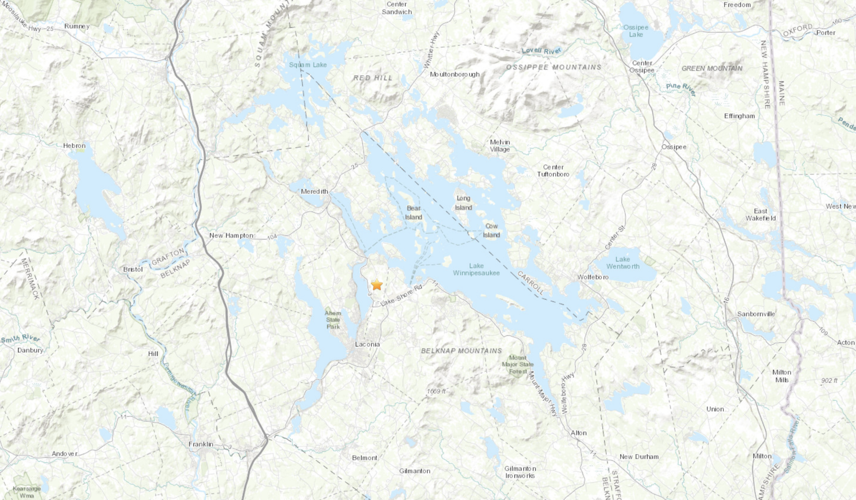
WEIRS BEACH — A magnitude 2.2 earthquake struck the Lakes Region Wednesday evening, according to the United States Geological Survey.
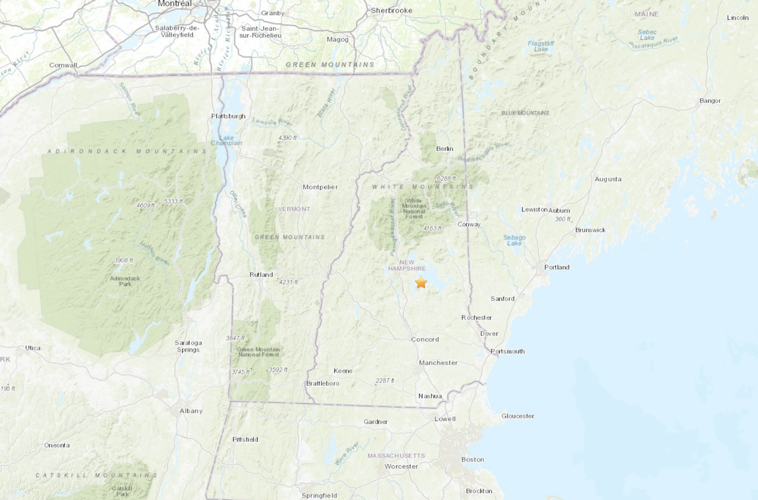
The quake was detected at a depth of 4.5 kilometers in the Weirs area just before 9 p.m., about 2.8 miles northwest of Gilford, and could be felt as far away as Concord and Rochester.
“One hundred eighty-four people felt that one,” Amelia Redhill of the USGS said Thursday morning.
Public Works Director Wes Anderson said there wasn’t any damage to city infrastructure resulting from the earthquake that struck near White Oaks Road.
Anderson sent out public works crews to survey road conditions, verifying that none of them shifted and there weren’t cracks created by the quake. His employees also surveyed the sewer system and a nearby water pump station and concluded no damage occurred to those systems either.
The earthquake struck far enough away from city bridges, so damage to those was not one of Anderson’s concerns, he said.
But he did feel it at his house.
“I thought it was a tree falling last night,” he said. “That intensity scale is logarithmic so this one really wasn’t very severe.”
Water Department Superintendent Benjamin Crawford said the earthquake didn’t cause any damage to the city’s water systems.
“We didn’t see anything immediately,” he said. “I think at this point we’re pretty much in the clear.”
The water department deals with pressurized pipes, so damage to those would likely be quickly apparent, he said. He has six staff members who are routinely out and about the city checking for indications of problems such as bubbling instead of standing water.
Fire Chief Tim Joubert said there were no injuries or damage to buildings reported after the earthquake hit. Firefighters did receive one 911 call where the caller reported hearing an explosion in a residential area, but that turned out to be the earthquake in question. The fire station in the Weirs received numerous calls from residents inquiring regarding loud noises, however.
“These earthquakes this size do occur in New Hampshire but they’re not common,” USGS Research Geophysicist Robert Pratt said. “It’s one of the more active areas along the East Coast.”
A network of seismometers — devices buried in the ground which detect seismic activity — generally start registering earthquakes around magnitude 2.0. Lesser earthquakes tend to be lost in the background noise, he said.
But this earthquake, although small, struck at a shallow depth which is why so many people felt it. This earthquake is not cause for concern, he said.
“This one’s not hazardous because it’s so small, I mean, people barely felt it,” he said. Earthquakes that strike deeper are generally felt less frequently on the surface than shallow earthquakes and quakes under magnitude 4.5 are generally not destructive.
But this earthquake could be a sign that more severe earthquakes could follow, although Pratt said that is extremely unlikely.
“We can’t say it won’t [lead to massive earthquakes] because sometimes they do,” he said, noting there’s about a one-in-a-million chance a larger earthquake could be caused by this one. “I wouldn’t lose much sleep over it — it can happen but it’s pretty unlikely.”
The massive earthquake that struck Charleston, South Carolina, in 1886 registered about 7.0 in magnitude and caused $180 million of damage in today’s dollars was triggered by smaller quakes in the days leading up to it. The magnitude 5.1 earthquake that struck Sparta, North Carolina, was also triggered by similar events, he said. That earthquake caused widespread damage to roads and water mains.
New Englanders have reported earthquakes and suffered damage infrequently since Colonial times, according to the USGS. Moderately damaging earthquakes are recorded every few decades and minor earthquakes are felt by residents approximately twice each year.
The largest earthquakes recorded throughout New England occurred in the mid 1600s in Vermont and New Hampshire and are estimated to have been about 6.5 in magnitude on the Richter scale. More recently, a moderate earthquake, magnitude 5.6, caused damage in central New Hampshire in 1940, according to the USGS.


(0) comments
Welcome to the discussion.
Log In
Keep it Clean. Please avoid obscene, vulgar, lewd, racist or sexually-oriented language.
PLEASE TURN OFF YOUR CAPS LOCK.
Don't Threaten. Threats of harming another person will not be tolerated.
Be Truthful. Don't knowingly lie about anyone or anything.
Be Nice. No racism, sexism or any sort of -ism that is degrading to another person.
Be Proactive. Use the 'Report' link on each comment to let us know of abusive posts.
Share with Us. We'd love to hear eyewitness accounts, the history behind an article.