


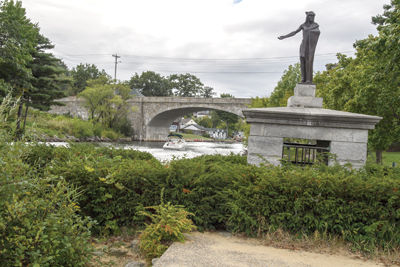
The Native American statue over Endicott Rock looks out over the Weirs Channel on Friday. (Alan MacRae for The Laconia Daily Sun)
Weirs Drive-in site is one of best in state for archeological study
By RICK GREEN, LACONIA DAILY SUN
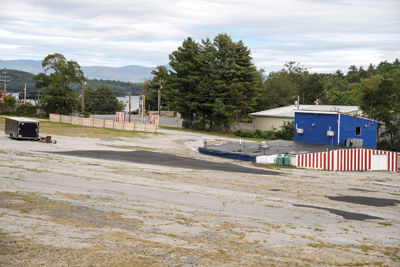
LACONIA — A look at the deserted Weirs Drive-In Theatre on a sunny afternoon reveals an expanse of cracked blacktop, four movie screens, an aging snack bar, boats stored along the periphery and the blue water of Lake Winnipesaukee in the distance.
But unseen below the blacktop is what puts this land in the top rank of archeological sites in New Hampshire, State Archeologist Richard A. Boisvert said.
The drive-in has been here since 1948, but the land was heavily used by Native Americans for almost 10,000 years. The tools used by these people and perhaps even some of their skeletal remains could be beneath the ground.
Al Mitchell had agreed to acquire the 12.5 acre drive-in property for $2.5 million but backed out amid uncertainty over the expense and complication of archeological exploration and recovery that would be required as a condition for redeveloping the area.
The duration and extent of this archeological work won't become clear until building plans are produced. Testing would be done at various places at the site to determine through consultation with state officials how much archeological excavation would be necessary. Archeological investigation of construction sites can get complicated, as developers often need to employ specialists to sift through excavated material.
Sometimes, sites have been so disturbed through previous construction work that artifacts that were once there have been destroyed.
Mitchell had planned as many as 80 condominiums, together with shops and other commercial development.
Previous archeological explorations in the general area have found extensive evidence of ancient encampments, Boisvert said.
“It doesn't take a lot of imagination to realize what an attractive place this would be to Native Americans, a mouth of a lake with fish coming through,” he said.
“A weir is a fence in a river to channel fish into a spot where you can take them. They would roast them, dry them, eat them. It was well known in the historic period, with reports that 200 canoes' worth of Native Americans went there to take the fish.”
Shad, which spend much of their life in the Atlantic Ocean, and return to freshwater in the spring to spawn were hugely abundant until modern times when dams interfered with their yearly runs. Salmon and eel were also plentiful.
The native Abenaquis, members of the Penacook tribe, used the fishing village.
Paul Pouliot, council chief and speaker for the Cowasuck Band of the Pennacook/Abenaki People, said a complicating factor in any development of the area is the likelihood that burials took place there.
“It fits the profile for a burial ground,” he said. “It is on high grounds, has the right soils and the right exposure. It’s a very sacred site. It is our people, our ancestors. If anything is uncovered, there are serious issues to deal with.”
He said that when remains are found, they are studied to determine their age and if they are thought to be those of a Native American, they are reburied in a spiritual ceremony. Any discovery of religious artifacts, including pipes, would be of particular interest.
Charles Bolian, a retired University of New Hampshire professor, did archeological excavation at Weirs Beach in the 1970s. He found ancient tool kits, projectile points and scraping implements. Long, manmade stone rods were also found. They may have been used as files, but their exact purpose remains a mystery. Some of the items were nearly 10,000 years old.
He didn’t find any human remains, which often hold up poorly in New Hampshire soil conditions.
“If you did find human remains, it would make the site more important,” Bolian said. “A burial site could show indications of religious activity and would bring up a whole set of issues.”
Boisvert, the state archeologist, said the Weirs Beach area is truly special.
“Here you have the largest lake in New England funneling out through a channel,” he said. “This is most unusual. Things were happening there that didn't happen elsewhere. Was it a major gathering place where people came from great distance to socialize and exchange goods? Did its importance change over time?”
The earliest evidence of human presence in the area started after the end of the last ice age.
Some of the tools that have been found, including axes and gouges used to make dugout canoes, seem to date from the time when forests returned to the area after glaciers receded. Pottery and bone fish hooks have also been found.
Although thousands of artifacts have been discovered in the area over the decades, there is still much to be learned.
Modern scientific techniques allow for microscopic and trace analysis that can shed light, for example, on what was cooked in an ancient pot. Tools can be examined to determine how they were used.
“We have new techniques to study archeological materials we didn't have five years ago,” Boisvert said. “We have the opportunity to bring to bear new science and technology to answer the questions of just exactly what were they eating, what time of year were they present, how they lived. You often need to get artifacts fresh out of the ground for this sort of thing.”
One mystery is where those who populated the fishing village in the warm-weather months went in the winter.
“Indicators are very scarce,” Boisvert said. “Some people say they went to the Seacoast, or that they may have dispersed into small hunting camps for moose and deer and other animals that were amenable to being stalked and taken by lone hunters. They may have also gone to river areas that take longer to freeze and were able to catch the odd fish or aquatic bird.”
Boisvert said he and his colleagues will closely monitor what happens with the site.
The Weirs was listed on the National Register of Historic Places in 1975 as a major Native American archeological site.
”I would say this is one of the most important remaining archeological sites in the state,” he said.
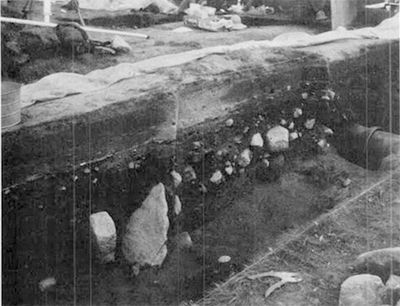
This is a "stratigraphic profile" of the Weirs Beach dig, as shown in the book "The Archeology of New Hampshire: Exploring 10,000 years in the Granite State," by David R. Starbuck. (Courtesy photo)
A storage trailer and the projection booth at the Weirs Drive-in Theatre border a small visual opening to Weirs Bay from the drive-in parking lot. (Alan MacRae for The Laconia Daily Sun)


(0) comments
Welcome to the discussion.
Log In
Keep it Clean. Please avoid obscene, vulgar, lewd, racist or sexually-oriented language.
PLEASE TURN OFF YOUR CAPS LOCK.
Don't Threaten. Threats of harming another person will not be tolerated.
Be Truthful. Don't knowingly lie about anyone or anything.
Be Nice. No racism, sexism or any sort of -ism that is degrading to another person.
Be Proactive. Use the 'Report' link on each comment to let us know of abusive posts.
Share with Us. We'd love to hear eyewitness accounts, the history behind an article.