




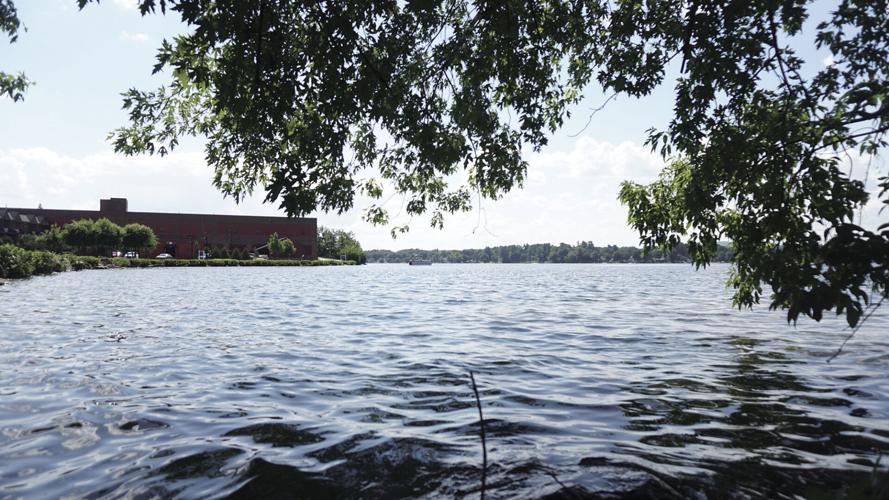
LACONIA — For beach lovers, swimmers and lakefront property owners in the Lakes Region, there is no water quality emergency. But there are reasons to be concerned, even in late summer and early fall.
For the first time since 2018, the Lake Winnipesaukee Association this summer issued cyanobacteria advisories at Lake Winnipesaukee, in addition to one at Lake Winnisquam and a longer-running advisory at Lake Kanasatka in Moultonbourough, which was lifted two weeks ago, according to the New Hampshire Department of Environmental Services.
Toxic algae blooms in Winnipesaukee at Jockey Cove in Wolfeboro, Ellacoya State Park in Gilford and Opechee Bay were documented at the end of June, earlier than sightings in previous summers.
Reported cyanobacteria blooms in the Lake Winnipesaukee watershed area have grown “both in severity and longevity severity over the last few years,” said Bree Rossiter, conservation program manager for the Lake Winnipesaukee Association. “There have been way more sightings,” she said, adding that public awareness and vigilance have also increased.
“It’s usually pretty clear if there’s an algae bloom,” said Karen Reardon, vice president of public affairs for Responsible Industry for a Sound Environment, or RISE,. “You can see these bright green moving areas” in contrast to the surrounding water. “These spots and clumps can move around,” propelled by wind, current and waves.
A cyanobacteria advisory means water samples indicate the presence of phosphorescent bacteria that have been found dangerous to humans and pets and harmful if swallowed.
According to water quality experts, blooms of cyanobacteria are most common during July and August — but the season in New Hampshire lasts through September. Blooms occur when fresh water is warm and the concentration of phosphorous and nitrogen reaches critical levels, often as a result of lawn or stormwater runoff, or contaminants leaching from failed septic systems and pet waste.
Fertilizer also takes a toll if too much enters ponds and lakes. “Having green lawns right up to the edge of lake water” without a vegetation barrier to inhibit stormwater runoff can increase the overload, said Rossiter, who recommends planting low bush blueberries, sweet pepper or spice bushes between a fertilized lawn and fresh water.
Rossiter said cyanobacteria reports have been “increasing worldwide, regionally and locally. It’s not just New England.” Rising temperatures coupled with development and runoff from more paved and impervious surfaces is hastening the uptick.
In New Hampshire, caution doesn’t end with the arrival of fall. Lakefront residents shouldn’t blow or dump leaves into lakes and ponds, Rossiter said. She advocates "leave the leaves” because when left in place to decompose they act as natural fertilizer for lawns.
In general, small, shallow waterbodies become vulnerable during spells of hot weather. “Waters that are not moving are more susceptible” to cyanobacteria, Reardon said. “Not every bloom has toxic elements but they should be avoided, especially if you’re in a remote area and have no idea” what the actual water conditions are. Public and town beaches are generally posted and routinely tested, but tranquil water bodies in wilderness areas are unknown.
Kate Hasting, cyanobacteria program coordinator for NH DES, said the number of reported occurrences statewide this year, 30, is in line with the last three summers: in 2019, 33 advisories were reported, followed by 18 in 2020 and 23 in 2021.
Public awareness of cyanobacteria has increased along with photos and reports, Hastings said. Since the problematic algae overgrowth was first tracked by New Hampshire authorities in 2003, “it looks like it has increased in frequency, but it’s not a statistical increase,” Hastings said.
Currently, there is a cyanobacteria advisory for Duncan Lake in Ossipee and the next closest to the Lakes Region is Tucker Pond in Salisbury. State advisories are issued when samples are collected and identified with concentrations higher than the state’s threshold of 70,000 cells per milliliter.
Physical contact with the bacteria has been known to cause rashes and headaches, Rossiter said. Longterm consequences of consistently swimming in water with a high cyanobacteria content include liver and kidney disease, she added. The potential link between cyanobacteria and ALS, or Lou Gehrig’s disease, is the subject of ongoing research.
“My advice is to do a visual assessment. If it looks cloudy, blue or blue green, they should stay out of the water and keep their pets out,” Hastings said. Moving clumps of bright, lighter green are also potential hazards.
The statewide count hinges on the reports from residents and water users, and does not follow scheduled testing. “It’s the communities around water bodies that report cyanobacteria and initiate samples” to be evaluated. “We cover the state but we can’t be everywhere. We depend on the communities to be our eyes on the water,” Hastings said.
“There can be a brackish odor and an unpleasantness in the water,” Reardon said. “You should avoid being in any proximity to that slimy surface. People should use their best judgement to ensure that they’re not coming in contact with that.” It’s critical, too, to prevent dogs from drinking or swimming in the water. Rivers are usually safer because of the water movement, Reardon said.
The NH DES website updates its list of advisories in effect. If someone suspects cyanobacteria locally, the best approach is to take a cell phone photo and send that by email with reporting information to hab@des.nh.gov. Hastings said it’s also possible to report by phone or text to 603-848-8094 or drop off water samples for testing.
For more information, visit winnipesaukee.org/how-we-protect-winnipesaukee/monitoring and des.nh.gov/water/healthy-swimming/harmful-algal-blooms.


(0) comments
Welcome to the discussion.
Log In
Keep it Clean. Please avoid obscene, vulgar, lewd, racist or sexually-oriented language.
PLEASE TURN OFF YOUR CAPS LOCK.
Don't Threaten. Threats of harming another person will not be tolerated.
Be Truthful. Don't knowingly lie about anyone or anything.
Be Nice. No racism, sexism or any sort of -ism that is degrading to another person.
Be Proactive. Use the 'Report' link on each comment to let us know of abusive posts.
Share with Us. We'd love to hear eyewitness accounts, the history behind an article.