


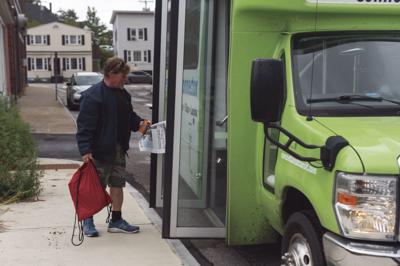
The Concord-Laconia commuter bus route will suspend operations permanently as of Jan. 30, according to a press release from Concord Area Transit on Monday.
The decision was made because of lower-than-anticipated ridership along the bus route, which ran from Concord to Laconia with stops in between, mostly for work or other appointments. Also cited was a lack of solid funding opportunities for future operations.
“It’s a press release from the Community Action Program for Belknap and Merrimack counties,” City Manager Kirk Beattie said at a council meeting on Monday night, “they are suspending the Concord-Laconia commuter bus route.”
The free commuter bus service ran from Concord up Route 3 through Franklin and Tilton, and then into Laconia, before turning back the other direction. The press releases cites a low number of riders and financial constraints as key factors influencing the decision.
“When that was discussed, when they started that, wasn’t it at the request of businesses in the area, that they wanted to be able to get employees in on the buses?” Ward 3 Councilor Eric Hoffman asked Monday.
There was a business in Franklin that pushed hard for the program, Beattie said. Then the route expanded to businesses at Tanger and Walmart in Tilton, and eventually Concord Hospital-Laconia, too.
“The hospital here was another big push,” he said.
On Tuesday afternoon, CAPBM Mobility Manager Cindy Yanski confirmed service would be suspended at the end of January.
“The decision comes after careful review of ridership trends and current funding limitations,” the press release reads, in part. “Despite strong interest from some riders, overall use of the route did not reach levels needed to sustain long-term operations. After a thorough evaluation of ridership data and operational needs, CAT and the CAPBM board of directors made the decision that suspending the route is the fiscally responsible option.”
“This was not an easy decision,” Transportation Director Terri Paige wrote in the release. “We know this route matters to commuters traveling between Concord and Laconia, and we truly appreciate the community’s understanding. Given the funding available to us right now, we must make choices that allow us to maintain stable and reliable service across our system.”
Reached on Wednesday morning, Paige said the original ridership goal, based on state Department of Transportation studies ahead of the creation of the program, was never achieved.
Those studies, based on ridership generators — businesses and services along the route — suggested there could be as many as 12,000 riders annually. The actual figure was 5,811, and the estimated number in a best-case scenario for fiscal year 2026 was 7,000 riders. Ridership increased over the first few months of the program, but, in the most recent six months, plummeted.
“We did everything we could try to do” to get ridership established, but it plateaued, Paige said.
CAT will continue to monitor transportation needs, funding opportunities, and operational capacity, and intends to share updates with the public as more information becomes available.
Though relatively short-lived, the program did make a difference in people’s lives. Their first ride occurred in January 2024.
“It was set up to be a commute route, getting folks back and forth to work,” Paige said. The length of the trip was about 1.5 hours between Concord and Laconia. “It was a long trip. I think the length of the service itself was a factor.”
Trying to align logistically with working shifts at various businesses and other locations was “complicated at best,” though there were people relying on the service to get to work.
“We had a core group of folks who were using it regularly,” Paige said.
Now, CAPBM staff are asking people with concerns about the dissolution of the bus route to contact them to discuss what options may be available. Most rider feedback about the closure has centered around it being a cost-effective means of transport, much more accessible than taxi services or relying on friends and family members for the commute.
Though gone for now, Paige said she doesn’t think the concept is off the table, though the funding piece of the equation is a difficult nut to crack. They need a dependable source of funding.
Initial money came from the Federal Transit Administration by way of New Hampshire Department of Transportation grants, which require local match. The program received American Rescue Plan Act funding through Merrimack County, but those funds are now expended and expired. Efforts to secure additional funding from communities along the route were not successful.
“All of the municipalities, at this point, are really stretched,” Paige said. Businesses are stretched, too, and the decision to shutter the route was in part a matter of timing regarding securing future funding.
CAT staff encourage riders affected by the change to explore other transportation options, and to contact Yanski for assistance at 603-225-1989, ext. 1210, or cyanski@capbm.org.
“I don’t think it’s off the table for the future,” Paige said. “Maybe we approach it from a different angle.”


(0) comments
Welcome to the discussion.
Log In
Keep it Clean. Please avoid obscene, vulgar, lewd, racist or sexually-oriented language.
PLEASE TURN OFF YOUR CAPS LOCK.
Don't Threaten. Threats of harming another person will not be tolerated.
Be Truthful. Don't knowingly lie about anyone or anything.
Be Nice. No racism, sexism or any sort of -ism that is degrading to another person.
Be Proactive. Use the 'Report' link on each comment to let us know of abusive posts.
Share with Us. We'd love to hear eyewitness accounts, the history behind an article.