


LACONIA — When Gov. Chris Sununu gave his news conference on Tuesday, Laconia City Clerk Cheryl Hebert was watching. At one point the governor announced that he had signed a new emergency order requiring people to wear masks during events involving 100 people or more.
“I wonder if that will include polling places,” Hebert asked shortly afterward. “We’ll need to get some clarification on that.”
With the state’s primary election less than a month away, Hebert and her counterparts in other Lakes Region communities are navigating in uncharted waters as they figure out procedures that will ensure that voting is safe and efficient.
“There are a lot of unknowns now,” Hebert said.
Clerks can tell by absentee ballot requests that this election cycle will be unlike any other. The state Attorney General’s Office announced in April that any voter who has concerns about showing up to vote in-person due to COVID-19 will be able to vote absentee in both the primary on Sept. 8 and the general election on Nov. 3.
The number of absentee ballot requests for the September primary is much higher than four years ago. Most clerks say they have processed about double the number of requests they did prior to the primary in 2016. But in Belmont the requests are four times greater, according to Town Clerk Cynthia DeRoy.
For clerks, the primary will be a dry run for November’s election. General elections — especially during a presidential election year — generate a much heavier turnout than primaries. In 2016, 72.5 percent of the state’s registered voters cast ballots in the general election, according to VOTE and the U.S. Elections Project. And with the coronavirus pandemic continuing, clerks are all predicting that the number of voters who will request absentee ballots for the November election will be extraordinarily high.
For weeks clerks have been trying to get a handle on the logistics of balloting in these days of social distancing and intense personal hygiene.
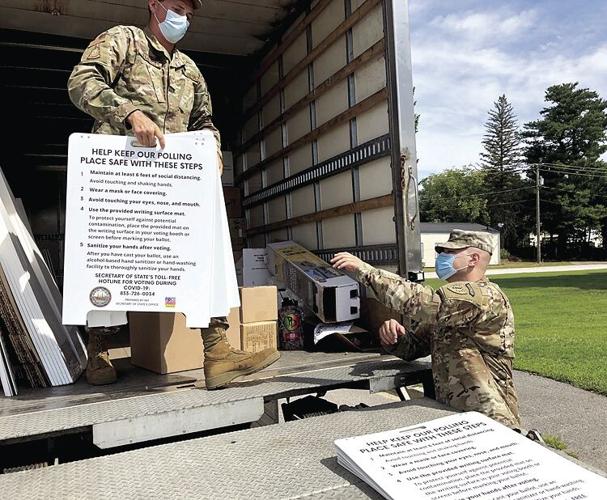
On Thursday two members of the National Guard delivered and unloaded a truck loaded with personal protective equipment and special supplies for use in this year’s election. The truck pulled up in front of Laconia High School, where local election personnel came to collect the material for use in their community’s polls.
Among the supplies were masks, face shields, gloves, gowns, gallon jugs of hand sanitizer, and plexiglass shields. The latter will separate voters from ballot clerks who check the voter roll to make sure a person is registered to vote before handing them a ballot. The delivery also included signs which will be put up at polling places, telling voters to observe social distancing, wear a mask and sanitize their hands after voting.
Because of all the special precautions along with the changes in normal layout of the polls, greeters will help to guide voters to the proper line.
“Workers will guide people to the booths,” Meredith Town Clerk Keri Parker said.
Clerks are looking for additional helpers. DeRoy said she is planning to reach out to the Belmont High School Honor Society to see if any of those students would like to help out, including sanitizing voting booths after each person votes.
It is yet unclear whether Sununu’s face mask order applies to polling places, and the state has yet to issue guidance on how to respond to individuals who object to wearing a mask inside the polling place.
DeRoy said if face masks are not mandatory, she is thinking of sectioning off an area of the Belmont High School gym — the town’s polling place — just for non-mask wearers, and then making sure that those people are kept sufficiently away from other voters and poll workers.
Hebert and Gilford Town Clerk Danielle LaFond said the non-mask-wearing voter is an issue they need to discuss with their moderators, the elected officials who are in charge of the polling place.
Just when clerks need more help at the polls, the COVID crisis has prompted some poll workers to sit this election out, many because their age or underlying health condition puts them at greater risk of contracting the virus.
Hebert said some workers have told her they will not work at the polls at all this year. Others have said they are willing to work, but only to help set up or during the ballot-counting process after the polls close — but not when voters are in the building.
“In Ward 3, I need a ballot clerk. I could use one or two more people in Ward 4; and in Ward 2, I may need a moderator,” she said.
“We should be OK,” Parker said of help at the Meredith polls.
But LaFond said two longtime ballot clerks have bowed out because of health concerns. Meanwhile, those who have committed to work the polls are wary.
“Their main concern is whether there will be enough protective gear for me,” she said.
On top of all the COVID issues poll workers will be dealing with, poll officials will have to count far more absentee ballots than usual. Laconia: 390, compared to 167 that were cast by absentee in 2016. Meredith: 160, compared to 88 in 2016. Gilford: 207, compared to 111 four years ago. Belmont: 121, compared to 32 in 2016.
Because of the greater number of absentee ballots, the Secretary of State’s Office is allowing town and city clerks to process absentee ballots the week before the election, but only up to a point.
Under the waiver, the clerks can match up the return address on the outer envelope with addresses on the list of absentee ballot applications. And they can examine the affidavit — which must be signed — that is printed on the outside of the inner envelope. But the rest of the process must wait until after 9 a.m. on Election Day.
Laconia and Meredith do not plan to do any early processing.
“What’s the sense of touching the envelopes twice?” Parker said, explaining her decision to do all the absentee processing on Election Day.
But LaFond said being able to do some of the work beforehand will be helpful.
“It can take four or five hours to open all those envelopes,” she said. In addition, she said if a voter forgets to sign the affidavit, her office can call the voter and try to make arrangements to have the affidavit signed before Election Day.
Absentee ballots which are returned — whether by mail or hand-delivered by the voter — are kept in a secure vault until Election Day, when they are brought to the proper polling place.


(0) comments
Welcome to the discussion.
Log In
Keep it Clean. Please avoid obscene, vulgar, lewd, racist or sexually-oriented language.
PLEASE TURN OFF YOUR CAPS LOCK.
Don't Threaten. Threats of harming another person will not be tolerated.
Be Truthful. Don't knowingly lie about anyone or anything.
Be Nice. No racism, sexism or any sort of -ism that is degrading to another person.
Be Proactive. Use the 'Report' link on each comment to let us know of abusive posts.
Share with Us. We'd love to hear eyewitness accounts, the history behind an article.