


GILFORD — The health of trees on Lake Winnipesaukee’s many islands is rapidly declining, and islanders worry about the logistics of properly abating those ailments.
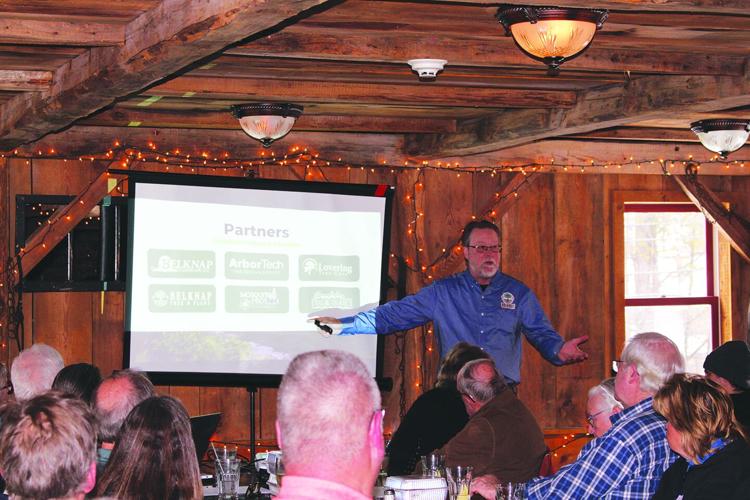
At a meeting of the Gilford Islands Association on March 7, whose members represent 18 of the 365 estimated islands on the Big Lake, islanders came together for a presentation about the health of their trees. After all, how do you treat using pesticides and herbicides if you can’t get the equipment from the mainland? And what’s an island without trees?
These are questions GIA President Jim McBride has been asking himself a lot lately.
“It's not so good, unfortunately. We have a lot of tree trouble.”
Tree trouble
There are several tree issues, including fungi, drought stress and invasive plants and insects, all addressed by urban forestry expert Peter Schmidt, and Kim Weeks, sales administrator, of Belknap Landscape.
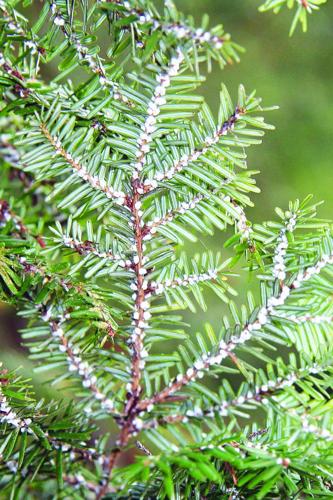
Hemlock trees are the hardest hit right now, suffering from hemlock woolly adelgid, a tiny, aphid-like insect nesting on hemlock twigs — not the needles — and hemlock scale, an insect oblong in shape, on the needles. Both pests are attacking the trees simultaneously on many islands, including Welch and Mark.
As Schmidt, a certified arborist, said, it’s a “one-two punch.”
HWA is a parasite that causes needle loss and thinning canopies, and can be identified by “white cottony masses” that serve as a jacket of sorts to protect the pest from fluctuations in weather. It’s often spread via bird, so it’s hard to prevent the spread.
“Each one of these little cottony masses here, there's an insect in there, and it inserts what is called a stylet. It's pretty much like a needle that they kind of drill down into the twig of the plant, and they're sucking the water, moisture and nutrients out of the plant,” Schmidt said.
Red pine trees are also falling victim to sap-feeding pests called red pine scale, a hard-scale insect that’s the "No. 2 nemesis" behind HWA. The red pine scale also attaches to twigs and small branches, yellowing needles and causing thinning canopies, which impacts privacy screens and windbreaks.
“They're just so badly infested with insects that they're reaching a tipping point,” he added. “Once a tree is that badly weakened, we very often see an infestation of turpentine beetles. Once you see this on the trunk of the tree, you have all this sap oozing out, and there's really nothing you can do. I mean the whole vascular system of the tree is broken down at that point.”
A tree this far gone would not respond to treatment.
Treatment and solutions
There are various treatments for both soft- and hard-scale pests, but getting to an island to perform preventative maintenance isn’t an easy feat.
Trunk injections are the best approach, although there’s no “blanket solution,” Schmidt said.
“Essentially, there's a small air tank that you would use for, you know, scuba diving, that discharges with air. There's an insecticide that's stored in this little little tank here. This is pretty much a needle. The technician comes out and many just visually measure the tree. If it's a 12-inch tree, it's like, OK, we have to treat it that much, drill a certain amount of holes into the right spot at the root layer of the tree, right at the base. They insert this object into that hole they drilled, hit a button, and the tree is treated,” he explained.
Using dinotefuran (also known as Transtect) is a positive approach, since it knocks out both pests, but has low toxicity to humans and pets.
“Dinotefuran, that is the product we use that will work on both hard- and soft-shell scale,” Schmidt said. “This is kind of like hitting the reboot button on your computer. If it works, it works fast.”
These treatments are 100% effective and take place every few years. And if the trees aren’t treated, soon enough a barge will be seen on Lake Winni, transporting the dead trees to the mainland.
Schmidt prefers a more organic approach than pesticides, which was also a concern for many in the audience.
“I like to do things organically. I like a challenge, and doing things organically is sometimes a challenge. If we're going to use a pesticide, let's find a way to apply it the most responsible way, with the least amount of product, at a point where the insect is most vulnerable, and before they do the damage,” he said.
Resilience for the future
There is no way to prevent the spread of these tree diseases, but islanders can remain vigilant by consistently monitoring their trees. Take notice of when a tree is suddenly infested, or if it’s too far gone for treatment.
Next, call a professional.
“Inspection is very important. When I come out to inspect your trees, pretty much I have some hand tools and binoculars,” Schmidt said. “It's good to have a certified arborist look at your trees just to make sure we're doing the right thing. I encourage my landowners to, you know, keep an eye on what their forests look like.”
For more information on tree health, visit belknaplandscape.com.
•••
Katlyn Proctor can be reached at katlyn@laconiadailysun.com or by calling 603-524-0150.


(0) comments
Welcome to the discussion.
Log In
Keep it Clean. Please avoid obscene, vulgar, lewd, racist or sexually-oriented language.
PLEASE TURN OFF YOUR CAPS LOCK.
Don't Threaten. Threats of harming another person will not be tolerated.
Be Truthful. Don't knowingly lie about anyone or anything.
Be Nice. No racism, sexism or any sort of -ism that is degrading to another person.
Be Proactive. Use the 'Report' link on each comment to let us know of abusive posts.
Share with Us. We'd love to hear eyewitness accounts, the history behind an article.