


LACONIA — It’s time the city stopped kicking the can down the road and made the decision to switch to a less labor-intensive and more cost-effective way to collect trash.
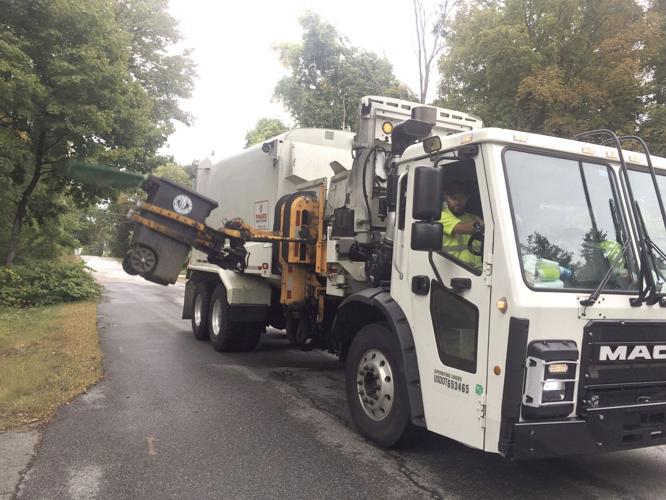
The City Council on Monday is scheduled to hear why the city needs to switch as soon as possible to an automated system — a method that will require residents to use large, new garbage and recycling carts that can be automatically lifted and dumped into collection trucks.
“It’s long past time to change our curbside collection system,” said Public Works Director Wes Anderson, who has been seriously looking at the switch for two years.
The reason, Anderson said, comes down to dollars and cents. The present method with one person driving the garbage truck and a second grabbing the trash or recyclable containers and dumping the contents into the hopper is becoming cost-prohibitive and impractical.
The city presently spends $38,753 a month to collect trash and recyclables from residences and businesses under a contract that is due to expire Oct. 1. The trash is collected every week, while recyclable materials are picked up every other week.
The city recently put that contract out to bid and received just one bid at a cost of $51,083 a month — a 27% increase. And that bid was for automated collection.
“I don’t think manual (trash collection) is viable,” Anderson said Wednesday.
A big part of the reason for the jump is the present labor market, with many employers finding it harder to hire workers unless they offer significantly more in pay than in the past.
The problem is not unique to New Hampshire or the Northeast, Anderson explained.
Across the nation communities and waste hauling companies are struggling to hire sanitation workers.
But another reason is that trash collecting is one of the most dangerous jobs there is — the fifth most-dangerous, after anglers, loggers, pilots and roofers, according to U.S. Department of Labor statistics. So in addition to having to pay higher wages, refuse haulers pay considerably more for workers compensation insurance because of the greater likelihood of on-the-job injuries.
With less hands-on work, worker compensation claims should decrease, there is less city liability, productivity increases and trash is picked up faster.
Anderson said he hopes that the council will approve the switch to the automated system no later than next month. The reason for the urgency is to give the waste hauler ample time to take delivery of the two new curbside pickup trucks that will be needed to implement the new system. It takes between 12 and 15 months for the special trucks to be delivered once they are ordered.
Because the city picks up recyclable materials on alternate weeks, an arrangement has been made to coordinate the pickup schedule with Belmont which also collects recyclables every other week.
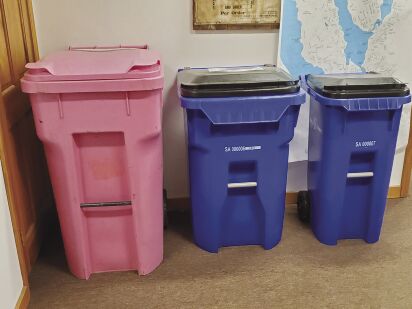
The city will provide each residence and eligible business with standard sized containers — called toters — one for the trash and the other for the recyclables. The containers, each marked with a serial number, will be assigned to specific addresses, and will remain the property of the city, Anderson explained.
When Anderson got an estimate for the toters about one year ago the cost for necessary number of containers was pegged at $600,000.
One important requirement of the new system is that all of the refuse, whether garbage or recyclables, will need to be inside the container because the driver will stop just long enough to activate the automated, mechanical, grabber arm to pick up the two-wheeled garbage carts, hoist them in the air, dump the contents into the truck and put them back on the ground. No overflow items will be picked up.
Also, the containers will need to be placed either right at the curb or in a driveway so the container is within reach of the hoisting mechanism. And they will need to be spaced a certain distance apart.
Educating the public about the changes will be crucial to the new system’s success, Anderson said.
He said plans are already in the works to provide information through the city’s weekly email newsletter Laconia Links, handouts, posts on the city’s website, and newspaper articles.
“You’ve got to get the information out,” Anderson said.
The amount of solid waste picked up by curbside collection varies from just under 1,000 tons to as much as 1,200 to 1,300 tons each week, with smaller volume occurring in February, March, and April.
Communities throughout the state have been switching to automated collection in recent years, including Franklin, Nashua, Rochester, and Stratham. Manchester, the state’s largest city, is in the process of switching over, Anderson said.


(1) comment
I don't think Wes Anderson has a clue about the trash picket, and it's time they find someone who understands the job.
I've seen the small, trash toter truck come around a few times here in Laconia, maybe on a test run.
I watch the farce; the truck is maybe half or a third of the size of the regular trash trunks that come around for trash and recycling.
I also watched the one guy driving the truck who had to get out each time to make sure the trash can was attached properly, not time efficient and is basically a joke.
I have some choice words for Wes Anderson's bright ideas, if it ain't broke don't try to fix it, period!
Welcome to the discussion.
Log In
Keep it Clean. Please avoid obscene, vulgar, lewd, racist or sexually-oriented language.
PLEASE TURN OFF YOUR CAPS LOCK.
Don't Threaten. Threats of harming another person will not be tolerated.
Be Truthful. Don't knowingly lie about anyone or anything.
Be Nice. No racism, sexism or any sort of -ism that is degrading to another person.
Be Proactive. Use the 'Report' link on each comment to let us know of abusive posts.
Share with Us. We'd love to hear eyewitness accounts, the history behind an article.