


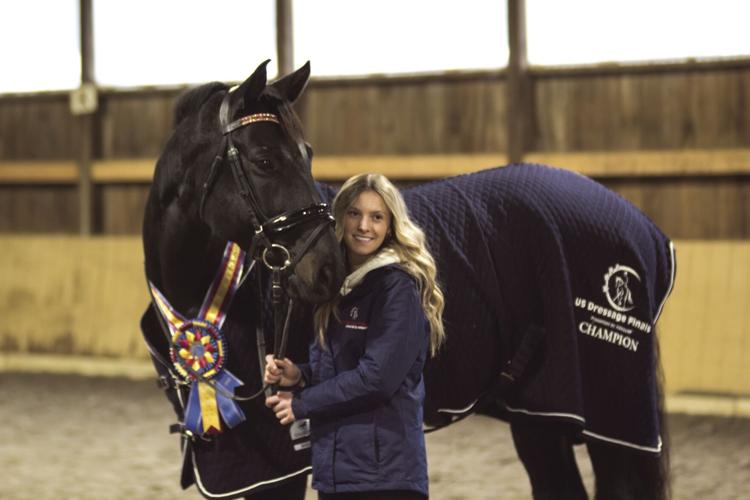
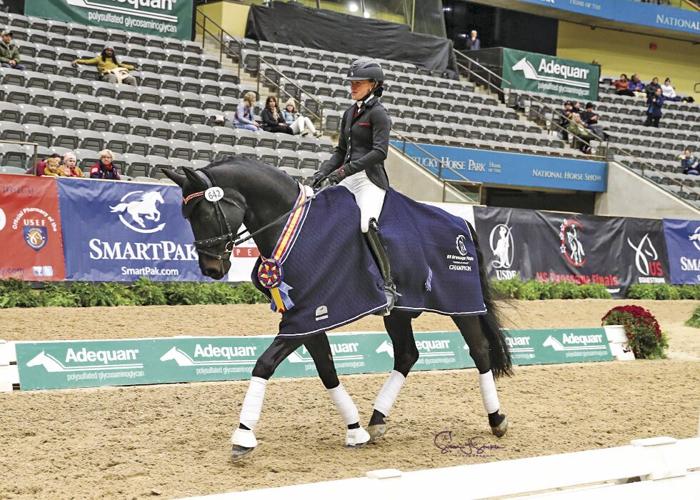
GILFORD — When Caroline Colby, 16, a junior at Gilford High School, rode for all of six minutes in the U.S. Dressage Finals last week on the horse she’s trained for two-and-a-half years, it wasn’t just business as usual. And it was more than a walk in the park.
Colby claimed a coveted a first-place title and a national rank that left her breathless.
At the national equestrian competition at the Kentucky Horse Park in Lexington, Kentucky, Nov. 10-13, she and nearly 800 riders from every corner of the U.S. competed by level and age group, hoping to take home a ribbon — not necessarily a blue one.
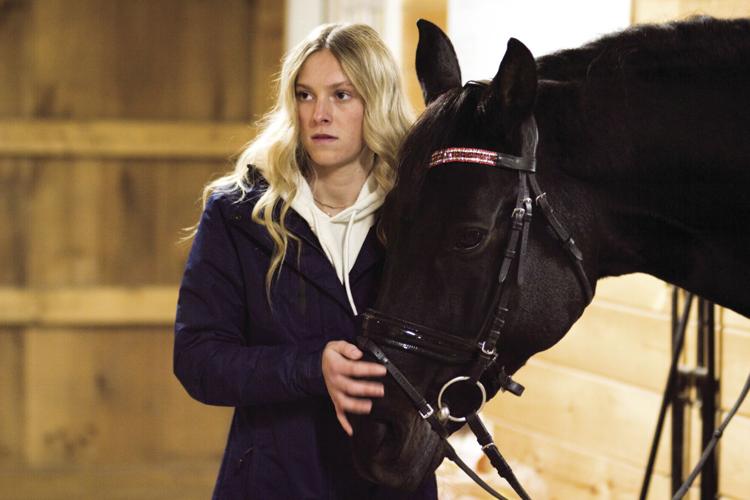
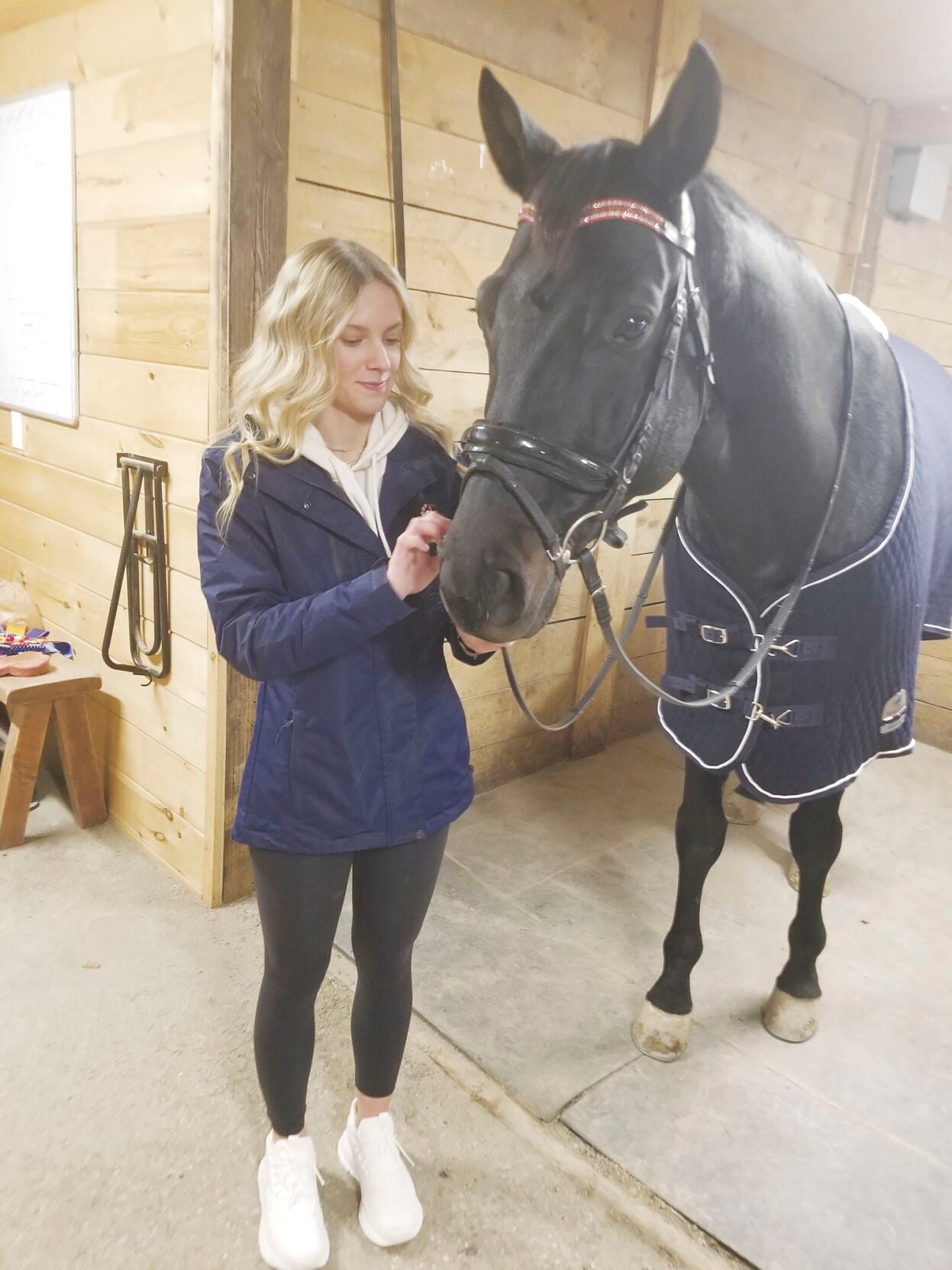
“It’s definitely a hope,” said Colby, standing beside Lorino, the coal-black Westfalian gelding she’s fed, groomed and ridden since the start of COVID-19, spending roughly three hours a day at the barn since she and her father trailered him back to the Lakes Region from a farm in South Carolina.
“We had some training issues and did not expect to come out where we did,” Colby said Thursday at Century Farm in Belmont where they train. “I feel like you know what kind of ride you’re going to have in the first 30 seconds. It was calm and relaxed. I take a deep breath before I go in the ring.”
“There is always that excitement and shock” with a win like this, said her coach and trainer, Danielle Gabree of CAF Equestrian in Belmont. “But I had a lot of confidence going in that they’d be first or second” after they competed well earlier this year.
For the past 12 months, Colby and Lorino have trained five or six days a week, memorizing and practicing the equine equivalent of a dance routine until it looks seamless — with grace, rhythm and 20 to 25 separate movements woven together into something smooth and picture-perfect.
In dressage, horse and rider are micro-analyzed for various attributes, including balance, straightness, a desire to go forward, freedom from anxiety, and tempo, according the U.S. Dressage Federation. Dressage, the French word for "training," became an Olympic sport in the early 1900s, but is rooted in ancient cavalry displays of elegance and military horsemanship.
“They judge your horse, me as a rider, my position, the way your horse moves and responds to what you’re asking,” Colby said. One of the most challenging boxes to check is making everything look effortless, she explained, while you yourself appear composed and relaxed.
“When I was little, I liked the movements and how effortless it looked. I thought it was pretty and wanted to do it. As a little kid, I said, ‘Mom, I want to ride a horse. I kept begging and begging to do it,” she said.
Colby started riding at age 3-and-a-half, and progressed through years of lessons at Lakes Region Riding Academy in Gilford. “They taught me all the basics,” she said.
Last summer, she earned two dressage titles in competitions for Region 8, which includes New York and New England, qualifying her to vie for a national ribbon. Last week, she competed against 14 regional standouts ages 13 to 21. Her win in Kentucky was the first rung on a nine-step ladder of contests that increase in skill and complexity until equestrians embark on several more years of training to qualify for the U.S. Olympic team.
Right now, Colby plans to work diligently up the ranks with Lorino, who is now 7-and-a-half years old, and will start practicing requirements for levels 2 and 3 this winter in preparation for the national finals again next fall.
“We’re over-the-moon proud,” said her mother, Renay Colby. “I think she’s capable of doing whatever she sets her mind to.”
Both horse and rider are talented and capable, said Gabree, Colby’s coach. But it takes more than that.
“You have to be really dedicated to this sport. It takes a lot of dedication, time and training to accomplish what they did. For someone to not only win in the regionals but go on to win in the nationals” is truly exceptional, she said. “Just to be able to get there. Two years ago, they were a new team.”
Lorino had never competed before.
“He did not come as a get-on-and-ride pony,” Renay said. “She’s been training him for a couple of years and worked hard to get where they got.”
“Every rider and every horse react differently with each other. We’ve learned how to listen to each other and what works for us,” Caroline said.
“They’ve accomplished a lot in a very short amount of time,” Gabree said.
Success in the ring depends on constant communication and reading each other’s cues. Dressage is a pattern like a dance recital or a gymnastics routine, and competitors are judged on a series of precise yet fluid movements.
“It takes a lot of effort to make it look easy,” Gabree said. “This is a lifetime activity.”
Nurturing synergy and synchronicity also involves relaxing together. Sometimes Colby and Lorino go for trail rides with other horses and riders at Century Farm, or take walks by themselves — no riding.
“We keep it fun and entertaining,” she said. “Not every day can be a hard-work day.”
Colby said she intends to continue training with Lorino in college.


(0) comments
Welcome to the discussion.
Log In
Keep it Clean. Please avoid obscene, vulgar, lewd, racist or sexually-oriented language.
PLEASE TURN OFF YOUR CAPS LOCK.
Don't Threaten. Threats of harming another person will not be tolerated.
Be Truthful. Don't knowingly lie about anyone or anything.
Be Nice. No racism, sexism or any sort of -ism that is degrading to another person.
Be Proactive. Use the 'Report' link on each comment to let us know of abusive posts.
Share with Us. We'd love to hear eyewitness accounts, the history behind an article.