


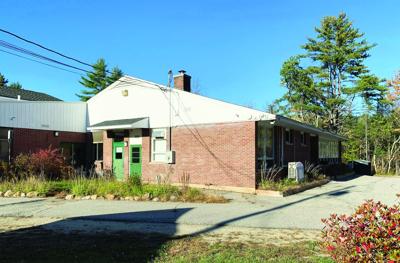
BRISTOL — Six months after the Newfound Area School Board voted to close Danbury Elementary School, members formally declared it an unused building on Oct. 5, and asked administrators to obtain cost estimates for a property appraisal and marketability assessment.
The vote came ahead of the Oct. 8 effective date of RSAs 194:3-f and 194:3-g, laws governing the discontinuance of schools and providing a community preservation option. The first would require a majority vote by district voters to close a school, and the second would allow a town or city to continue operating a school district voters decide to close.
By voting ahead of the law’s effective date, the school board avoided having to ask district residents to approve the closing, and blocked Danbury residents’ option to take over operation of the school. If they choose to lease the building, rather than sell it, the school board also would avoid having to seek voters’ approval — something that would be required if the district were to sell it.
The school board voted to close Danbury Elementary on March 16, after district voters failed to approve the proposed operating budget for Newfound schools, and administrators recommended elimination of extra curricular activities as a way of staying within the default budget. A huge backlash from athletes and parents who wanted to save school sports led the school board to retreat, and turn to closure of DES to reduce expenses.
Danbury residents responded to the decision by moving forward with plans for a charter school to use the local school building. They wanted the school district to follow past practice and deed the school back to the town.
“Danbury gave the building to the district [when the cooperative school district formed]. Danbury gets nothing back," Audrey Pellegrino, involved with the charter school initiative, said. "Alexandria got their one-room school back. Hebron got their one-room school back. Danbury doesn’t get anything back for what they gave the district.”
The recent law no longer allows school districts to donate unused facilities to the communities, but it does provide for charter schools to have the first option to purchase or lease those buildings.
Danbury residents have consulted with the towns of Bridgewater, Groton, and Hebron, whose voters withdrew from the Newfound Area School District over policy decisions with which they disagreed, along with efforts by Alexandria to revise the school assessment formula and shift more of the cost of education to those communities. A Danbury withdrawal would leave just three towns in the former seven-town district.
The school board wants to preserve options for the Danbury school. Alexandria board member Dennis Fitton advocated for a one-year, short-term lease to the charter school.
“In my mind, just after hearing everything I’ve heard and been looking at it, we would almost be better to enter into a lease agreement, because there are a lot of charter schools that are trying to get off the ground, and they’re not having great success rates,” Fitton said. “This would give them an opportunity to come into it and see suitability, and allow us to still remain having some type of command and control for the future if they’re taking care of all of the assets, as it would be.”
“A charter is for five years. You can’t sign a lease for one year, because you have to put all that money into the building to get it up to the current use, because it is a school that’s no longer in use," Pellegrino later said. "Everything has to be adapted to meet the new codes. So, you’d have to put a lot of money into it to meet those codes. So, no one’s going to do that for a one-year lease in your five-year charter.
“And the other thing,” she said, “is, you keep talking about charters failing.
"I believe only eight have closed, and there’s over 50 in the state.”
District residents pushed back on the idea of “becoming a landlord” when the school district was considering the purchase of the TD Bank building in downtown Bristol for use by the central office. The tentative plan was for the district to use the upper floors, and rent or lease the ground floor of the building. Faced with public opposition, TD Bank withdrew its sales offer and the school board abandoned the purchase.
The district business office recommended the school board engage an attorney or a firm specializing in “the marketing/sale/lease of commercial properties like Danbury Elementary School” to determine interest from businesses, nonprofits, developers, medical providers, daycare operators, municipal users, or other tenants.
“I think, if we do the lease route, at least if something were to go completely sideways, if it was a charter school, we could probably work with them,” School Board Chair Melissa Suckling, of Danbury, said.
Suckling said the problem with selling the building to the charter school is it would delay the opening.
“Say we said, ‘Oh, we’ll just give it back to Danbury.' It’s going to have to go on the warrant in March. Hopefully, it passes. Then, they’re going to have to negotiate an agreement, etc., and things like that. I think that delays the process.
“I think [a lease is] a beneficial agreement for the district, as well as Danbury, where it’s not just going to be Newfound students, right? Like, Danbury’s a unique spot, where on the opposite side you have Grafton, you have Andover. You know, some people live closer there than they do their schools, right? So, like, I can understand some people might be wanting to entertain that idea. It will be a smaller class, you know. I just feel like they’ve done so much work, that trying to put it out to a lease, so that the potential for them to open next fall will be more obtainable — personally, I feel like that if we do something else, I feel like anything else is going to be just kicking things down the road.”
At large member Michele Lang, of New Hampton, agreed.
“Let’s take the charter school route, because we know that there’s interest," she said. "If the charter school does lease it from us, and it doesn’t go well, then we can still help the community find a better use for it. If it does go well, then, in the long term, that’s when we can make the plan and say, ‘OK, you’re off the ground, you’re running,’ and then we can sell the building then, if need be. But, in the short term, until we figure out exactly what it is that we want, or what the community members want, it would be better to lease it out than just outright sell it.”
“There’s a lot of people that have hopes and dreams, and most of what they’re talking about is emotional," Business Manager Michael Limanni countered, "there may be no market for a sale of this, and having someone take over the building would be a blessing, [but] I don’t know that, which is why taking your time to take a look at it ... is good.”
He added keeping the building within the district offers flexibility for the future, which may present other needs.
“Is this the way [the district is] going to look five years from now?” Limanni asked. “Is it going to be more consolidated? There’s a lot of unanswered questions.
"Part of [what] the building committee was tasked with [was] closing two other elementary schools, narrowing it down to just essentially two campuses, one for elementary, one for middle-high. Right? What do you do with those schools? There’s a lot of programming needs for this region, from special ed to career tech and trades, and there’s a lot of possibilities in there.
“Maybe Danbury’s not a great option for some of those; maybe it is, but we don’t have much, other than a lot of Facebook activity. I know there’s a lot of community conversations going on that we’re not always a part of, but it would be good to formalize some of that and say, ‘OK, I know you want to do this, but now, if you have to come up with the money to manage the building, repair things when they go wrong, are you going to be able to do it?' This is a lot harder than people think.”
Bristol member Jacob Corneau agreed, saying deciding to lease it is “a little bit of a cart before the horse."
"I would see value in seeing the value we have, and then we’d also be able to communicate to the citizens and the communities, ‘Hey, look, we’ve done our due diligence, and this is really what we’re seeing. This building is going to best serve you.' I see the potential for lost revenue with it being empty for a year, but, I mean, how long does a study like this take? I mean, there’s firms out there that I’m sure do this" regularly.
Limanni said, before committing to pay for the study, he could get some cost estimates, “if you’re ready to go down the road to look at it. We usually do that anyway; we want to know what we’re getting into.”
The board agreed to take that approach before deciding what to do with the building.


(0) comments
Welcome to the discussion.
Log In
Keep it Clean. Please avoid obscene, vulgar, lewd, racist or sexually-oriented language.
PLEASE TURN OFF YOUR CAPS LOCK.
Don't Threaten. Threats of harming another person will not be tolerated.
Be Truthful. Don't knowingly lie about anyone or anything.
Be Nice. No racism, sexism or any sort of -ism that is degrading to another person.
Be Proactive. Use the 'Report' link on each comment to let us know of abusive posts.
Share with Us. We'd love to hear eyewitness accounts, the history behind an article.