


LACONIA — It is never too early, and maybe never too late, to learn financial literacy, and on Monday, Laconia Middle School students received real-world training in how to budget their funds in the future.
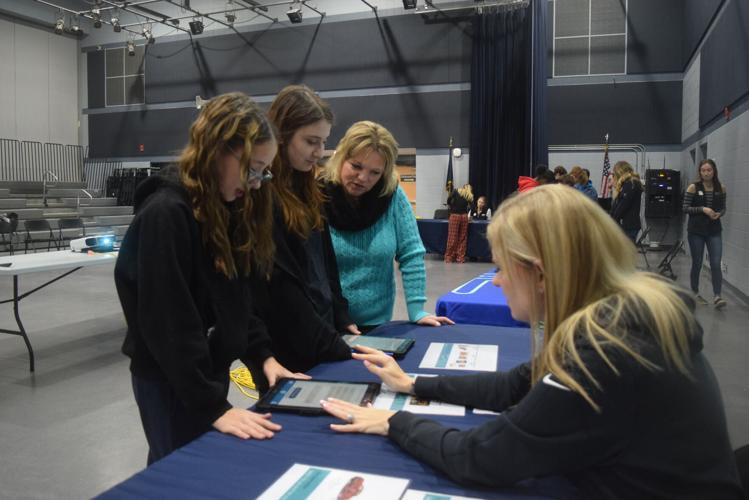
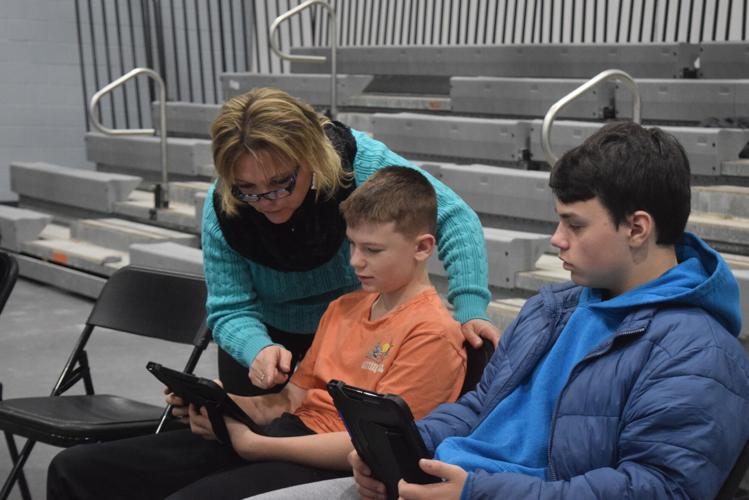
Representatives of Service Credit Union set up shop at the middle school for a program called “Bite of Reality,” where students from Tiffany Dube’s family and consumer science class used an app to choose a fictional job and salary, as well as family members including spouse and children, student loan and credit card debt, and insurance payments.
Dube said the students are part of a new family and consumer science program that kicked off last January. The program includes instruction on financial literacy, nutrition, career exploration and cooking skills.
“I’ve really been trying to do my best to reach out to the community for resources,” Dube said. “In this case, it is financial literacy to teach students about budgeting, credit scores, and the differences between credit and debit.”
Dube said she reached out to Service Credit Union, which works with schools around the state on teaching in a hands-on way about financial literacy. She said it was great to use a free resource in a fun way for students.
“This is the first time I’ve had an organization like this come in, but I have been working with the community on things like career exploration,” she said. “The next thing I want to do is reach out to a financial planner to talk about things like compounding interest. If we can get these kids to start saving now, that is huge.”
The students made their way around the multipurpose room, where representatives were set up as merchants, selling necessities like housing, food, clothing, day care and transportation.
Some students were looking at apartments; others had a house in mind. They had to decide on whether it was groceries or restaurants for dinner, and whether they were getting their clothing at a department store, thrift store, or somewhere high end. Some jobs required a vehicle, but otherwise they could choose whether to take buses or other public transportation to cut costs.
They could also choose to spend money on entertainment, such as a sound systems, or vacations and other luxuries.
The merchants worked to persuade students to buy certain items, and they would have to decide what they could afford to stay within their budgets.
At the end, the students had to pay their bills. Depending on how they managed their money, students could pay off their credit card total, and could also speak with the bank about putting money into savings.
There were a wide range of jobs from which to choose, and naturally, they came with different salaries, which translated to different budgets.
Eighth grader Kasey Paquin chose lawyer as his occupation, and he wanted to live in an apartment with a “realistic” option for furniture. He opted to purchase a truck, and his spouse would drive a sedan. An added cost was providing adult day care for his grandmother.
Paquin thought it was a helpful exercise, and it opened his eyes to some of the costs that come with life.
“I learned that a lot of stuff is really expensive,” Paquin said. “I was surprised about the prices of the vehicles."
Sean Hladick, the manager of community relations for Service Credit Union, said it's important for students to have such education early, so they are ready to make any decisions life throws at them. He said as they enter adulthood, credit union staff try to give them the tools to have a lifelong, healthy relationship with money.
“The idea is to target students right as they are getting their first job,” Hladick said. “They’ll start getting a paycheck, and will have to make these important choices.”
Dube already teaches the students to spend 50% on needs, 30% on wants, and to save the remaining 20% of their income. She was happy to see most students did so during the exercise.
“I really wish I had something like this when I was younger,” Dube said. “When it comes from a teacher or someone else, it’s not as effective. Anytime I can get someone else in the community working with students, that is a great idea. I’m doing my best to make this program fun and exciting. You’ve got to find ways to keep kids engaged.”
Dube said the class recently went to a career expo at Lakes Region Community College, where there was a panel representing various businesses to speak about their experiences. Students will be going twice more, in the spring, for culinary and health science programs, as well.
“They all seem to really be enjoying this,” Dube said. “It’s great exposure. I don’t want to wait until they’re in high school to see their options.”


(0) comments
Welcome to the discussion.
Log In
Keep it Clean. Please avoid obscene, vulgar, lewd, racist or sexually-oriented language.
PLEASE TURN OFF YOUR CAPS LOCK.
Don't Threaten. Threats of harming another person will not be tolerated.
Be Truthful. Don't knowingly lie about anyone or anything.
Be Nice. No racism, sexism or any sort of -ism that is degrading to another person.
Be Proactive. Use the 'Report' link on each comment to let us know of abusive posts.
Share with Us. We'd love to hear eyewitness accounts, the history behind an article.