


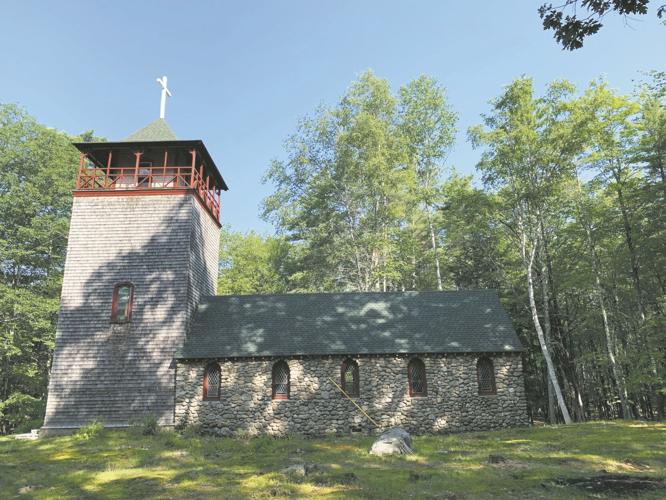

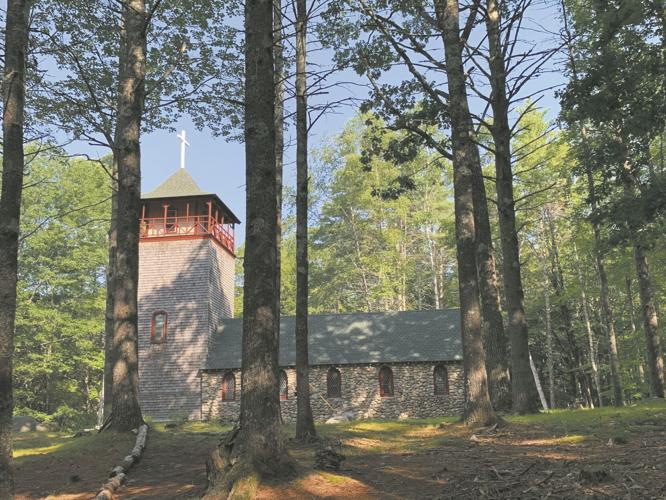
MEREDITH — In about two years, the organization that stewards a chapel at the highest point on Bear Island will celebrate the building’s centennial. Thanks to a recent grant award, St. John’s on-the-Lake is likely to be standing as strong as ever just in time for the party.
St. John’s, a nondenominational chapel, was among 26 recipients of this year’s batch of Land and Cultural Heritage Investment Program grants, totaling $3.3 million.
St. John’s on-the-Lake will get $79,823 of that total, money requested to restore the foundation and tower, to install perimeter drainage and to add lightning protection.
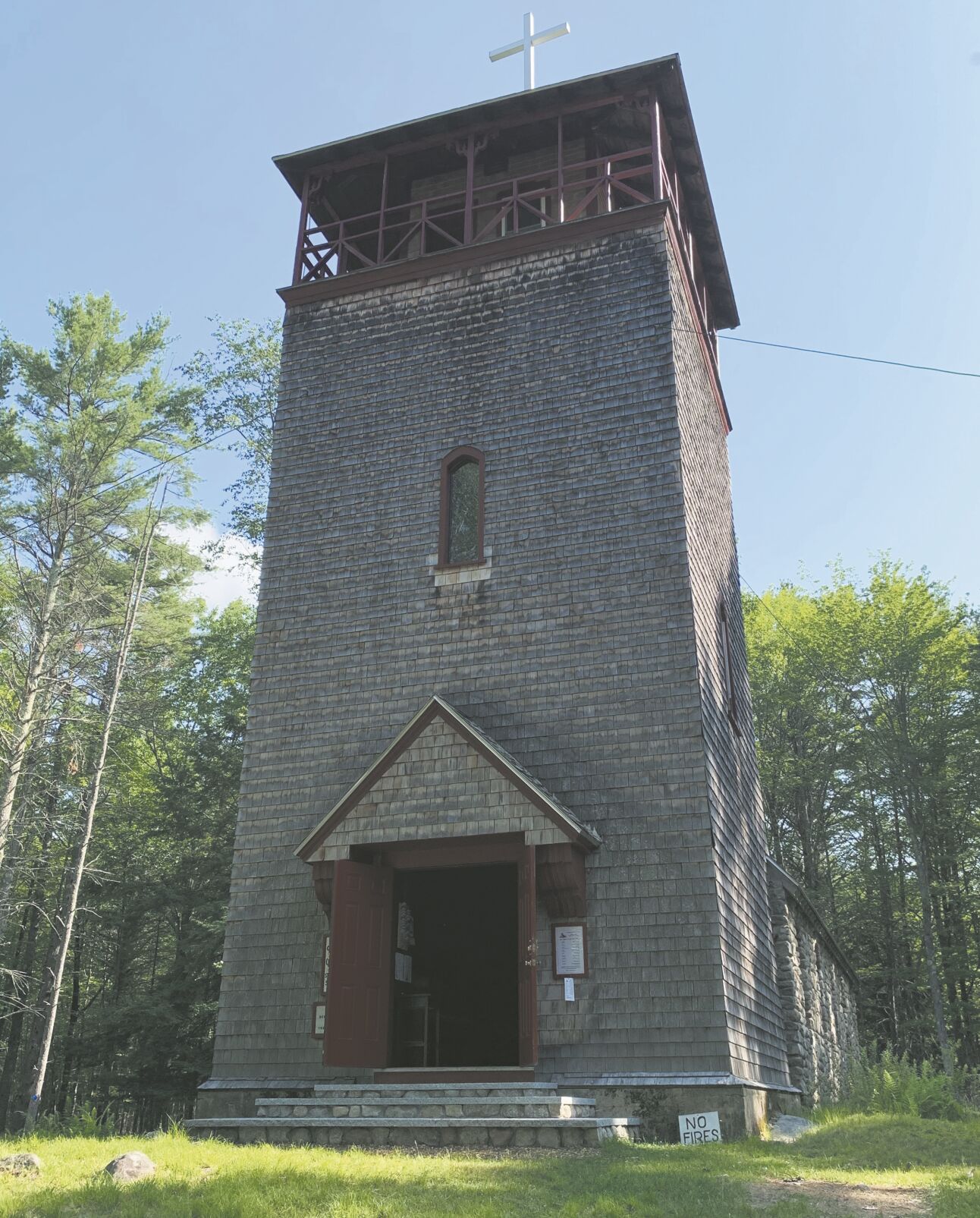
Originally an observation tower built in 1898, St. John’s church was created in 1927 when a small stone chapel was built to adjoin the tower, which was also enclosed at that time with exterior siding.
Ripley Forbes, of the St. John’s on-the-Lake Association, said improvements funded by the work will enable the association to again welcome the public to climb the stairs of the tower — though the growth of pine trees has significantly diminished the breadth of observation possible from its deck. Once offering a commanding view of Lake Winnipesaukee, it hasn’t had any sight lines to the water since the 1960s, he said.
“But there is a view of the canopy of Bear Island,” Forbes quickly added, noting many families had a tradition of climbing the tower as a point of interest during hikes through the island’s trail system, and they’d like to be able to welcome younger generations into that practice.
“The hike up to the chapel, and up the tower stairs and to look out over the island, is a special experience,” Forbes said.
In recent years, the condition of the nonagenarian stairs had caused the association to lock access to the tower.
“Part of this process was to make those stairs safe for people as well as to protect the tower itself with new cedar siding.”
Because the grant requires matching funds, Forbes said fundraising efforts will continue, but he expects work on the tower to begin this spring, with the hope it will be completed sometime in the fall of 2025.
A press release from LCHIP noted the program is funded through surcharges assessed at county registries of deed. Because the funding stream is dependent on the volume of real estate transactions, 2024 was an underwhelming year, and 19 of 45 proposals went unfunded, “leaving some projects unable to move forward and communities facing the very real possibility that farm and recreational lands will be lost, and historically significant buildings permanently damaged,” the release read.
Other Lakes Region LCHIP recipients include:
- The Morse Preserve in Alton, which received $250,000 to enable the Society for the Protection of New Hampshire Forests to add 385 acres to the preserve, bringing it to a total of 1,630 acres just west of Alton Bay
- Red Hill Pond/Handford Conservation area in Sandwich, which received $90,000 to add 96 acres to the existing 821 acres surrounding Red Hill Pond


(1) comment
This is great news...it's a very deserving site.
Welcome to the discussion.
Log In
Keep it Clean. Please avoid obscene, vulgar, lewd, racist or sexually-oriented language.
PLEASE TURN OFF YOUR CAPS LOCK.
Don't Threaten. Threats of harming another person will not be tolerated.
Be Truthful. Don't knowingly lie about anyone or anything.
Be Nice. No racism, sexism or any sort of -ism that is degrading to another person.
Be Proactive. Use the 'Report' link on each comment to let us know of abusive posts.
Share with Us. We'd love to hear eyewitness accounts, the history behind an article.