


LACONIA — New Hampshire might have been the last state in the country to officially declare the third Monday of each year as Martin Luther King Jr. Day, but that fact didn’t translate into any diminished enthusiasm for those who attended a celebration of the civil rights leader held on Sunday at The Colonial Theater.
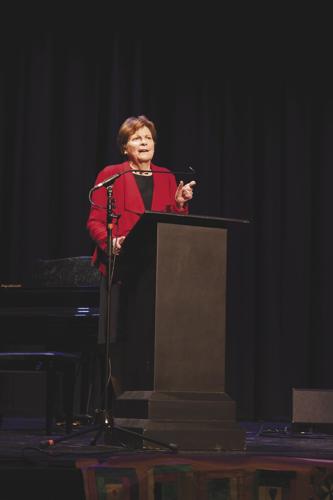
Indeed, two of the people responsible for bringing the Granite State in line with the federal government’s observance of King’s contribution and sacrifice to his country were present in the Main Street theater on Sunday: Former state legislator Alida Millham, who introduced the bill establishing Martin Luther King Jr. Day in New Hampshire, and U.S. Sen. Jeanne Shaheen, who was governor in 1999 when that bill passed, some 15 years after the holiday was already on federal calendars.
Shaheen told the audience signing that bill into law gave her a measure of personal satisfaction.
“Some of you know that I grew up in southwest Missouri. I went to segregated elementary schools, I remember the separate drinking fountains, the theater where if you were African-American, you had to sit in the balcony,” Shaheen said. Then, as a young teacher who was hired in a newly integrated school, she saw how different the education system had been for her students, based on the color of their skin.
“You know, opportunity isn’t a zero sum game. ... Whether we’re talking about African-Americans, or Jews, or Muslims, or the LGTBQ community, opportunity for one means opportunity for all,” Shaheen said. “And that’s the part of the lesson that Dr. Martin Luther King shared with this country.”
The event was held in the Colonial for the first time. In recent years, the event has been held at Laconia Middle School or The Belknap Mill. Hosting it at the historic theater gave organizers a chance to better involve both schools — a middle school chorus performed, and students at the high school provided artwork and cookies, as well as a video tribute to King. Students from Laconia Middle School read speeches and poetry they wrote. Meanwhile, Power Chords, an adult community chorus, also performed and several community members were invited to speak.
One of those, Belknap County Attorney Andrew Livernois, said he has been inspired by King’s optimism, expressed in a speech he gave on the eve of his assassination in Memphis in 1968, that the movement would succeed, even if King didn’t live long enough to see it.
“Dr. King was not afraid of death, because he was a man of faith, and because he had spent his life doing good works, and he was confident that justice will prevail,” Livernois said. He continued, noting the significant changes that the movement brought: the Civil Rights Act of 1964, the Fair Housing Act, the Americans with Disabilities Act, the Lilly Ledbetter Fair Pay Act and the legalization of same sex marriage.
Yet, Livernois noted, there remains much left to do. “There is still too much of a divide between people of different races, people of different religions, different nationalities, different backgrounds, who live, in many ways, in totally different mental and emotional universes,” he said. “And there’s still a deep and pervading sense of not understanding each other, being other, and not part of the same social fabric.” He also noted economic divisions, which he said are due in part to centuries of slavery, followed by another century of legal discrimination, the effects of which are still apparent in the realities of many Americans today.
“Sadly, the forces of division and entitlements are still there, sometimes just under the surface, waiting to burst forth,” Livernois said. “There are still white supremacist and neo-Nazi groups out there, and hate groups active in our community that need to be stopped.”
Livernois said he identified four principles he has taken from King’s writing and speeches which he endeavors to apply to his own life: staying awake and aware of injustices and to new ways of thinking; take to heart the importance of courage, even when doing the right thing means making enemies; to be motivated by love; and never forgetting the lessons of history.
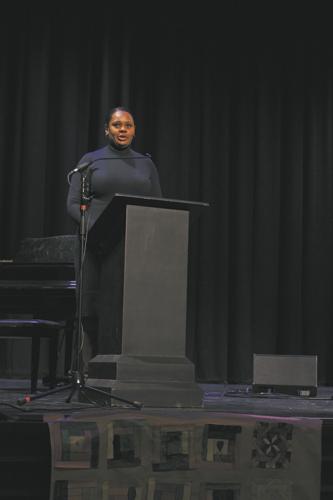
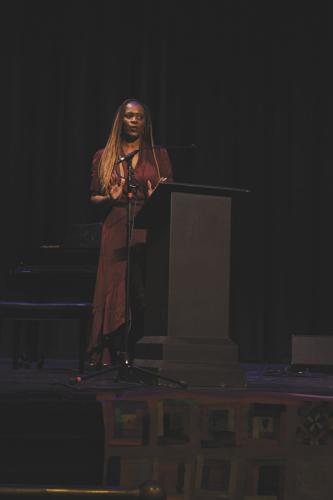
LaToya Beck, a member of the Laconia School Board, reminded the crowd that King’s dream was based on love. “Our love for our community, our love for our friends, and our love for our families,” Beck said. While there may be ways to divide members of the community, she said a shared love for the community ties all of its members together.
“I’ve noticed countless times that when there’s a need we come together, we brainstorm and fulfill that need,” Beck said. “Of course, not everything can be fixed overnight. But I do believe with the help of others within our community, like we have shown before, that we would get together and fulfill that need.”
Downtown business owner Jose Diaz told the audience he grew up in New York City in a multicultural environment, and it wasn’t until he grew older that he realized that not every American was afforded the same opportunities.
“Depending on your ethnicity, your socioeconomic situation, you didn’t have the opportunities that some folks are given,” Diaz said. King desired for all Americans to have access to the same opportunities, and he did it in a way that leveraged the new technology of the time — television — with the understanding the average American viewer would be made uncomfortable by the sight of government oppression of peaceful demonstrators.
“Dr. King’s tireless and courageous leadership challenged us as a society to do better,” Diaz said, and said the best way to honor his legacy was for everyone in the theater to find their own way to continue that work.
Francine Sullivan, a native of Detroit who works at Navigating Recovery in Laconia, said, “I get to work with a really great community here, and it wouldn’t be possible if it wasn’t for Martin Luther King. ... But I think if he was here today, he would be really proud to see this and we should be proud of ourselves in the community.”
In her view, she sees the world King described in his “I Have a Dream” speech: white and Black people working together, valuing in one another what they bring to the community, rather than the color of their skin.
“It’s wonderful that we’re together like this. He said that we come on different ships but we’re all on the same boat together, and we are. Laconia is our boat,” Sullivan said. “We need this community all together to pull this boat together. And I think we’re doing a good job and I hope we continue to do it. I just hope we continue to do that, and do it without prejudice.”
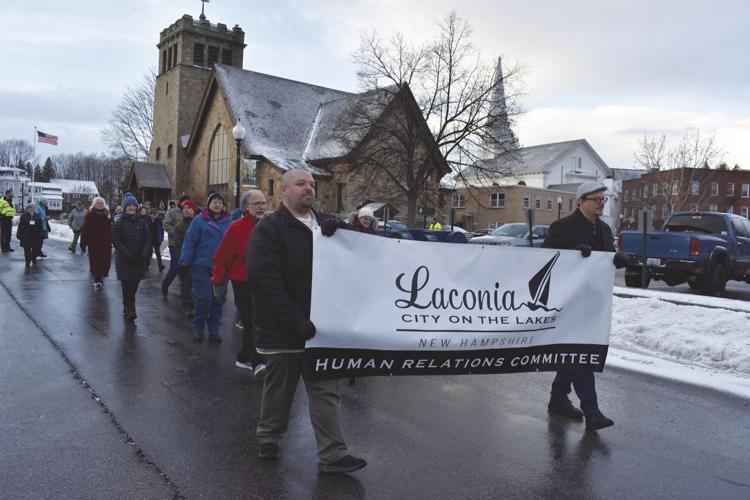
After the celebration, attendees were invited to join a march through downtown. Richard Littlefield, a member of the Human Relations Committee and one of the organizers of the march, said he said he hoped the goal would be an expression of, “solidarity ... against hate, for love, for compassion, and for just the ability to be genuine.”


(0) comments
Welcome to the discussion.
Log In
Keep it Clean. Please avoid obscene, vulgar, lewd, racist or sexually-oriented language.
PLEASE TURN OFF YOUR CAPS LOCK.
Don't Threaten. Threats of harming another person will not be tolerated.
Be Truthful. Don't knowingly lie about anyone or anything.
Be Nice. No racism, sexism or any sort of -ism that is degrading to another person.
Be Proactive. Use the 'Report' link on each comment to let us know of abusive posts.
Share with Us. We'd love to hear eyewitness accounts, the history behind an article.