


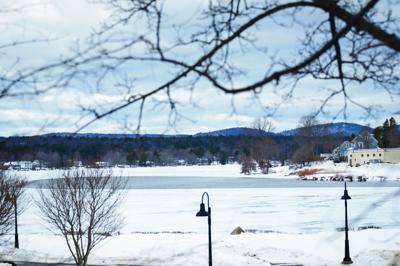
Despite a couple of warmer days in a row, the ice on Lake Winnipesaukee is still thick as can be.
The weekend brought temperatures above freezing throughout the Lakes Region for the first time in recent memory, which intuition may tell you could have had an effect on the thickness of the ice. As it turns out, that’s not the case.
Most of Lake Winnipesaukee is covered by 15 to 18 inches of ice, fishing guide Tim Moore of Tim Moore Outdoors said Wednesday morning while out near Bear Island.
Moore spends the winter season on Winnipesaukee almost exclusively, trudging out and showing anglers the ropes around the many bays and coves the Big Lake has to offer.
The main difference he’s noticed over the past few days is the layer of snow on top of the ice, about a foot deep, is melting in places, leaving some areas slushy and introducing a modicum of difficulty to traversing the icy landscape by all-terrain vehicle.
Temperatures in and around Laconia are expected to dip back below freezing for extended periods of time, potentially extending the season of ice fishing, skating and generally getting out and onto the frozen lakes and ponds of the Lakes Region.
Given the experience of anglers last year, this season started out with a bang, Moore said.
“Twelve inches of ice felt like a win for everybody,” he said.
The areas of Lake Winnipesaukee with the deepest ice tend to be its narrow bays, such as in Alton, Center Harbor, 19-Mile and Moultonborough. Areas where a pressure ridge forms and ice along the shoreline are generally the first to thaw, Moore said.
Though conditions out on the ice are good, the waters underneath potentially are not.
“It’s been slower than expected,” Moore said. “We’ve been catching fish, but it’s been slower.”
The spiny water flea — an invasive species first documented on Sept. 13, 2023 in the Broads and later confirmed in the waters in Alton and Wolfeboro — are zooplankton native to Europe and Asia. They were first introduced to the U.S. in the Great Lakes of the midwest in the 1980s, according to the New Hampshire Department of Environmental Services. They most likely made their way to Lake Winnipesaukee on recreational or fishing gear, or in the bilge of a boat.
The only way to mitigate their introduction to lakes, ponds and rivers is by cleaning, draining and drying all vessels and equipment after leaving a waterbody.
And last summer, the fish in Lake Winnipesaukee were full of them, Moore said, pondering if unusually high temperatures last summer — the same which contributed to severe blooms of cyanobacteria all over the lake — could have played a role in their proliferation.
“All the lakes are super skinny,” he said, referring to the amount of fish caught through the ice this winter.
Even so, other recreational activities on the lake including hockey or skating should be done with caution, he said. Enthusiasts should stick to well-traveled routes and double-check the thickness of the ice as they venture out and onto it. Visible heaves on the ice, indicative of pressure ridges, should be checked before crossing.
“This year the pressure ridges don’t seem to be giving people much of a problem,” he said.
Officers with New Hampshire Fish and Game have a few recommendations of their own: never assume the ice is safe, always fish with another person and avoid the shoreline if it’s cracked or squishy.
New ice is usually stronger than old ice, and wind and water currents can cause the integrity of it to deteriorate. According to the NH Fish and Game website, officers recommend not gathering in large groups or driving vehicles onto the ice and if you were to fall in, reach for solid ice and kick and roll your way to safety.
Laconia Fire Department Assistant Chief Jay Ellingson echoed many of NH Fish and Game officers' recommendations.
“We haven’t gone on any ice rescue calls recently,” he said.
With the warmer weather, it’s possible there are areas which could become thin, he said, and anyone going out on the ice should let someone know where they’re headed and when they expect to return — better yet, bring a buddy with you. Wearing a personal flotation device or floating swimming gear could also help reduce some of the risks.
“We’ll never say if the ice is safe because there’s so many variables,” Ellingson said Wednesday morning.
And that large hole in the ice on Lake Opechee which never seems to freeze? That’s where the dam lets water out, through the dam itself, through an underground pipe and through the fish ladder. Rapidly moving waters don’t freeze as easily as the still, calm depths of the rest of the lake.


(0) comments
Welcome to the discussion.
Log In
Keep it Clean. Please avoid obscene, vulgar, lewd, racist or sexually-oriented language.
PLEASE TURN OFF YOUR CAPS LOCK.
Don't Threaten. Threats of harming another person will not be tolerated.
Be Truthful. Don't knowingly lie about anyone or anything.
Be Nice. No racism, sexism or any sort of -ism that is degrading to another person.
Be Proactive. Use the 'Report' link on each comment to let us know of abusive posts.
Share with Us. We'd love to hear eyewitness accounts, the history behind an article.