


GILFORD — Someone once said, "Submarine life, most of the time, is hours and hours of boredom with intermittent terror thrown in to keep you on your toes."
Jack Sousae can relate to that. He spent almost one-third of his life involved – one way or another – in the Navy’s “Silent Service,” a service full of rich culture, honed over years of stuffing busloads of sailors into steel tubes for months on end.
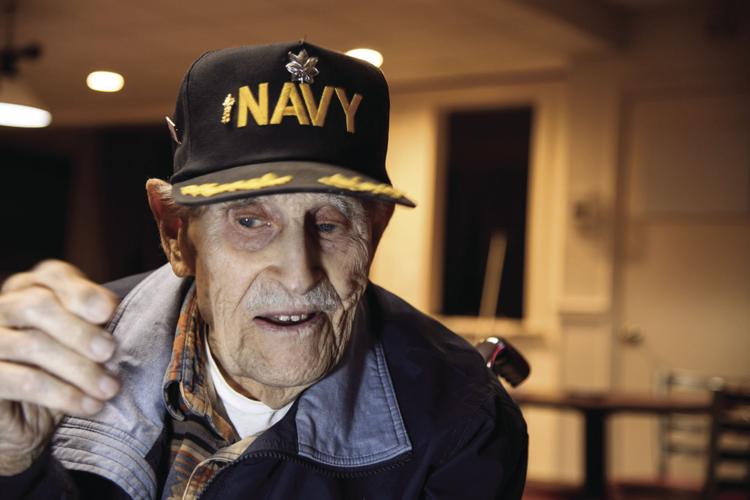
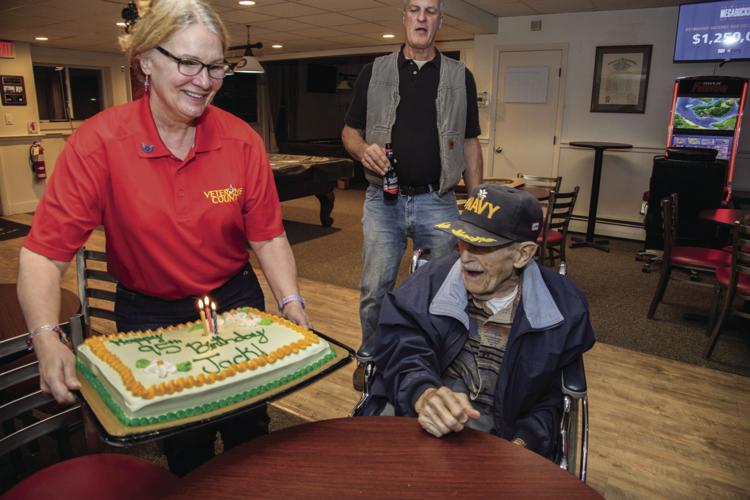
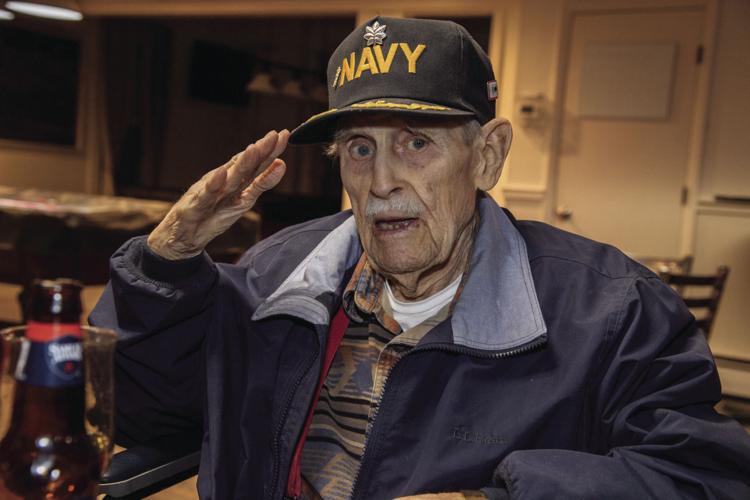
The occasion of Sousae’s 95th birthday – Thursday – was an opportunity for him to think back upon his military career, which started during World War II and ended while the U.S. was still fighting in Vietnam.
During those 30 years in uniform, Sousae was a witness to one of the biggest technological transformations in the Navy at the time.
Sousae enlisted, at age 19, in 1943. After training as a torpedoman, he was assigned to the USS Seal, a 308-foot-long submarine with a five-eighths-inch thick hull, capable of reaching a top speed of 21 knots (24 mph).
“It was a thin-skinned boat. We spent most of the time looking for Japanese merchant ships to sink,” Sousae recalled.
During his time onboard, the Seal mainly patrolled the Kuril Islands, located between the Japanese Home Islands and Russia.
By the time the war was over, Sousae had reached the rank of chief petty officer, the highest non-commissioned officer rank in the Navy at the time.
After that his career path made an important change which shaped his remaining years in the Navy.
In the 1950s, Sousae was sent to Union College in Schenectady, New York, where he got a crash course in engineering. “Three years of college in six months,” he called it. After that, he was sent to the Knolls Atomic Power Laboratory outside Schenectady, where he learned first-hand about the creation of electricity from nuclear power, the technology that would be used in the Navy’s nuclear-powered submarines, which were then on the drawing boards.
The facility was a nuclear power plant encased in a sphere. The plant was able to produce enough electricity to power the entire town of Saratoga Springs nearby.
It was at that time that Sousae received a Navy commission as a limited duty officer. Like other LDOs, Sousae was selected based on his skill and expertise, and was not required to have a college degree.
From then on, Sousae spent a lot of time stationed at the Portsmouth Naval Shipyard, where he helped oversee the construction of nuclear power plants for two submarines that were under construction at the yard. In time he moved up to be in charge of an entire submarine construction or overhaul project.
He also returned to sea duty for a time to become qualified as a submarine officer.
Sousae said proudly that, as far as he knows, he’s the only Navy submariner who has received two silver dolphins badges — for enlisted men — and one gold badge — for officers.
Though the submarines he served with during the Korean and Vietnam wars were always on standby for combat duty, they were never deployed from their base in Groton, Connecticut.
Toward the end of his career, Sousae was the assistant to the repair officer on a Navy submarine tender — a floating repair facility — where he oversaw job orders for nuclear-power ballistic missile submarines which were in port at the time.
When he retired after 30 years later – on Nov. 1, 1972 – he was back at the Portsmouth shipyard.
The first submarine he served on had a crew of 85 officers and men. By the early 1970s, submarines had grown in size, displacing 60,000 tons, and were manned by a crew of about 130.
For going on three years, Sousae has lived alone in a small house in a condominium development off Watson Road in Gilford.
His wife died several years ago, and their only child, a daughter, has also passed away. His only family is a grandson who lives on Long Island who comes up to visit him just about every month.
Though he needs to use a motorized scooter to get around the house, he takes care of his own needs. He’s proud of living his golden years simply.
“In 1990, I promised myself I would never buy a new wardrobe or new furniture,” he said pointing to the skirt around the bottom of his living room sofa, held together with packing tape.
He’s proud of his Navy service. His full dress-uniform sword hangs on the wall in the front hallway.
The Navy has changed tremendously since he hung up his uniform more than 40 years ago. Not all of those changes have been for the better, in his view. When a visitor mentions that there are now women serving at sea, he interjected “that’s too bad.”
All in all, he wouldn’t change any of his life experiences for the world.


(0) comments
Welcome to the discussion.
Log In
Keep it Clean. Please avoid obscene, vulgar, lewd, racist or sexually-oriented language.
PLEASE TURN OFF YOUR CAPS LOCK.
Don't Threaten. Threats of harming another person will not be tolerated.
Be Truthful. Don't knowingly lie about anyone or anything.
Be Nice. No racism, sexism or any sort of -ism that is degrading to another person.
Be Proactive. Use the 'Report' link on each comment to let us know of abusive posts.
Share with Us. We'd love to hear eyewitness accounts, the history behind an article.