


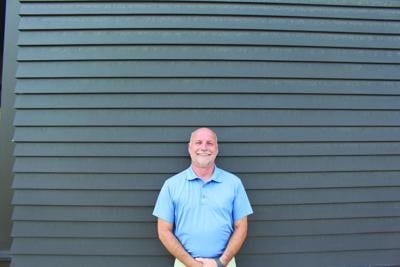
LACONIA — Sen. Timothy Lang Sr. (R-Sanbornton) has spent decades serving his community, and has no plans to stop anytime soon, as he runs for a third term in New Hampshire’s 2nd Senate District.
Lang previously serving three terms in the Statehouse.
He will face Kurt Webber, a Democrat, challenging his seat. Lang is running unopposed in the primary Tuesday, Sept. 8, and will face Webber in the General Election on Tuesday, Nov. 3.
Who is Lang?
Lang was born in New Jersey, and moved to New Hampshire with his parents in 1973, spending many childhood years in the Granite State. He spent his high school years living in Anchorage, Alaska, and went into law enforcement for 11 years. In 1987, he came back to New Hampshire, and has been here ever since, working in technology and engineering. Currently, Lang is the senior IT manager at Live Nation Entertainment, managing tech for shows across the Northeast.
Lang said his community involvement and political activity started with a habit of saying "yes." He was raised by parents who championed community service. His mother was a supervisor of the checklist, and his father worked at the local transfer station.
Lang has four children, all adults now, who graduated from the Winnisquam Regional School District. He ended up on the school board for six years, and serving as a budget committee member for two. Lang also spent a decade on Sanbornton’s zoning board.
On the school board, the middle school administrators planned to cut the soccer B-team, because there was no coach. Lang volunteered, and coached for six years.
When Lang ran a computer company, town leaders asked to use his parking lot for the farmers market. He agreed, and the next year was asked to be the new farmers market director.
“Even before that, within six months, the youth diversion program in downtown Tilton approached me and said, 'Would you please serve on our board of directors? We hear you like saying yes,'” Lang said.
His path to serving as town moderator in Sanbornton was similar. Lang was present at every Town Meeting, so after a newly elected moderator moved after three months in the position, Lang was asked to take over for a year. Then someone else was elected, and resigned after a few months, due to illness. Lang was again asked to step in, then encouraged to run, and has been moderator for 12 years.
In 2016, Lang was elected to the Statehouse. He served three terms, describing himself as a “bit of a utility player,” serving on the Ways and Means and Election Law committees. Typically, representatives are only tied to one committee. In the Senate, many serve on multiple committees.
Lang was approached to run for Senate on his doorstep. Former Sen. Bob Giuda told him he was retiring, and wanted Lang to take his place. Giuda was chair of the Senate Ways and Means Committee, and wanted somebody who would be able to understand New Hampshire’s tax structure. Lang won his first term in a three-way primary, in 2022.
Lang serves as chair of the Senate Ways and Means and Joint Administrative Rules committees, vice chair of the Election Law & Municipal Affairs Committee, and on the Senate Education Committee.
Lang said he was also assigned to the Executive Departments and Administration Committee, which reviews legislation regarding state agency rules and operations.
Taxes and housing
Lang said taxes are a large conversation right now, and although New Hampshire relies heavily on property taxes, when you actually look at the citizen tax burden, we're third lowest.
“We just happen to burden it, and you get a big bill twice a year, right? So, obviously taxation is going to be one. I'm not a believer in income taxes or sales taxes. I think those kinds of taxes diminish New Hampshire,” Lang said. “And, if people come to New Hampshire for a reason, the Live Free or Die state, you know, and it’s not just a motto, it's a way of life."
Lang said we should not even be thinking about income tax.
“Every state that’s implemented sales and income taxes for the purposes of lowering property taxes have achieved neither. They’ve created their tax, and then property taxes stay the same.”
Last year, Lang introduced a constitutional amendment to the state’s tax policy, attempting to keep income taxes off the table. If reelected, Lang said, it “will be back.”
Lang said he thinks housing should be more affordable, but does not believe the state should be able to set home prices or enforce rent control, nor dictate how much profit you can make.
Lang said the best thing the state can do is get out of the way of developers, and reduce regulation.
“The last time I saw a statistic, the average cost of regulatory burden on building a single-family home was almost $100,000, to get through the entire process of permitting and everything else. Where do you think that price goes? Right onto the price of the house,” Lang said. “So, If we can reduce the regulatory burden, so the cost of the regulatory process isn't so big, then we can potentially lower some prices. Not a lot, but that's the only way the state can, I think, really deal with affordable housing, is by reducing the regulatory burden.”
Education
Lang authored House Bill 751, heard in the 2025 Legislative session. The bill proposed parents be authorized to enroll their children in any public school.
Lang said he thinks parents deserve a choice, because not every kid learns the same way.
“I had a public school teacher approach me, and her children learned by music. That's what they went to school for. They maintained their grades in all classes, so they could do music. And the school that they were in had a very limited music program. They weren't able to hire teachers,” Lang said. “They had a very rudimentary music program, and she asked her school to allow her kid to go to Laconia, and the school district said 'no,' and she didn't have any other choice other than to pull her kids out and go to private school.”
This led Lang to sponsor HB 751, modifying the open enrollment law.
“I just believe that parents deserve choice, and it shouldn't be limited to either you go to the public school you're assigned to by zip code, or you have to leave the public school system altogether,” Lang said. “I think that if we have an obligation to educate, then the public school system should be for everybody, and you should be able to pick your best public school that works for you, or parents should be able to pick what works for their child.”
Serving on the Winnisquam Regional School District Board and Budget Committee, and Sanbornton Budget Committee, Lang said the education funding system is broken.
“I rewrote it in my first term in the Senate. I was able to work with Sen. [Jeb] Bradley, the Senate president at the time, to be able to take lead on rewriting that formula. We wanted to change it back to a student centric formula,” he said. “We had a problem with what’s called stabilization grants back then, as we've been having declining enrollments across the board.”
Lang changed the funding model to have two distinct “sides,” to ensure funding is going directly to students’ needs and not just flat rates. The “left-hand side” is base aid, with modifiers for students who qualify for free and reduced lunch, special education, or English as a second language.
On the “right-hand side” Lang’s model aims to deal with property-poor cities like Franklin, Claremont, and Berlin. The formula compares the number of low-income students against the town’s property valuation per student.
For the middle class, the grant program prevents average residential communities from being priced out by local property taxes.
Collaboration
“I have a collaborative approach, but there are some things I won't move on. That's just the nature of politics, right?” he said. “You have certain beliefs, and then you have other areas where we're willing to have a conversation, you know, where can we find common ground?”
Lang said he discussed and modified bills with deputy Democratic leader Sens. Cindy Rosenwald (D-Nashua), Tara Reardon (D-Concord), and Minority Leader Rebecca Perkins-Kwoka (D-Portsmouth).
“The worst kept secret in the state Legislature is that about 80% of the bills are unanimous. We agree, right? We all agree this is a really good idea, or we all agree this is a really bad idea. It's about 20% of the bills, maybe 25% of the bills that are partisan.
“Anybody who knows me, I'll talk to anybody. Maybe we're going to agree, maybe we're not, maybe we can find common ground.”


(0) comments
Welcome to the discussion.
Log In
Keep it Clean. Please avoid obscene, vulgar, lewd, racist or sexually-oriented language.
PLEASE TURN OFF YOUR CAPS LOCK.
Don't Threaten. Threats of harming another person will not be tolerated.
Be Truthful. Don't knowingly lie about anyone or anything.
Be Nice. No racism, sexism or any sort of -ism that is degrading to another person.
Be Proactive. Use the 'Report' link on each comment to let us know of abusive posts.
Share with Us. We'd love to hear eyewitness accounts, the history behind an article.