


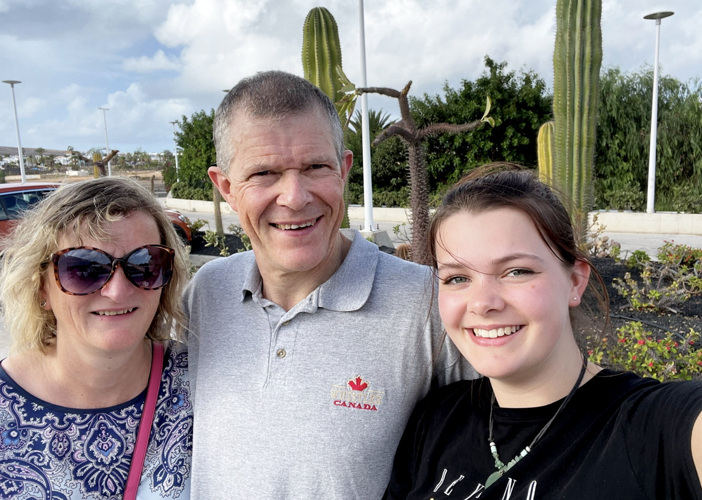
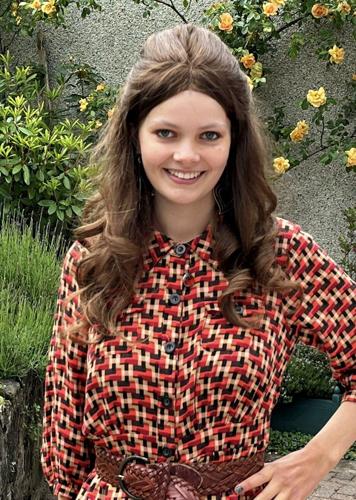
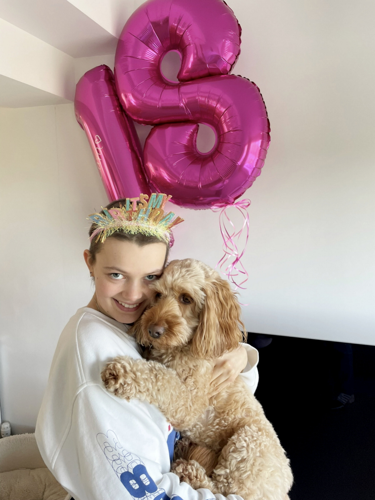
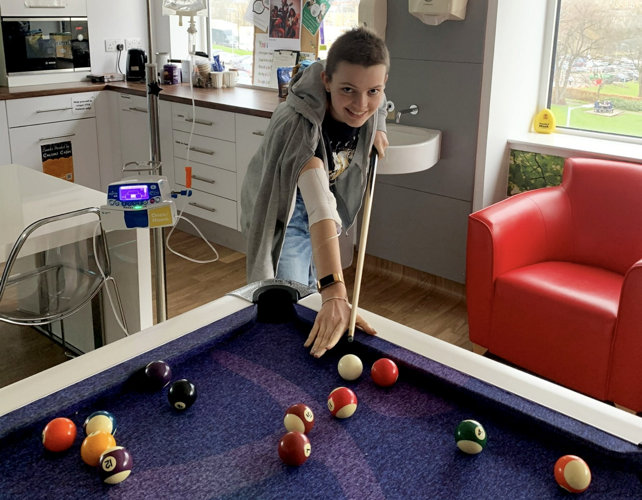
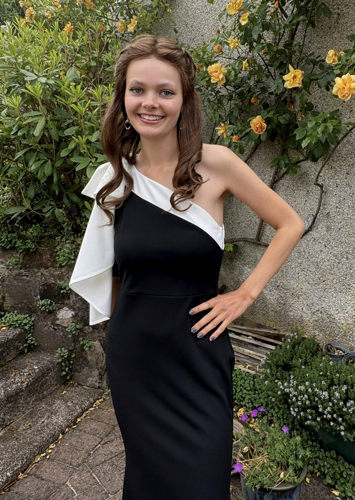

Cara started complaining of migraines in the spring of 2024. (Graham Hood via SWNS)
By Jack Fifield
A teenage girl died after her "exam stress headaches" turned out to be cancer.
Dad Graham Hood, 62, says daughter Cara started complaining of migraines in the spring of 2024 - which the family thought were related to the pressure of upcoming tests.
But the headaches persisted through the summer and, in August, they were given the devastating news that she had medulloblastoma - a type of brain tumor.
Cara, 18, bravely underwent chemotherapy and radiotherapy but her condition deteriorated over the next year.
She died in hospital on November 8, 2025.
Graham is speaking out ahead of cycling 56.7 miles (91.2 km) with son Rory, 21, in memory of Cara.
The dad, who works in customer support for a software company, said: “She was doing her Higher exams, in the springtime in 2024.
“She was complaining about headaches, which we assumed stress related with her doing her exams.

Cara, 18, bravely underwent chemotherapy and radiotherapy but her condition deteriorated over the next year. (Graham Hood via SWNS)
“She got through her exams, and the headaches didn’t stop.”
Throughout July and into the beginning of August, community pharmacist mum Lyndsay, 55, and dad Graham took Cara to see the doctor multiple times.
She was given blood tests, with both parents worried as she was being sick with no apparent cause.
Graham said: “It was a locum GP when I took her.
“The locum GP said ‘it’s most likely migraines, but if you want to cover all the bases then we could see about getting a CT scan for you, if you would like’.
“[Cara] said ‘OK, I’ll do that’.”
The teenager was booked in for a CT scan the same day, August 8, at the Queen Elizabeth Hospital’s same-day urgent care centre in Glasgow.
Graham said: “When she was being taken away for the CT scan, the doctor said ‘I’m sure it will just be migraine, we’ll just need to look at different migraine medication for you’.
“But then when he came back, he said ‘I’m afraid we’ve found something that’s not right’ and got one of his colleagues to go through it with her.”
Cara had been diagnosed with a brain tumor, affecting the part of her brain that controls the sickness reflex.

Cara died in the hospital on November 8, 2025. (Graham Hood via SWNS)
The tumor was removed the next day in an operation.
As the family thought the tumor was non-malignant, dad Graham thought Cara would be ‘back in school in a couple of months’.
Graham said: “One of the doctors on the night said ‘I’ve seen the scans, it looks good, and that reassured us.
“We thought it was non-malignant’.
“But on the 21st of August we were told by the specialist dealing with her it was an aggressive cancer – Medulloblastoma.
“They weren’t expecting that, because Cara at that point was 17, and Medulloblastoma is more commonly found in younger children.”
She was referred for further treatment, including six weeks of proton beam therapy, a type of radiotherapy, carried out at The Christie hospital in Manchester that year, and five rounds of chemotherapy starting in early 2025.
But, Cara, who turned 18 in March 2025, started getting sick again.
While the family initially put her symptoms down to a reaction to the chemo, a quarterly MRI showed differently.


On September 23, they were told the cancer had returned to her brain and her spine.
Graham said: “We were devastated.
“Because it was just a routine appointment, if there can be such a thing, it was just my wife who went in with her.
“She phoned me and said that Cara had to be kept in overnight because she needed another MRI, and that she wanted me to bring in overnight stuff because she hadn’t been expecting to stay overnight.

(Graham Hood via SWNS)
“I went in on the afternoon of the 23rd.
“She met me in the car park and said ‘prepare yourself for bad news’. That’s when she told me.
“My wife and I were devastated, but Cara was stronger than we were.
“I was a mess. Cara took it with stoicism and courage.”
A week later, on September 30, Cara became disorientated and couldn’t understand things her mum and dad were saying to her.
They took her back to the Queen Elizabeth Hospital where the family learned that she would have a ‘do not resuscitate’ order on her file.
Graham said: “That was probably the lowest point – we thought that was it, she was gone.”
The next morning, she was transferred to the Beatson West of Scotland Cancer Centre, where she was given six weeks of specialist care.
She passed away in the early hours of November 8.
Dad Graham and Cara’s brother Rory are now both riding in Sir Chris Hoy’s ‘Tour de 4’ to raise money for Brain Tumour Research.
Graham has already raised more than $6,700 in donations ahead of the ride, which sets off from the Sir Chris Hoy Velodrome on September 6.

(Graham Hood via SWNS)
The dad said: “Brain tumor research is pretty much underfunded.
“I don’t know why there’s less focus on that particular area of illness, but there just is.”
He added: “It’s difficult, because if you look back there were signs.
“She maybe complained about her balance a wee bit.
“But, there weren’t any signs that you’d say ‘right, she must have a brain tumor’.
“You just don’t expect that kind of thing.
“I’m sure you can imagine, my wife and I have both gone back in our minds and thought ‘if we could go back, what would we do differently?’
“As soon as she started saying ‘I’ve got a sore head’, or ‘I’m a wee bit off balance’, should we have gone to the doctor then? What would the doctor have done? I don’t think they’d have done anything.
“Could we have absolutely insisted on getting an MRI at that point, and would anything have even shown up?
“It’s difficult to know what we would have done differently.
“The positive I can spin on it is that she lived a healthy, happy life for her first 17 years, and Medulloblastoma is an illness that typically affects younger children.
“Other families who go through this are likely to go through it at a younger age, and even if the outcome is successful, the outcome often includes long-term effects from the treatment.
“So, it’s really those families I feel for, who go through it with a younger child.”


(0) comments
Welcome to the discussion.
Log In
Keep it Clean. Please avoid obscene, vulgar, lewd, racist or sexually-oriented language.
PLEASE TURN OFF YOUR CAPS LOCK.
Don't Threaten. Threats of harming another person will not be tolerated.
Be Truthful. Don't knowingly lie about anyone or anything.
Be Nice. No racism, sexism or any sort of -ism that is degrading to another person.
Be Proactive. Use the 'Report' link on each comment to let us know of abusive posts.
Share with Us. We'd love to hear eyewitness accounts, the history behind an article.