


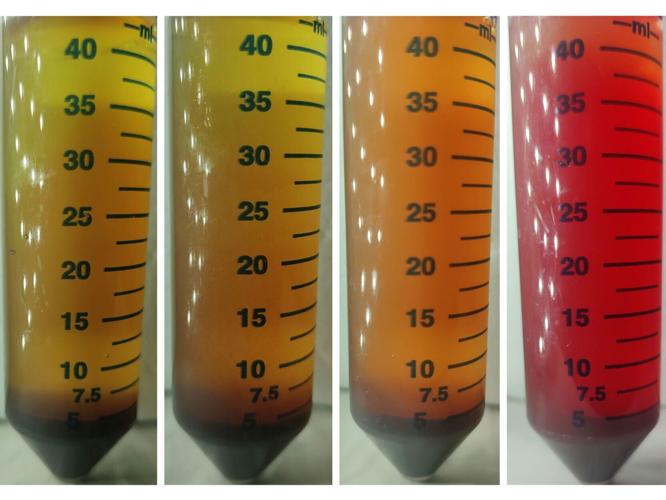


The figure showcases the brothÂused to monitor red blood cell depletion in whole blood spiked with one colony-forming-unit of E. coli bacteria, each incubated at different orbital shaking speeds left to right: 0 RPM, 65 RPM, 120 RPM and 200 RPM after four hours of incubation. This culturing raises a bacteria-rich, plasma-like layer of bacteria to the top of the vials, while clusters of stuck blood cells known as a Rouleaux formation sink to the bottom. (Pak Kin Wong via SWNS)
By Stephen Beech
Sepsis could be diagnosed in just seven hours rather than days — saving thousands of lives every year, according to new research.
A newly developed approach drastically shortens the process of diagnosing the potentially deadly condition, say American scientists.
Sepsis, which stems from the body trying to fight off an infection, affects up to 250,000 people in the U.K. each year, causing about 44,000 deaths.
It is more common than heart attacks and can lead to severe complications if not treated promptly.
But, despite the severity of the condition which can kill in just 12 hours, it takes between two and seven days for most traditional approaches to definitively identify sepsis-causing bacteria in blood infections.
Now scientists have developed a way to condense the diagnosis timeline.

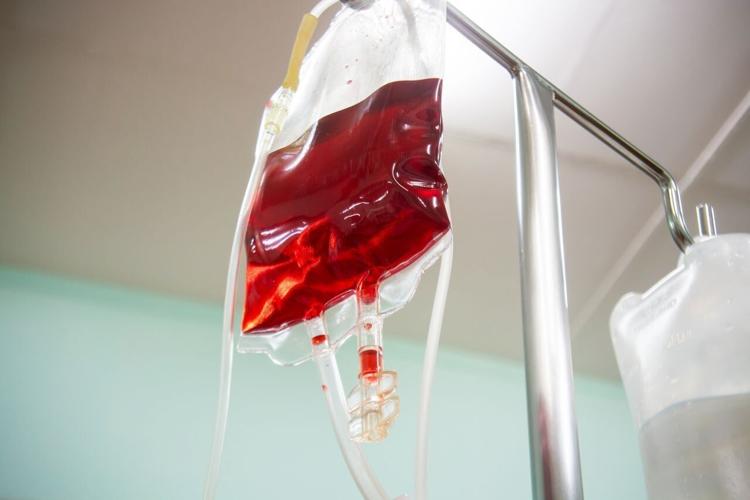
(Photo by Stephen Andrews via Pexels)
The approach rapidly grows the bacteria present in collected blood samples, intermittently analyzing the samples with advanced techniques that help identify the specific pathogens causing infection.
Researchers say their method, described in the journal Science Advances, enables much faster diagnosis and could help clinical decision-making that avoids worsening antibiotic resistance in the bacterial strains causing infections.
Corresponding author Pak Kin Wong said: "For a physician, 'what actually caused this infection and how should it be treated?' are the most important questions when it comes to the timely management of a bloodstream infection.
"We are developing a comprehensive diagnostic platform that rapidly tells physicians both the specific bacteria causing a bloodstream infection, as well as the ideal antibiotic to treat the infection, before sepsis ever sets in."
With a bloodstream infection, he explained that it is "critical" to find and neutralize the cause as quickly as possible, before it triggers a septic response from the body.
As well as detecting the presence of bacteria, Wong says doctors must also identify the specific pathogens, as well as the best antibiotic for treatment.
He says the risk of a false positive or negative complicate the situation as every hour counts when treating a bloodstream infection.
Wong, of Pennsylvania State University, said: "This is not like a Covid test, where we are checking to see a specific virus is present in a patient's system.
"Many different bacteria can cause sepsis, and they may respond differently to treatment.
"Therefore, analysis must be thorough to ensure the best treatment is prescribed."

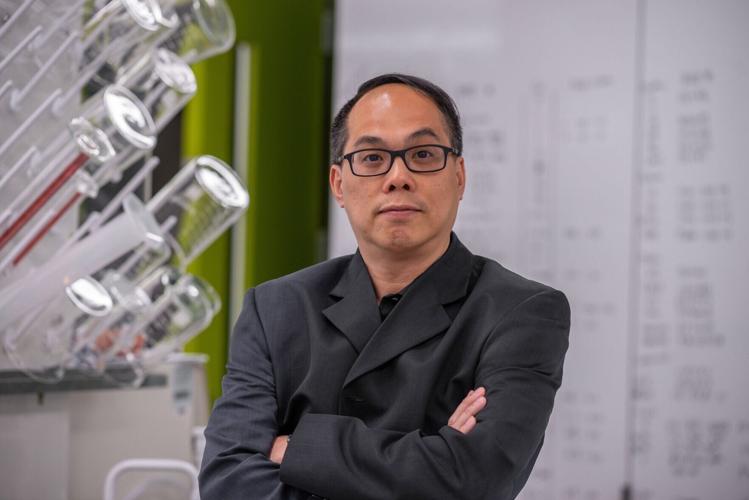
Pak Kin Wong, professor of biomedical engineering, of mechanical engineering and corresponding author on the paper, leads the Systematic Bioengineering Laboratory at Penn State. His lab investigates cutting-edge approaches to precision medicine, including bacterial pathogen and microbiota characterization and personalized immunotherapy. (Kate Myers / Penn State via SWNS)
Bloodstream infections are responsible for about 40% of all sepsis cases that lead to hospitalization.
The complex biological makeup of the blood and the low pathogen loads needed to trigger sepsis make pinning the cause of a bloodstream infection time-consuming.
To identify the bacteria causing a bloodstream infection, current best practices require bacterial culturing where blood samples are enriched over a few days so that present bacteria grow to measurable levels.
Then, technicians further analyze the samples to identify the specific bacteria, a process that adds another 24 to 48 hours to diagnosis.
Streamlining bloodstream infection diagnosis is not a new idea, with several commercial products offering culture-free blood testing already on the market.


But, to reduce diagnostic time, Wong says those products provide less comprehensive and less sensitive readings.
To accelerate diagnosis without sacrificing accuracy, the team had to rethink culturing.
Traditionally, bacterial growth in a cultured blood sample is measured through the carbon dioxide released by the bacteria.
When the change in carbon dioxide levels confirms the presence of pathogens, bacteria are separated from the blood sample and analyzed.
The team's new approach, called STREAM, fast-tracks the culturing by facilitating rapid bacterial growth, while isolating and analyzing the pathogens inside simultaneously.
Blood samples are mixed in a specialized "broth" that separates whole blood cells from the individual bacteria found in the sample during culturing.

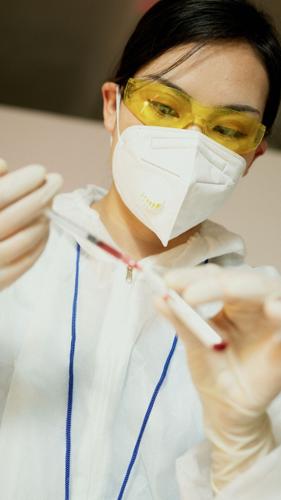
(Photo by panumas nikhomkhai via Pexels)
Molecular analysis — a process known as barcoding — allows researchers to detect tiny fragments of genetic information from isolated bacteria.
From the smaller samples collected intermittently during culturing, the researchers can name the specific bacterial species present.
Wong said: "Instead of sampling at a particular endpoint after culture, we collect samples at multiple time points throughout the culture process.
"This approach maintains robust bacterial detection while minimizing the time to results."
The smaller samples are then subjected to a series of new, single-cell-based techniques that allow researchers to analyze a bacterium with microscopic imaging.
The images are then analyzed by computer algorithms the team developed to eliminate visual clutter from the images, helping doctors determine the specific bacteria causing infection.
The analysis also suggests which antibiotics the strain is susceptible to and any existing antibiotic resistance the strain may have.
The team tested their approach with about 100 positive bloodstream infection samples donated by patients.
The researchers found that combining the techniques offered "comprehensive diagnosis" in as little as seven hours.
Wong said: "Using single-cell analysis technologies developed by our team, we can accurately identify pathogens in blood even when they are present at very low concentrations.

(Photo by Artem Podrez via Pexels)
"Identifying the pathogen alone is not enough; we must also determine which antibiotics are effective against it.
"This led us to integrate antibiotic susceptibility testing into the same process, providing physicians with the information needed to select the most appropriate treatment."
He noted that just over 4% of the samples were classified as "very major errors" — meaning a bacterium was inaccurately identified as resistant or susceptible to an antibiotic, which could cause the prescribed treatment to be ineffective.
The team acknowledged that although some large hurdles need to be addressed before clinical implementation, the framework offers a "promising foundation" for detecting and treating sepsis more effectively.
Wong added: "We are integrating artificial intelligence and lab automation to make the entire process even more efficient and accurate.
"This framework is scalable, so the list of pathogens we can detect could feasibly be expanded.
"We believe we could adapt this approach to identify infections originating from sources other than bacteria, like fungal infections."


(0) comments
Welcome to the discussion.
Log In
Keep it Clean. Please avoid obscene, vulgar, lewd, racist or sexually-oriented language.
PLEASE TURN OFF YOUR CAPS LOCK.
Don't Threaten. Threats of harming another person will not be tolerated.
Be Truthful. Don't knowingly lie about anyone or anything.
Be Nice. No racism, sexism or any sort of -ism that is degrading to another person.
Be Proactive. Use the 'Report' link on each comment to let us know of abusive posts.
Share with Us. We'd love to hear eyewitness accounts, the history behind an article.