


“I will be the gladdest thing under the sun! I will touch a hundred flowers and not pick one.”
― Edna St. Vincent Millay
With May comes the arrival of wildflowers. The drab brown of dead leaves laying on the forest floor is slowly giving way to a plethora of colorful wildflowers dotting the ground, awakening the forest from its winter’s sleep. They mark the beginning of summer, when the forest overstory hasn’t unfolded and the humus is feeling the sun’s radiant warmth. This is the signal to the dormant wildflowers to arise from the dead and begin life anew, like Lazarus rising from his grave. Even with the cold snaps and intermittent snow we have experienced over the last several weeks, the season’s timeclock keeps ticking and new life is emerging from the dead of winter. It is nature’s resurrection that happens every year at this time. Now is the time to walk a forest path and look for wildflowers rising out of the leaf duff, bringing joy to bees and other insects that have an interrelationship with flowers of the wild. The floral display in woodland landscapes is an event that should not be missed, just as avid gardeners make it a point to attend the Boston Flower Show.
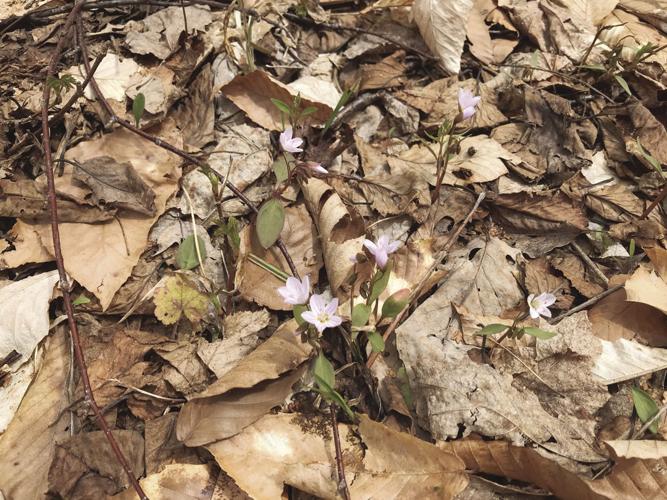
On a recent hike in the Province Road State Forest in Dorchester, NH with Reuben, Fran and Karen, we found numerous blankets of spring beauties growing on the south side of the hills where the sun’s rays are strongest. These delicate, tiny flowers are one of the first harbingers of summer’s arrival. They were spread over the ground like freshly fallen snowflakes, so numerous they couldn’t be counted. These New Hampshire natives grow in large patches of rich open woods, along streams and seeps. Their brightly colored pedals are discernable by their delicate pink and white veined petals.
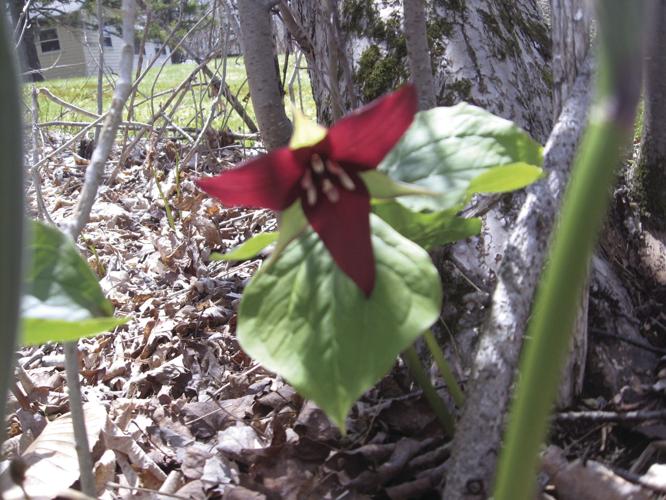
Three species of trillium were growing in abundance on our trek to the summit of Province Road Peak: Wake Robin, also known as “Stinking Benjamin” due to its acrid odor; Sweet Beth which has a soft sweet scent in contact to “Stinking Benjamin” and Painted Trillium with its multicolored petals. All three of these species grow in rich, moist forest floors, many times in clusters of 4-8 plants. Wake Robin and Sweet Beth have similar looking crimson pedals, while the painted trillium has 3 white pedals with crimson veins. Some people consider trillium as the “grand champion” of the woodlands. Word of note: Trilliums should not be picked or disturbed because its root system will be damaged. Admire the flowers and take photos, but leave them so they can return the following spring.
Continuing our climb we found numerous patches of Dutchman’s breeches. Dutchman’s breeches are easy to identify by their distinctive yellow-tipped flowers hanging in clusters, resembling the fanciful pantaloons worn by Dutchmen. The leaves resemble parsley, but don’t attempt to eat them as they are poisonous and you may not leave the forest alive if you choose to partake in munching on a few leaves.
Trout lilies were everywhere on our walk. They grow in abundance in wet, rich soil, many times along stream banks. The name is derived from their mottled brown leaves that resemble brown or book trout and they bloom in the beginning of fishing season. The yellow flower grows out of a slender stalk and closes up during bad weather.
Hobblebush, a member of the Honeysuckle family, was just beginning to throw out their blossoms. As the name implies, this is a bothersome shrub for hikers, hobbling them as they tramp through the woods. It has deep green heart shaped leaves with showy clusters of brilliant white flowers. It is also noted for its red/purple foliage in the autumn. Yellow violets, Canada mayflowers, sessil-leaves bellwort (also known as “wild oats”), clintonia and anemones were also springing up in abundance from the forest floor. This dazzling display of flora made us stop often to admire the splendor surrounding us and marvel at the beauty of these tiny wildflowers. Soon these spring flowers will give way to flora that thrive under the shade of the forest canopy. But for now the early bloomers reign. I think of the verse from the Bible, “Consider the lilies, how they grow: they neither toil nor spin; but I tell you, not even Solomon in all his glory clothed himself like one of these.”
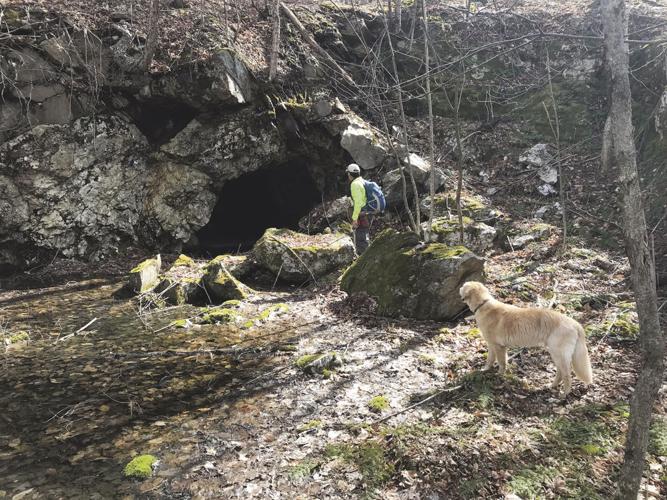
After reaching the summit of Province Road Mountain Fran, Karen and I, with Reuben lagging behind, hiked back down to explore the two mine shafts drilled into the hillsides. At one time significant ores were taken from the hills and mountains of New Hampshire. There are 260 USGS records of mines in New Hampshire that extracted beryllium, feldspar, mica, silica, copper, lead, silver, iron and other ores, even gold. Three of the most prominent mines are: The Ruggles Mine in Grafton, the Paddock Copper Mine in Lyman and the Mascot Lead Mine in Gorham.
The mines in the Province Road State Forest were mined for feldspar and mica in the early 1900s by Golding-Keene Company, a large mining corporation. Feldspar is used to manufacture dinnerware, bathroom and building tiles, as well as used in the production of ceramics and glass. Mica is used to manufacture wallboard and shingles and has many other uses. The mines and associated land was later deeded to the State of New Hampshire and are now managed by the NH Department of Forests and Lands.
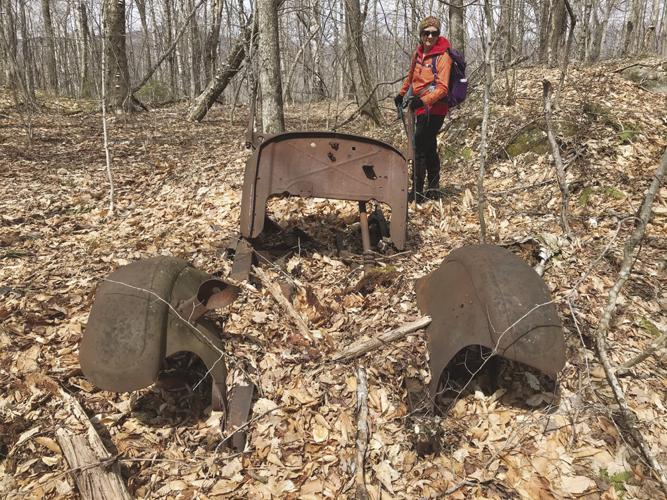
We not only found the two mine shafts, but many artifacts from the mining operations, including a rusted truck body most likely used to haul ore off the mountain. Large piles of tailings were piled near the mine entrances. At one time this mine employed a number of laborers to extract the ore and transport it to a smelter. The mountain buzzed with activity: The sound of pneumatic drills boring into the mountain filled the air; the roar of truck engines echoed off the hillside; and the shouts of miners cascaded down into the recesses of the mine shaft. Today the woods surrounding the mine lay starkly silent. The only sound we heard was the lonely cry of a raven.
This coming weekend pick a forest trail and take to the woods. Keep your head down, eyeing the forest floor and you’ll be amazed at the plethora of wildflowers emerging from dormancy. I would suggest bringing a wildflower guide with you. I use Wildflowers of the White Mountains by John Hession and Valerie Michaud. This is easy to use and will fit easily into your pocket. There are other guides available on-line or check out your favorite bookstore, now that they are open.
•••
For comments or question contact Gordon at forestpd@metrocast.net. If you are interested in hiking on remote or less frequented trails Gordon’s Paths Less Travelled, Tramping on Trails (and sometimes not) to Find New Hampshire’s Special Places is available at Innisfree Bookstore in Meredith and on-line at Amazon and Barns and Nobel.


(0) comments
Welcome to the discussion.
Log In
Keep it Clean. Please avoid obscene, vulgar, lewd, racist or sexually-oriented language.
PLEASE TURN OFF YOUR CAPS LOCK.
Don't Threaten. Threats of harming another person will not be tolerated.
Be Truthful. Don't knowingly lie about anyone or anything.
Be Nice. No racism, sexism or any sort of -ism that is degrading to another person.
Be Proactive. Use the 'Report' link on each comment to let us know of abusive posts.
Share with Us. We'd love to hear eyewitness accounts, the history behind an article.