


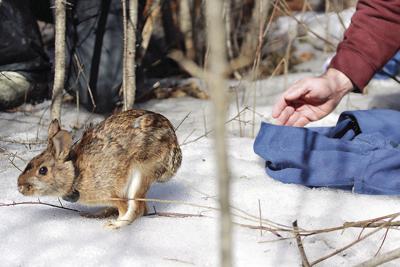
DURHAM —Researchers with the New Hampshire Agricultural Experiment Station at the University of New Hampshire monitoring the reintroduction of New England cottontails raised in captivity into the wild used DNA to find the reintroduced rabbits survived and bred in the wild over multiple years. The reintroduction by wildlife biologists was the first attempt at releasing captively bred New England cottontails into the wild.
“We learned that captively reared New England cottontails released in the wild bred successfully, as did their wild-born offspring,” said Adrienne Kovach, associate professor in natural resources and the environment. “This led to growth of the population and subsequent dispersal of individuals to a nearby patch about 700 meters away. This is an important measure of success, given the low documented dispersal rates in the wild.”
The New England cottontail is an endangered species in New Hampshire and a high conservation priority species throughout the Northeast. Populations in New Hampshire have declined to very low levels in the past few decades, and it is estimated that there are fewer than 100 cottontails in the state today.
Extensive New England cottontail conservation efforts have been underway for the last decade, including habitat management and restoration, the creation of new habitat and captive breeding. Because the species has declined to such low levels in the New Hampshire Seacoast region, reintroduction of captively bred rabbits was determined to be necessary to help the population rebound and boost genetic diversity.
Doctoral student Melissa Bauer worked with Kovach to track the outcome of a reintroduction of 42 cottontails over five years to the Bellamy River Wildlife Management Area in Dover. Of the original 42 rabbits released, six bred in the wild, along with nine of their offspring, resulting in at least 29 wild-born rabbits. Integrating the genetic data with data from rabbits collared by New Hampshire Fish & Game biologists it was also determined that only a small percentage of the original rabbits released survived long enough to reproduce, and survival was highest in the year of the initial release.
Researchers released the rabbits in late summer and early fall. Rabbits need to survive through the winter to the next spring to reproduce. While the survival and reproduction of reintroduced cottontails is an important success, the reintroduction is not yet self-sustaining.
“A single reintroduction was not sufficient to keep this isolated population persisting robustly,” said Kovach. “In the absence of natural immigration, multiple releases of cottontails are needed to prevent negative consequences of unpredictable events, such as mortality during winter snowstorms.”
This material is based upon work supported by the NH Agricultural Experiment Station, through joint funding of the National Institute of Food and Agriculture, U.S. Department of Agriculture, under award number 1006954, and the state of New Hampshire.


(0) comments
Welcome to the discussion.
Log In
Keep it Clean. Please avoid obscene, vulgar, lewd, racist or sexually-oriented language.
PLEASE TURN OFF YOUR CAPS LOCK.
Don't Threaten. Threats of harming another person will not be tolerated.
Be Truthful. Don't knowingly lie about anyone or anything.
Be Nice. No racism, sexism or any sort of -ism that is degrading to another person.
Be Proactive. Use the 'Report' link on each comment to let us know of abusive posts.
Share with Us. We'd love to hear eyewitness accounts, the history behind an article.