


If ever there were a spring day so perfect,
so uplifted by a warm intermittent breeze
that it made you want to throw
open all the windows in the house.
— Billy Collins
The snowbanks are shrinking, the melodiousness of flowing water can be heard again, ice is melting away from the shorelines of lakes and ponds, and the air has the dank smell of mud. These are uplifting signs that spring has returned to New Hampshire and all is well in the natural world.
Our hiking trails are showing signs of revival after their long sleep under a quilt of soft, deep snow. Mud, slush, and monorails are now the dominant theme of the trails. Snow bridges that provided safe travel over steams and brooks are collapsing, exposing rushing streams, swollen by snow melt. Winter storms have heaped the trails with their aftermath: blowdowns, broken trail signs, and scattered debris. This is the shoulder season when we experience the transition from winter to spring.
Recently, I was fortunate to get a last “winter” hike into Jobildink Ravine, which is situated on the southeast side of Mount Moosilauke. In the Jan. 25 edition of The Laconia Daily Sun, I recounted my unsuccessful attempt to reach the ravine floor. Due to the shortened days of mid-winter and the heavy snow pack, Fran and I had to turn back before reaching the headwall. I was determined to return while the snow bridges were still erect and the beaver ponds, sitting in the floor of the ravine, were frozen. I knew spring conditions were fast approaching and time was at a premium in order to reach my goal.
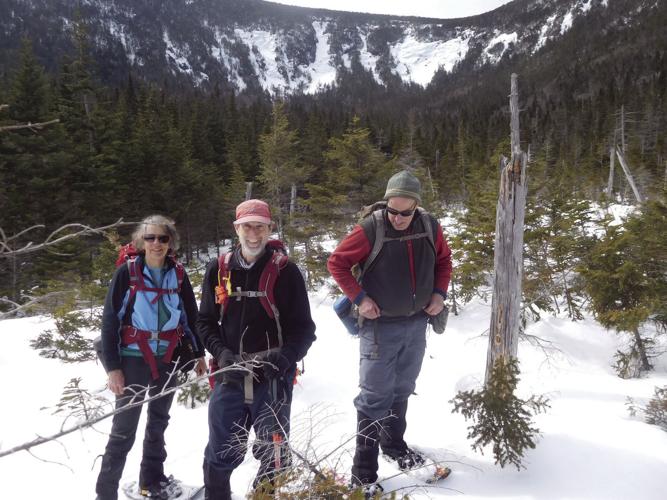
I pulled together three stalwart hiking companions — Ron, Barb and Doug. Together we ventured forth on the Asquam-Ravine Trail, which starts at the Dartmouth College Ravine Lodge, located off Route 110.
Making our way along the Asquam-Ravine Trail, we quickly realized we needed snowshoes, as the snow was still several feet deep and we were plunging into depths up to our knees — something that is called “bare-booting” — making travel difficult and creating a mess of the trail. Trails become almost impassable because of the craters left by bare-booters.
When we reached the first of two wooded bridges crossing the Baker River, we realized that warming temperatures were playing havoc with the trail and turning the footpath into a tightrope of snow pack, called monorail.
After daintily stepping across bridge 2, trying to avoid a long fall into the river, we came to the obscure trail junction of the abandoned Asquamchumauke Trail. The trail was abandoned in early 1970s due to its remoteness and erosion by water courses that flow through the ravine.
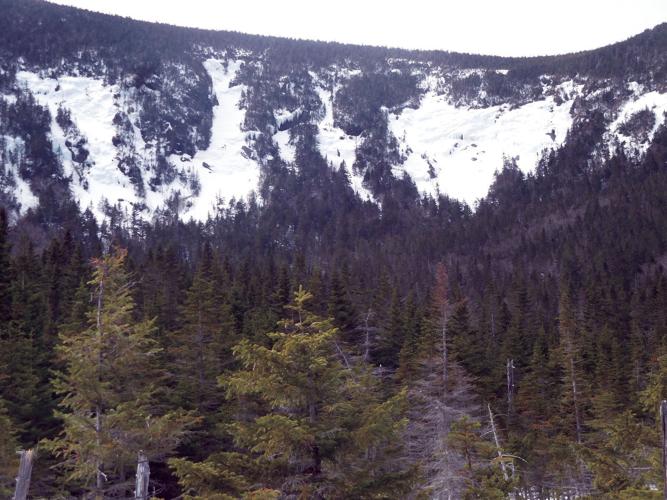
We were fortunate that many of the steams and brooks were still frozen and several feet of snow covered the path. Within a mile after beginning the bushwhack along the abandoned trail, we found ourselves pushing through thick stands of spruce and fir and then across frozen beaver meadows. After doubting we would ever find the base of the headwall, we at last stood at the base of Jobildunk Ravine, staring in awe at the 300-foot wall of ice leading to the summit of Mount Moosilaukee, knowing that it was one of the last days before the abandoned Asquamchumauke Trail would be accessible.
It was a hike for the ages, and we found the secret treasure others have told us about. After gobbling down our lunch, we climbed as high as we could on the headwall and then we began our journey home, using our tracks to guide us through the forest. With the afternoon sun beating down, the snow bridges and iced-over streams were soon dissipating. We were glad that we had this chance to get into the Jobildunk Ravine before water ruled the trail.
With spring now here, there are a few things to keep in mind. Although much of the snow and ice is gone from the trails in the Lakes Region, there is still plenty farther north at higher elevations, so plan accordingly. Trail crampons, as well as snowshoes, are still in order; don’t be a bare-booter. Pockets of ice linger late into spring along rocky hillsides, especially in the shade. Step cautiously to avoid slipping. Trekking poles can provide extra stability for those slippery areas, especially wet logs. You don’t want to take a spill and end your spring hike by having to be carried out on a litter.
With the melting snow and recent rain, sections of trail will be laced with mud. Avoid those muddy areas, if possible. It’s important to allow trails to dry out and minimize any permanent damage to the path. If you do encounter large pools of water, stay to the middle, trudge through it, and avoid widening the footpath, possibly trampling delicate wildflowers.
Be aware that the winter has brought with it significant blow-downs and many of the downed trees have fallen across trails. If you do run into downed trees or branches, remove what you can to free the trail for others. You may want to carry a small saw to assist in trail maintenance work, as it will be a while before trail crews can begin their work.
Also, with the melting snow, debris (candy wrappers, bottles, cans, paper) emerge on the forest floor, left by careless hikers. Bring along a plastic bag to retrieve the litter, helping to keep the forest floor in a wild state, not looking like a garbage dump.
With the warming temperatures and April showers, creeks and streams are running to full capacity. Cross water flows carefully or reconsider your route, looking for a safe crossing or not crossing at all. Water temperatures are in the 40s and, if you get wet trying to cross a swollen stream, it will be an extremely uncomfortable hike, or it could even result in hypothermia, a serious issue when hiking in the backcountry. Err on the side of caution and don’t take the risk of falling into the water.
Black flies — “the state bird” — will soon be flying free. The black fly season doesn’t last long — just a few weeks — but the hordes of pesky bloodsuckers can drive you off the trail within minutes. Headnets are almost essential for any outdoor activity this time of year. Wear protective clothing, long-sleeve shirts, pants and gloves. Also, an insect repellant with Deet will help repel the little demons.
Another pesky and dangerous insect is the black-legged tick. Over the past few years, due to climate change, the population has exploded. There are two types of ticks you should familiarize yourself with: the wood tick and the black-legged tick, better known as the deer tick. The wood tick is the most common and doesn’t pose an immediate health risk. They can cause infection if not removed before they burrow into the skin. The black-legged tick is a dangerous parasite that serves as a vector for Lyme disease. It must be removed within 24-48 hours to avoid infection. They hang on low-lying branches and shrubs, waiting for a comfortable host to leap onto (like your bare legs or arms). Be sure to wear long pants and long-sleeve shirts to prevent you from becoming an innocent host.
One last important note: With the warm temperatures, the abundance of leaf litter, downed branches and other tinder lying on the ground, brush fires are an imminent risk. Be very careful with fire. Leave the matches at home, and no campfires.
Spring is a great time to hit the trail and cast off those cobwebs of winter. Break out your hiking boots and day packs. However, as with most outdoor activities, it comes with risks. Prepare and plan your hike carefully. Leave your hiking plans with a spouse or friend. Remember to bring binoculars and camera. With leaves in the budding stages, views are unencumbered by vegetation. Birds and other wildlife can be spotted much more easily during the spring. You may get a chance to see that barred owl you hear frequently at home, or a porcupine sitting atop a tree munching on the bark. Enjoy this beautiful time of year; it will be gone quickly.
One last note for your consideration: If you want to give back to the trails we love to hike in the Belknap Range, here is the opportunity. The Belknap Range Trail Tenders are looking for volunteers to join their trail crew or to sign up as a trail adopter. Work with the trail crew will begin on May 4 and continue every Saturday through summer and into the fall. The trail crew will be working on trails on Lockes Hill, Gunstock Summit, Belknap Mountain and on the East Gilford Trail. Several trails are now open for adoption and BRATTS is willing to assist you in learning the skills of an adopter. If you are interested in either volunteering with the trail crew or becoming a trail adopter, email BelknapRangeTrailTenders@gmail.com. You can also check out BRATTS' Facebook page.



(0) comments
Welcome to the discussion.
Log In
Keep it Clean. Please avoid obscene, vulgar, lewd, racist or sexually-oriented language.
PLEASE TURN OFF YOUR CAPS LOCK.
Don't Threaten. Threats of harming another person will not be tolerated.
Be Truthful. Don't knowingly lie about anyone or anything.
Be Nice. No racism, sexism or any sort of -ism that is degrading to another person.
Be Proactive. Use the 'Report' link on each comment to let us know of abusive posts.
Share with Us. We'd love to hear eyewitness accounts, the history behind an article.