


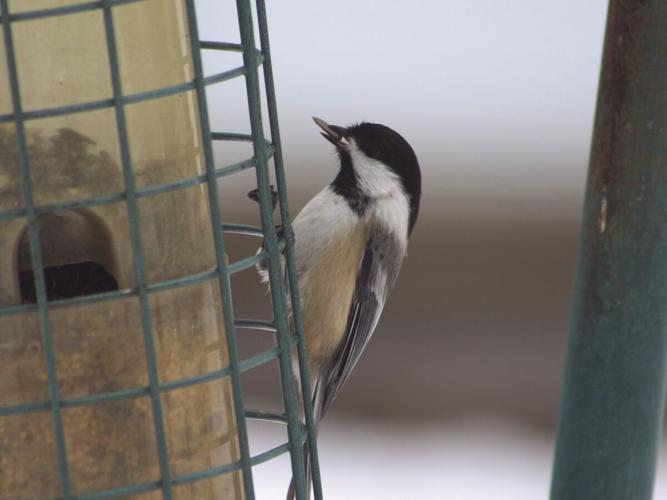
The bird feeders in our yard attract a fair selection of the common birds in the Lakes Region during winter: chick-a-dees, nuthatches, titmice, woodpeckers, and several others. They also provide the occasional sighting of an unusual bird such as a redpoll or a cross-bill. They’re great entertainment on cold winter days and it’s nice to know we’re helping these birds through our harsh winter season. One thing that surprises me is that we don’t see some common birds that others nearby do see regularly, even though we offer the same food. For example, less than a mile away, rose-breasted grosbeaks are often seen at a feeder with the same food, yet we have never seen a single grosbeak at our feeders. On the other hand, we have large flocks of goldfinches all winter long while our nearby friends rarely see them. Even though it’s less than a mile — as the crow flies — each localized habitat supports different birds and they don’t travel very far from their preferred cover and food sources.
We don’t put the feeders out until December first, or even later if there hasn’t been enough cold weather and snow to be confident the bears have settled down for the winter; we’ll bring them in again when it warms up in spring, before the bears awake ravishingly hungry and in search of food. Years ago we fed the birds too long into the summer and woke one morning to find a large black bear sitting on the ground, a single claw on one paw pulling the feeder over its mouth, shaking and lapping the seeds out. It wasn’t easy to scare it off as it really didn’t want to abandon that easy food source. That was the end of feeding the birds past winter.
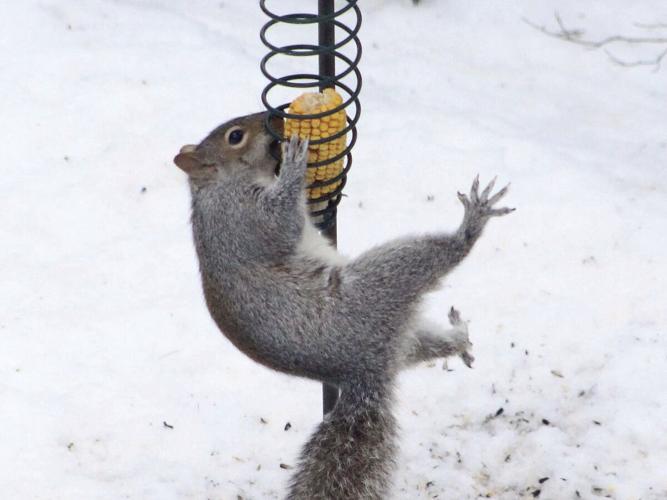
Anyone who has a bird feeder knows all too well that they feed more than just birds and bears, the gray squirrels being the most blatant and annoying non-avian customers, able to quickly empty a full feeder, or chew up an empty feeder, determined there’s more inside — or even steal it away completely. But over time we’ve found a happy compromise with these visitors by providing them their own separate feeders. The most entertaining feeder is the one that hangs an ear of dried corn about a foot off the ground; the squirrels leap up on it and hang upside down as they gobble up one kernel at a time, holding it nimbly with their front paws. As the snow melts and the feeder gets higher off the ground the show only gets better.
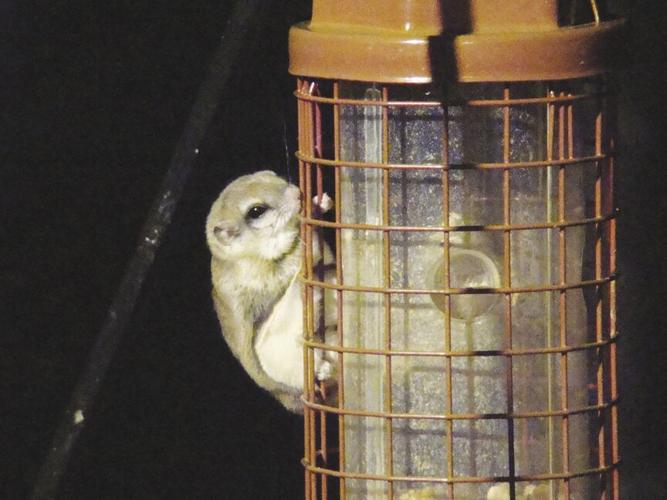
Other consumers of our seeds include red squirrels and mice, the latter not often seen as they are nocturnal, but their little footprints in fresh snow reveal their presence. One of the most exciting visitors to the feeders, also nocturnal, is the flying squirrel. We see them late on the coldest nights, stealing seeds from a feeder that hangs high above the ground. Becoming startled if we turn on the outside light, they’ll decide it’s time to abandon ship, and they really do fly off the feeder, using the thin webbing of skin between their front and rear legs as a wing to glide 40 or 50 feet away, steering perfectly towards the base of a tree on which they land and then scurry up to safety.
And bird feeders don’t benefit only those that dine directly at the feeder — the whole food chain takes advantage of it, and not just the neighborhood cat that stalks the birds. The next step up the food chain that ultimately ends up with that all birdseed in its system includes larger birds such as owls and hawks. Mice, voles, and squirrels are favorite foods of raptors including the barred owl and the red-tailed hawk. Smaller, faster raptors like kestrels and sharp-shinned hawks will go after small birds, sometimes catching them in flight, others times, taking them right off the feeder.
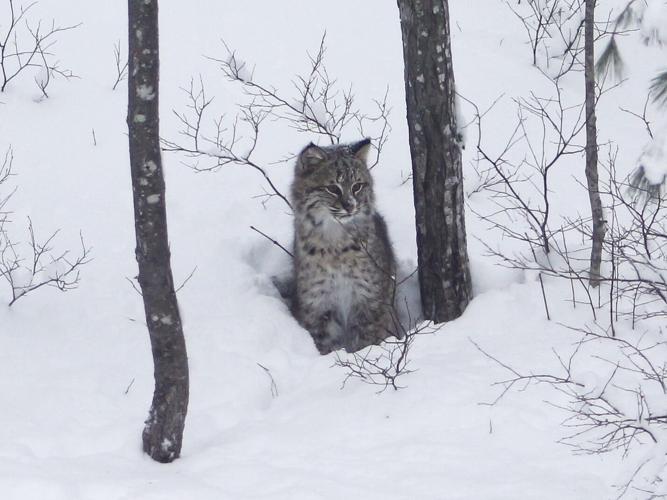
Mammals are also secondary beneficiaries of bird feeders. The fisher (also called fisher cat) largely lives off of squirrels, and ones fattened up by bird feeders are most appreciated. Fox also consume a large number of rodents, but my favorite next-level predator is the bobcat. I’ve watched bobcats creep stealthily along the edge of the trees on their way to feeder, then stop at the closest hidden approach and wait for their moment. When they decide it’s time to strike they move with amazing swiftness. On one occasion we watched as a bobcat stalked a gray squirrel hunting for dropped seeds under the bird feeder. As the bobcat made its move the squirrel sped to the nearest tree and climbed up with everything it could muster. The bobcat bolted towards the tree, somehow calculated the perfect trajectory, and in one leap jumped six feet in the air and perfectly intercepted that poor squirrel as it was still ascending at full speed. It was over in one second, and the cat had a nice dinner to bring home that day.
Bobcats used to live primarily on snowshoes hares, but as the hare population has declined bobcats have learned to hunt the gray squirrel, which also explains why bobcats have become more visible: hares were out mostly at night while squirrels are daytime creatures.
On another occasion we watched a bobcat break from its hiding spot and sprint after a red squirrel, but the squirrel had a secret hole in the snow to dive into and escape. The cat dug down into the snow for quite a while but the squirrel’s tunnel was too long, so the cat stopped, sat, waited, and watched for a long time before eventually giving up. Within minutes of the bobcat leaving, the little squirrel popped its head up and went back to searching for dropped sunflower seeds.
Like many things in life, taking one action presents unknown opportunities for others. A bird feeder may be put out to help the winter birds as well as for our own personal enjoyment, and though you may never see the other animals that appreciate your bird feeder, know that there are many more creatures out there benefiting from your gifts to the food chain.
•••
Scott Powell lives in Meredith, visiting the forest and waters in the Lakes Region and the White Mountains. He is a Conservation Commissioner for the town of Meredith, on the board of directors of the Lake Wicwas Association, and a member of the Land Stewardship Committee at the Lakes Region Conservation Trust. He writes a weekly journal about nature in the Lakes Region at https://wicwaslake.blogspot.com/ You can contact him at scottpowellnh1@gmail.com.


(0) comments
Welcome to the discussion.
Log In
Keep it Clean. Please avoid obscene, vulgar, lewd, racist or sexually-oriented language.
PLEASE TURN OFF YOUR CAPS LOCK.
Don't Threaten. Threats of harming another person will not be tolerated.
Be Truthful. Don't knowingly lie about anyone or anything.
Be Nice. No racism, sexism or any sort of -ism that is degrading to another person.
Be Proactive. Use the 'Report' link on each comment to let us know of abusive posts.
Share with Us. We'd love to hear eyewitness accounts, the history behind an article.