


Sometimes I envy crop farmers. Their corn and potatoes do not steal food from the apple trees, then run around the farm looking for trouble. But neither do they provide entertainment.
Ferdinand is a white Scottish Highlander calf. Such calves typically weigh 60 to 80 pounds at birth. Ferdinand weighed only 40 pounds. But what an energetic 40 pounds! At first, I worried that, because he was small, he'd also be weak, but within days of his birth, he charged around the field, investigating every twig and rock. When wild turkeys walked through his pasture, he would chase them, wanting to play. Always on the lookout for fun, he'd engage older calves, chasing them or being chased. He was a free and energetic spirit.
Ferdinand quickly realized that, because he was small, he could duck under the electric fence without getting zapped. Then he'd wander around the barnyard, exploring its possibilities. His mom, Brittany, watched him from the confines of the pasture and, if she lost sight of him, she'd moo for his return. After a few months, Brittany ended her vigil. She either gave up or just trusted he would return.
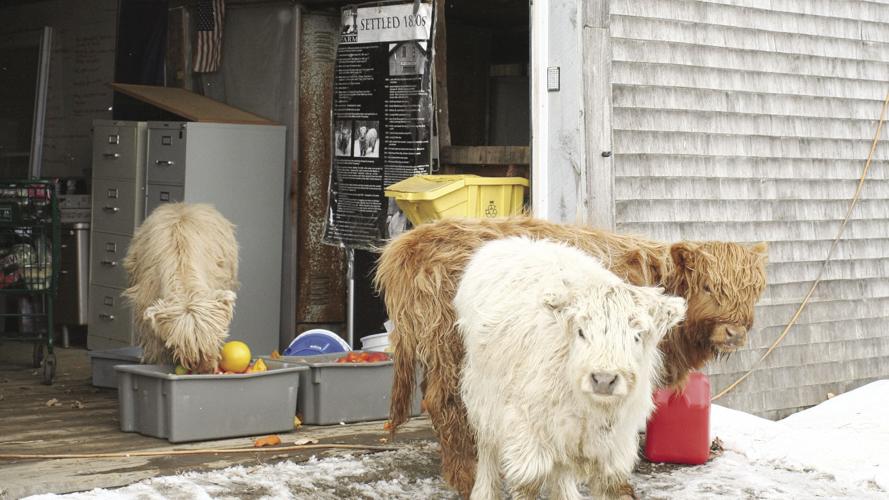
Calves develop friendships, and soon he convinced pasture-mates Allie and Lorna to join him. He taught them to go under the wire and check out the chicken coop, or munch on hay in the feed bunker. The feed bunker is a sturdy, concrete structure where the dry hay and other feed are stored and served. Cattle belong outside the bunker; they have to reach in when food is served. Every morning, we'd straighten up the small bales of hay the calves pulled down and clean up the manure deposited where it shouldn't be.
We call those calves “The Three Amigos.” Their ages range from 6 to 10 months, with Ferdinand the youngest and smallest. Although he is their leader, he is also capable of acting alone.
Every morning, we let the chickens out and leave the coop door open so the birds can return during the day to eat or (hopefully) lay eggs. Until recently Ferdinand would start each day waiting outside the coop, staring at the closed door, willing it to open so he could squeeze inside and help himself to the chicken feed.
Then he'd go spend the rest of the day with his gal pals, all of them slipping under the electric wire, willing to risk a shock for the pleasure of roaming freely around the farm.
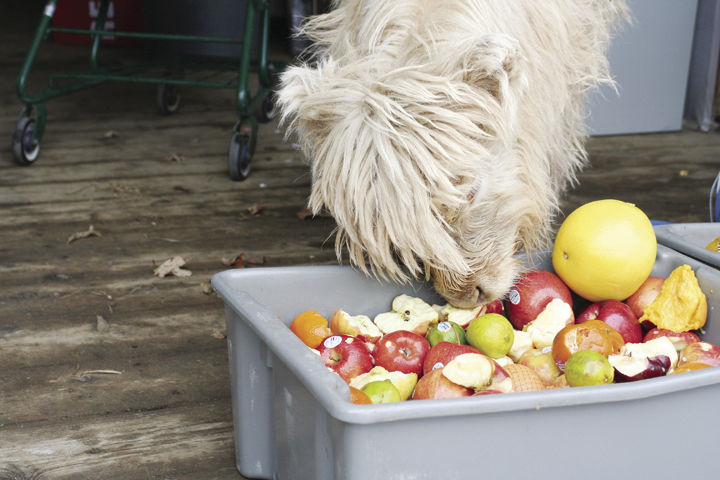
This freedom allows the Amigos to come running when we serve veggie scraps. We distribute bruised and out-of-date produce, collected twice a week from Shaw's in Gilford, to the cows who gather outside the feed bunker. While they follow the rules and poke their heads in to eat, the three partners-in-crime stand inside the bunker, ready to snatch pineapple skins and melon rinds that fall out of the reach of the bigger animals.
When the Amigos get bored or want a drink of milk, they return to their mothers' pasture.
It's a good thing the older cattle don't plunge through our fences. It's one thing to have calves walking around the yard, but if 1,400-pound Stash or Topper ran free, that would be a problem.
Soon we'll have to wean the three delinquents and train them to respect the electric fence. We did chain the chicken coop door to protect the feed, but for a while yet, I'm going to savor the joyous spectacle of the three calves kicking up their heels and bouncing across the lawn like kids at recess. Youth is fleeting and should be celebrated fully, don't you think?
Carole Soule is co-owner of Miles Smith Farm, where she raises and sells pastured pork, lamb, eggs and grassfed beef. Contact her at cas@milessmithfarm.com.


(0) comments
Welcome to the discussion.
Log In
Keep it Clean. Please avoid obscene, vulgar, lewd, racist or sexually-oriented language.
PLEASE TURN OFF YOUR CAPS LOCK.
Don't Threaten. Threats of harming another person will not be tolerated.
Be Truthful. Don't knowingly lie about anyone or anything.
Be Nice. No racism, sexism or any sort of -ism that is degrading to another person.
Be Proactive. Use the 'Report' link on each comment to let us know of abusive posts.
Share with Us. We'd love to hear eyewitness accounts, the history behind an article.