


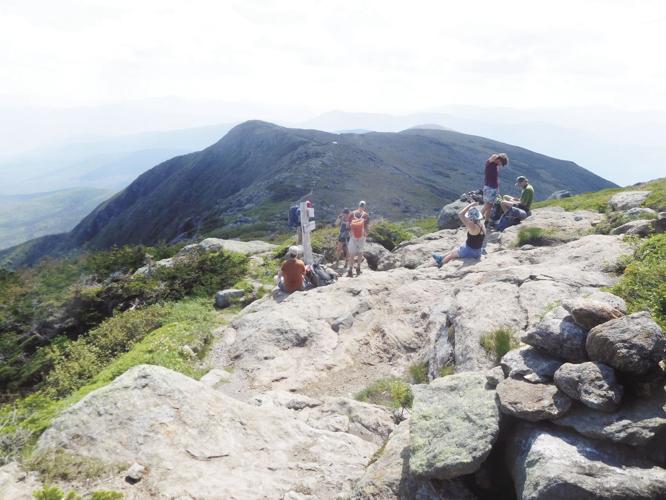
In 1819, Abel Crawford and his son Ethan finished cutting a trekking route from Crawford Notch to the summit of Mount Washington. Two hundred years later the Crawford Path is one of the most traveled trails in America, as hundreds of hikers take the Crawford Path to Mount Washington, including Appalachian Trail thru hikers. The Crawford Path is the oldest, continually used hiking trail in the United States. Last week, Barb, Susan, Dave and I walked the venerable grandfather of hiking trails to commemorate its 200th birthday and give honor to the Crawford family and those who have labored through the years to maintain the trail.
I have hiked the Crawford Path many times before, including a northbound AT hike and a Winter Presidential traverse. This time it was different. It was a day to reflect on the legacy of the Crawford family and to be absorbed by the magnificence of this 8.5 mile path that runs across the ridgetop of the Southern Presidential Range.
Abel Crawford, a woodsman from Vermont, settled in a deep pass now known as Crawford Notch. He took to farming, but soon found that rocks don’t make a good food source for a family of six children. In 1791, a road was cut through Crawford Notch to allow commerce to flow from Lancaster and the Upper Valley to the seacoast ports of Portland, Maine and Portsmouth, New Hampshire. The following year, seizing on the potential opportunities for income, Abel and his wife Hannah turned their farmstead into an inn. Shortly afterward, Hannah’s father, Captain Eleazar Rosebook, moved just north of the notch and built his own inn and tavern. Abel then moved his family six miles south and began a hospitality business (inn and tavern) at the southern end of the Notch. The Rosebrooks and the Crawfords became the first “hoteliers” of the Notch.
In 1803 the New Hampshire Legislature authorized funds to improve the primitive and rugged Notch Road, to increase commercial trade through the Notch. Soon teamsters and farmers were transporting goods through the Notch year round. Over the next several years tourists began to infiltrate the White Mountains and Crawford Notch became a destination point. By 1819 the Notch supported a healthy tourist trade. Abel and Ethan then struck on the idea of guiding these vacationers to the inner reaches of the forests and to the heights of mountain summits, including Mount Washington. The idea of a summit path became reality in 1819 and travelers could now experience the august presence of the highest mountain in the Northeast.
As more tourists flocked to the Notch a second Crawford Path was cut by Ethan. It followed the Ammonoosuc River into the Ammonoosuc Ravine and climbed the southwest ridge to Mount Washington. In the 1860s this route was taken over by the Mount Washington Cog Railway. Seizing on this opportunity of increased tourism, Ethan’s brothers built a third inn near the head of the northern gate. (Entering Crawford Notch from the north you will travel though a tight opening and this is “The Gate”). By 1840 tourists were eager to see the great peaks firsthand, but visitors wanted a more plush way to travel and the Crawford Path was reconstituted as a bridal path. It’s interesting to note that the Mount Washington Cog Railway, having been completed in 1869, is also celebrating a birthday – 150 years of continuous operation.
Susan, Barb, Dave and I began the Crawford Path commemorative hike of 15 miles by taking the Tuckerman Ravine Trail to the Lion Head Trail and continuing to the Mount Washington summit. The original plan called for us to hike the Tuckerman Ravine Trail all the way to the summit. However, sections of the ravine were blanketed in snow and the trail was blocked by snow fields and washouts. Skiers and snowboarders were hiking into the ravine, taking advantage of the snow fields still lingering in “Tucks.”
After a four-hour climb we reached the summit of Mount Washington, where we were inundated with tourists who drove the Mount Washington Auto Road for their summit experience. When we entered the Visitor Center it was humming with activity: people decked out in the finest outdoor gear, couples gawking at maps, photo ops galore, eyes peering out the wrap-around windows, awing the mountain vistas. It was truly an Americana experience. As the Cog engine whistle blared, announcing a new wave of sightseers, I was ready to leave and escape the mayhem. We left the Visitors Center and started our journey on the 200-year old trail.
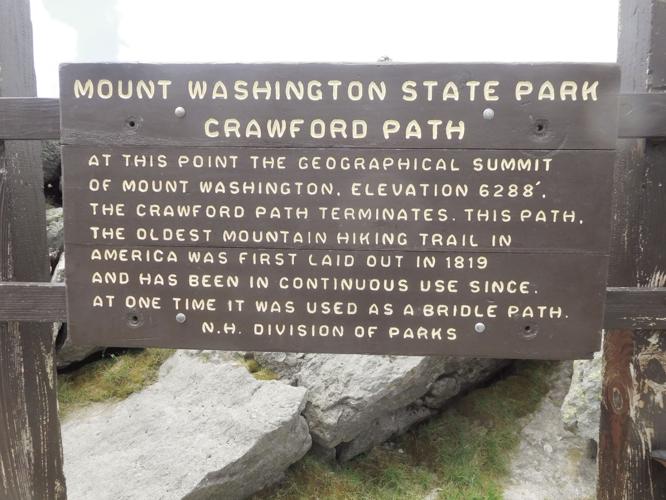
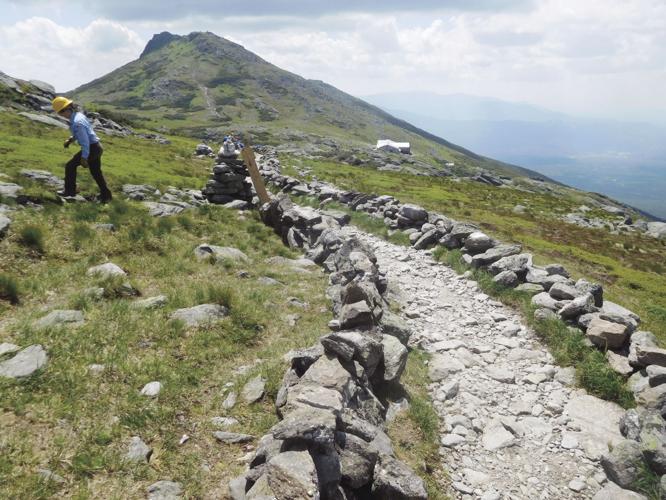
Just outside the Visitors Center we found the sign marking the beginning of the Crawford Path. As we descended we found rock work that served as the corral for horses that once brought tourists to the Tip-Top House and the Summit House Inns on the summit. Further on we noticed a small band of workers, donning yellow construction helmets, moving rocks and boulders along the trail. They turned out to be volunteers rebuilding the Crawford Path. After 200 years the trail needed a facelift. Over three hundred people and almost a dozen organizations have worked on the reconstruction project since the summer of 2018. Organizations such as the Youth Conservation Corp, Dartmouth Outing Club, Appalachian Mountain Club, Randolph Mountain Club, Student Conservation Association of New Hampshire and the U.S. Forest Service have contributed to the effort, building scree walls, stone steps, bog bridges, and cairns.
Because the venerable old path crosses through sensitive ecosystems, botanists have worked with crews to insure that the trail work would not damage alpine vegetation, especially on Monroe Flats where the alpine garden hosts the rare dwarf cinquefoil. Beautifully constructed scree walls have been built to insure hikers stay on the trail and not wander off into delicate alpine vegetation. MacGregor, of the AMC’s professional trail crew, told me that this labor of love is intended to maintain the integrity of the trail, insure hiker safety, and protect the fragile alpine vegetation by keeping people on the trail.
After watching the crew ferry huge boulders to the trail on cables, we left them behind and descended to the Lakes of the Clouds Hut, where we took a short break, enjoying the company of others mountain wanderers and AT thru hikers heading both north and south on their long distant hikes of over 2,000 miles. Leaving “Lakes” we continued trekking around Mount Monroe (5,372 ft.), which afforded us stunning views of Oakes Gulf and the Montalban Ridge. Along the ridge lies the Davis Path, built by Nathaniel Davis, son-in-law of Abel Crawford. It was completed in 1845 and was the third and longest bridle path constructed to the summit of Mount Washington.
Continuing on our journey along the southern Presidential Range, we passed the side trail to Mount Franklin (5,001 ft.), steered around Mount Eisenhower (4,760 ft.), and over the shoulder of Mount Pierce (4,312 ft.). Mount Pierce was formerly called Mount Clinton in honor of the naturalist and politician DeWitt Clinton of New York. In 1913, it was renamed after President Franklin Pierce (1804-1869) the only president from New Hampshire. It was originally referred to as Bald Mountain by Abel and Ethan Crawford.
We finished our 10-hour, 15-mile journey stumbling along the rock strewn path that descended off Mount Pierce and brought us to the Mount Clinton parking lot. It was a herculean effort to commemorate the 200th birthday pf the Crawford Path. I have no doubt that the trail will continue to be traveled by hundreds of hikers yearly and it will most likely celebrate its 300th birthday in another hundred years. The path is a tribute the Abel and Ethan Crawford, who 200 years ago constructed the grandfather of all trails and to those trail “engineers” who have worked thousands of hours to insure the trail will live on, bringing hikers of all ages to the Rock Pile. Perhaps this is a good time for you to tramp along the Crawford Path to honor its 200 year birthday or just to experience the splendor of the trail and the grandeur of the southern Presidential Range.


(0) comments
Welcome to the discussion.
Log In
Keep it Clean. Please avoid obscene, vulgar, lewd, racist or sexually-oriented language.
PLEASE TURN OFF YOUR CAPS LOCK.
Don't Threaten. Threats of harming another person will not be tolerated.
Be Truthful. Don't knowingly lie about anyone or anything.
Be Nice. No racism, sexism or any sort of -ism that is degrading to another person.
Be Proactive. Use the 'Report' link on each comment to let us know of abusive posts.
Share with Us. We'd love to hear eyewitness accounts, the history behind an article.