


GILFORD — When Kaarla Weston speaks about homework, curriculums, evaluations and alerts and tasks, she is talking about more than training a dog to be a service animal. On a deeper level, she is talking about compassion and her desire to help families in need of a service dog which will be more than a pet.
As the owner of Gilford’s Golden Guardians, Weston works with clients who benefit from owning a service dog to help with everyday tasks, as well as enhancing independence. The work is not a quick-fix. It requires dedication on the part of the family who will be living full-time with the dog, and on the part of Weston, who teaches and trains so the experience will be a success for all involved.
(Service animals are defined as dogs that are individually trained to do work or perform tasks
for people with disabilities.)
It is a 10-month curriculum and Weston works intensely with her clients. She said, “We focus on developing a bond between the service dog and the handler.”
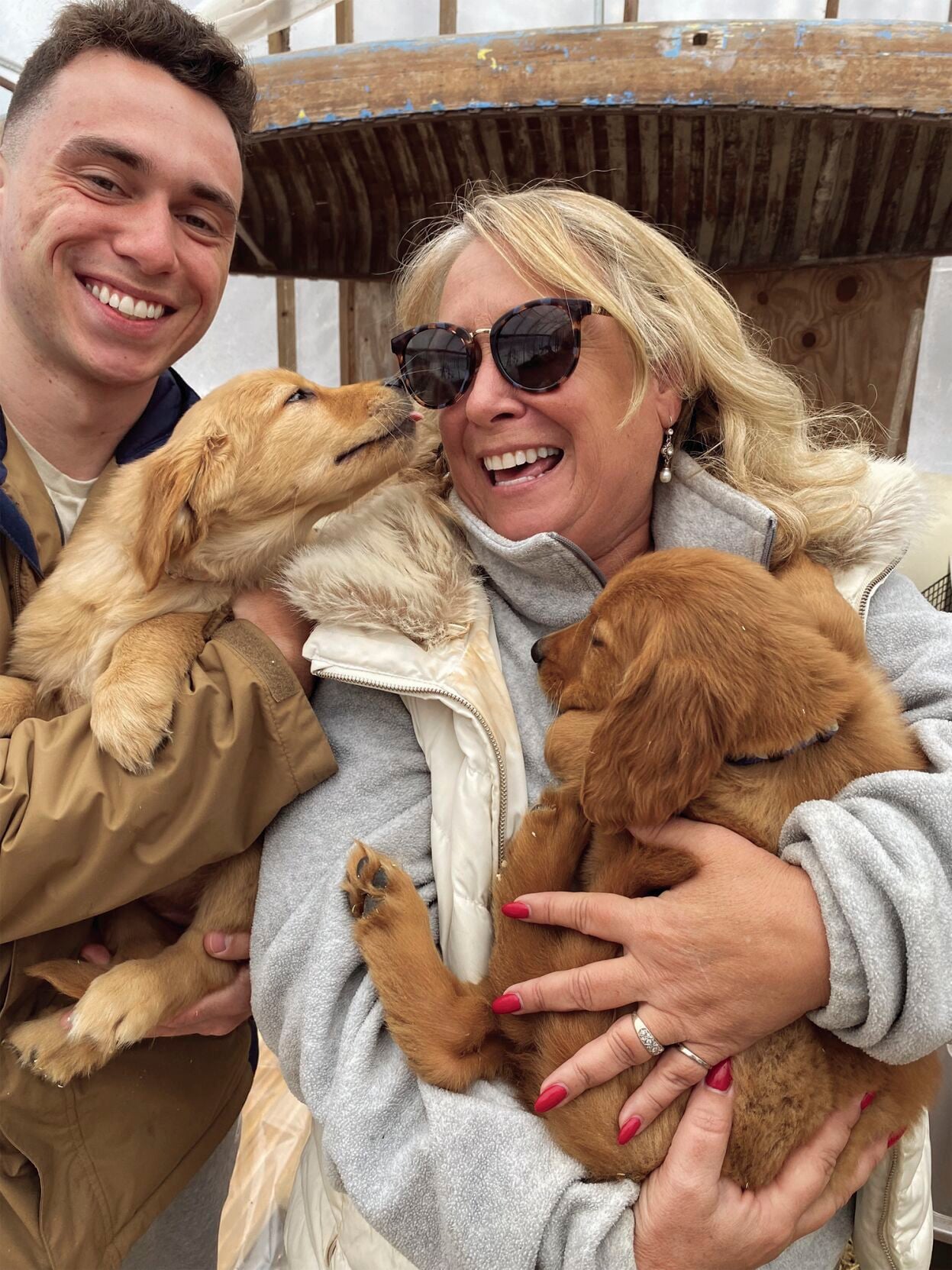
Weston trains Golden Retrievers and Golden Doodles, a type of dog that is allergy-friendly. She said Retrievers are “compassionate, empathetic and patient animals. They are called guardian angels for a reason.” Each dog works with an owner with a disability, such as autism, or a seizure or brain disorder, among other health-related issues. The training – for both the animal and its new owner – takes time, patience and dedication and Golden Retrievers and Doodles have tons of patience and a willingness to learn.
Weston explained, “We train service animals in accordance with Titles II and III (2 and 3) of the ADA. All eligible participants must have a documented diagnosis provided by a health care practitioner and the practitioner must provide a letter of recommendation that their client will benefit from a service animal. The service dog must be individually trained to complete tasks or alerts. New Hampshire further states only dogs can be service animals in RSA 167(d).
"Gilford’s Golden Guardian’s contract details the training methods used and the expectations set forth to pass the curriculum. Training is tailored to meet each handler’s unique needs. We do not train seeing eye dogs. We do train diabetic alert dogs, autism service animals, seizure response dogs and psychiatric service animals,” Weston said.
Her business comes from years of experience; Weston has a Bachelor of Arts degree in psychology from St. Michael’s College, and a Master’s in Human Service Administration with equal credits in Community Psychology. Added to this, she has been training dogs for years, and has a long history of teaching dogs to perform alerts.
Weston has worked in the field of developmental services for 32 years. She began training service dogs after a parent told her those in need of a service dog had to travel as far away as Pennsylvania because there were few closer options. She asked Weston to help. “I went home and put together a curriculum that very evening,” Weston recalled.
Weston has trained more than 43 service animals, all of whom think on their feet and demonstrate the ability to assess a situation based on their handler’s disability. The dogs perform tasks and alerts in order to save peoples’ lives and are trained to be one more tool in what she calls “the toolbox of health and wellness.”
Weston uses the Koehler's Methods of Dog Training, hands-free systems, and clicker training and has found these methods to be highly successful. Her training uses positive reinforcement techniques.
As an expert in the ways dogs learn, Weston assesses each dog’s potential to be of service to the handler. The program she has designed is unique. It allows months of training and a deep bonding that grows between the owner and the new dog. The process begins with the client/family choosing a puppy from one of the five reputable breeders Gilford's Golden Guardians works with. Weston helps them assess the right fit as they shop for a puppy. The family knows from the start they will be working with Weston for 10 months to train their new dog. The puppy comes home at eight weeks of age and must be accident-free for two weeks before it is allowed to have public access. “Dogs learn by association, repetition and reinforcement," Weston explained.
Meeting a specific client’s needs is vital as well. When she opened her business, Weston worked solely with children, but later expanded to work with adults with disabilities as well as chronic health conditions. Gilford’s Golden Guardians serves all of New England.
“I worked for years in developmental services, and I understand the challenges people face. I noticed that some of the children with disabilities, at around third grade, may experience feelings of isolation from their peers.” Service dogs can help children feel they belong and are not isolated. Whatever their disability, a child should feel valued and independent. Ultimately, the dog itself, after training, is the final tool in the dog owner’s toolbox.
Weston has had great success training puppies for children with autism; she also trains diabetic alert dogs, medical alert dogs and emotional support animals for people of all ages. For example, Weston works with a child with Angelman Syndrome. The child’s service animal is addressing seizure response and balance and coordination issues.
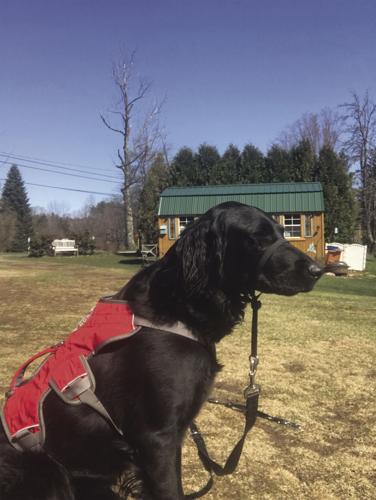
With an eagerness to share her work and increase awareness, Weston recently visited Gilford High School and New Hampshire Technical Institute with Gilford’s Golden Guardian "Ollie," a Golden Retriever. Weston spoke to students about health and wellness related to using the gifts of a service animal. In addition, Weston and Gilford’s Golden Guardian, Luna, a Flat-Coated Retriever, visited hospice patients at Golden View Health Care Center. “Luna visited patients and provided care and comfort and was lovely with them. We will be going back to visit once a month.”
As part of the training, the handler is expected to produce a community access log documenting 80 hours of public access. In addition, the dog needs to perform a 45-minute down/stay in a public setting to pass that aspect of the test. At the end of the process, Weston administers an intensive test, and once passed, the process is complete.
Along with the program Weston has designed, she encourages the handler and their service dog to be an asset within their local community. For example, one diabetic client went to a camp for children with diabetes and demonstrated how her service dog alerted her to high and low blood sugar.
In the future, Weston said she hopes "to train as many service dogs as I can to enhance the independence, safety and well-being of the people who need them.”
With a deep caring for people and a love for dogs, Weston's work at Gilford’s Golden Guardians opens the world to everyone who has a qualifying condition.
(For information, visit www.gilfordsgoldenguardians.com.)


(0) comments
Welcome to the discussion.
Log In
Keep it Clean. Please avoid obscene, vulgar, lewd, racist or sexually-oriented language.
PLEASE TURN OFF YOUR CAPS LOCK.
Don't Threaten. Threats of harming another person will not be tolerated.
Be Truthful. Don't knowingly lie about anyone or anything.
Be Nice. No racism, sexism or any sort of -ism that is degrading to another person.
Be Proactive. Use the 'Report' link on each comment to let us know of abusive posts.
Share with Us. We'd love to hear eyewitness accounts, the history behind an article.