


PLYMOUTH — On a summer day in 1850, a burly, bearded blacksmith stands over an enormous pile of glowing coals in the Enfield Shaker Village blacksmith shop, a hammer raised over his sweat-drenched head. In rhythmic and forceful blows, he relentlessly pounds a piece of red-hot metal into the shape of a horseshoe. He produces several dozen a day; protecting horses' hooves is critical because they are key to self-sufficiency in this agrarian society.
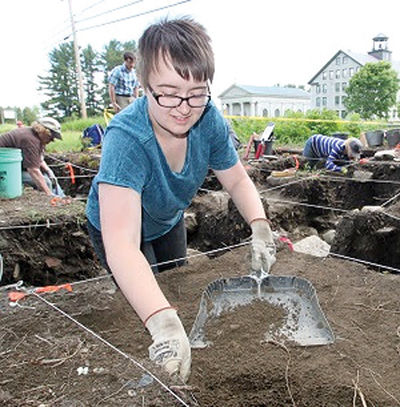
Fast forward to June 2016. A Plymouth State University student working at an archaeological dig just off Route 4A in Enfield crouches amidst a square, 15-foot excavation site. She gingerly scrapes layers of dirt from a two-foot section. Hearing the unmistakable ting of metal, she pauses and then carefully digs up a rusted but intact artifact. Holding it up to the sunlight, she realizes what it is — a horseshoe.
"It's so exciting going through the different layers and seeing how people lived," said Brittany Faulkner of Rumney. "There are stories here that historical documents don't tell."
Enfield was one of two Shaker Villages in New Hampshire founded in 1793 to foster a communal lifestyle that promoted equality between the sexes and races, celibacy, communal ownership of property, farming and craft industries. The 3,000-acre village overlooking Mascoma Lake was an idyllic setting for the community once numbering 300 inhabitants. The largest Shaker residential building, the six-story Great Stone Dwelling (completed in 1841), was once the tallest domestic building north of Boston.
This year's dig is concentrated at the site of a blacksmith shop.
"The blacksmiths were an important part of the community. They made and repaired all kinds of equipment and tools, so this was a perfect place to dig," said volunteer Dick Dabrowski, an expert on Shaker architecture.
The excitement of discovering each artifact is palpable. The crew, led by Plymouth State University Professor David Starbuck, a renowned anthropologist and archaeology expert, is comprised of PSU students, volunteers and Enfield Shaker Museum staff, including curator Michael O'Connor.
"There used to be 100 buildings in this village. Now there are only ten," O'Connor noted. "So much of the information about the Shakers is below ground. These archaeology efforts show people what went on here, and they can see the vibrant agricultural and trades community the Shakers built."
"We know there are stories here and this was a great place to start," added Carolyn Smith, of the Enfield Shaker Museum Board of Trustees.
Field school students and volunteers are working under Starbuck to learn archaeological methods, identify and process artifacts and investigate the distinctive lifestyle of New Hampshire's Shakers. He believes experiential learning is crucial in archaeology.
"Hearing about archaeology in a classroom, you can show pictures or occasionally pass an artifact around, but that doesn't tell you what it's like to do archaeology," said Starbuck.
Plymouth State sponsors four summer archaeology field schools, all overseen by Starbuck, who specializes in the archaeology of America's forts and battlefields, the archaeology of utopian societies (the Shakers) and the archaeology of medieval and post-medieval sites in Scotland. Starbuck earned a bachelor's in anthropology from the University of Rochester and both a master's and a doctorate in anthropology from Yale University. He has taught more than 40 summer field schools in archaeology at North American historic, prehistoric and industrial sites.
Brittany Faulkner, a recent Plymouth State University graduate, excavates artifacts at the site of a 19th century blacksmith shop as part of an archaeology dig at Enfield Shaker Village. (Courtesy photo)


(0) comments
Welcome to the discussion.
Log In
Keep it Clean. Please avoid obscene, vulgar, lewd, racist or sexually-oriented language.
PLEASE TURN OFF YOUR CAPS LOCK.
Don't Threaten. Threats of harming another person will not be tolerated.
Be Truthful. Don't knowingly lie about anyone or anything.
Be Nice. No racism, sexism or any sort of -ism that is degrading to another person.
Be Proactive. Use the 'Report' link on each comment to let us know of abusive posts.
Share with Us. We'd love to hear eyewitness accounts, the history behind an article.