


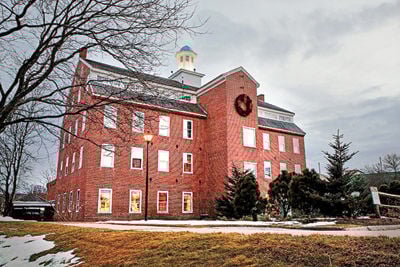
Hidden away behind the white louvers of the Belknap Mill cupola, is a bit of surprising history. Cupolas are so ubiquitous across the ancient New England landscape that we often don’t think about why they are there. In the case of the Belknap Mill, the cupola is housing a large bell connected both to Laconia and to Paul Revere.
In the old mill complexes, bells served dual purposes to mark time and to signal alarms. Mill workers would wake, work, eat and retire to the sounds of their mill bells. The bells would also serve to alert the community to fires and other disasters. One such disaster on Feb. 13, 1823 occurred when the Meredith Cotton & Woolen Manufacturing Company burned to the ground – a common occurrence for wooden mill buildings of the day, especially the cotton and woolen mills.
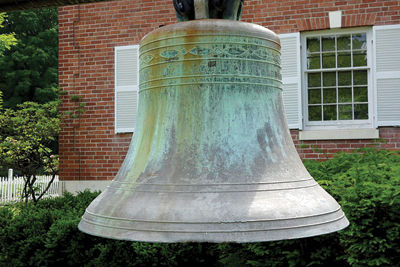
Although the mill was a complete loss, the bell was salvaged from the rubble. Originally, the bell had been cast by Major George H. Holbrook. As a young man, Holbrook apprenticed at the Revere Foundry in Boston – the same Revere, American patriot, of the “The Midnight Ride” poem by Henry Wadsworth Longfellow. Originally a silversmith, after the Revolutionary War, Revere went on to build the foundry that Holbrook would apprentice at.
Major Holbrook’s son, Col. George Holbrook, took up his father’s work in the family business and became one of young America’s foremost bell casters. Being gifted musically, Holbrook could cast bells that were pleasing to the ear. When the owners of the destroyed mill decided to rebuild, they asked the Holbrook bell foundry to recast the ruined bell. Supposedly, locals supplied 50 silver dollars to be added to the molten metal to improve the tone – a common practice for centuries.
In any case, within a few years the Belknap Mill was back to full production in its new brick and post-and-beam construction on the bank of the Winnipesaukee River. The bricks were locally manufactured at a brickyard in The Weirs and the tall spruce beams had been harvested from Prescott Hill. Once built, the bell would have been hoisted into the cupola, to once again mark time and disasters for Laconia.
Imagine the sounds of bells and cries of alarm, on the night of Nov. 21 when over 25 buildings covering four blocks were destroyed in the Great Laconia Fire of 1860. The Belknap Mill was spared the conflagration, but just barely, as many of the buildings on Mill Street were destroyed.
We invite you to come celebrate the season at the Belknap Mill on Saturday, Dec. 16, from 9 a.m. – 1 p.m. for a family event, Yuletide Traditions: Spirit of Community. All new members are welcome to ring in the season in the oldest building on the oldest bell in town! #belknapmill #wherecommunityhappens
- David Stamps, Belknap Mill Society volunteer
The Belknap Mill is ringing in the holiday season. (Courtesy photo)
This bell, cast by Major George H. Holbrook, was saved from the rubble of a fire in 1823 that destroyed the Belknap Mill. (Courtesy photo)


(0) comments
Welcome to the discussion.
Log In
Keep it Clean. Please avoid obscene, vulgar, lewd, racist or sexually-oriented language.
PLEASE TURN OFF YOUR CAPS LOCK.
Don't Threaten. Threats of harming another person will not be tolerated.
Be Truthful. Don't knowingly lie about anyone or anything.
Be Nice. No racism, sexism or any sort of -ism that is degrading to another person.
Be Proactive. Use the 'Report' link on each comment to let us know of abusive posts.
Share with Us. We'd love to hear eyewitness accounts, the history behind an article.