


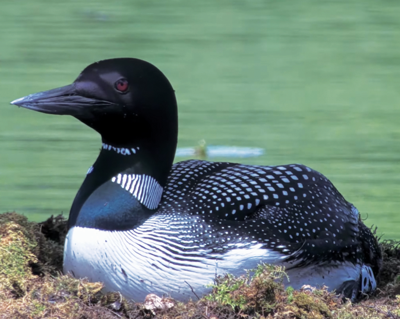
MOULTONBOROUGH — After losing three eggs to a remarkable series of setbacks (including a group of playful otters, swarms of black flies, and mink predation), the Lakes Region loon pair featured on the Loon Preservation Committee’s Live Loon Cam is once again incubating an egg in an attempt to produce a chick this season.
“Nesting loons face many challenges,” said Harry Vogel, senior biologist and executive director of the Loon Preservation Committee. “The Live Loon Cam offers viewers a rare glimpse into the trials and tribulations that New Hampshire’s loons endure as they work to hatch their chicks.”
The female of the Loon Cam pair laid her first egg of the season on May 22. Loons typically lay two eggs per clutch, and they will not incubate the first egg consistently until the second has been laid. In the early morning hours of May 24, before the second egg was laid, a group of six otters climbed onto the unattended nest raft. Although the otters did not eat the egg, they climbed onto the cover of the nest raft, and their combined weight collapsed the cover and smashed the egg sitting below.
Later that same day, the pair laid a second egg. However, in the days that followed, heavy swarms of black flies appeared to prevent the loons from sitting on the nest for more than a few seconds at a time, and the pair eventually abandoned the egg.
Because the failure occurred early in the nesting season, the loons had time to try again. Loons often renest after an early nesting failure, typically beginning a new attempt 8-18 days later.
Just after midnight on June 10, the female laid the first egg of their second nesting attempt. Unfortunately, just 90 minutes later, a mink swam to the nest raft and ate this third egg.
Undeterred, the female of the pair laid another egg, the second of the second clutch and fourth overall, on June 12. Because this egg was the second egg of the clutch, the loons immediately began to incubate it consistently. If successful, the egg is expected to hatch between July 8 and July 10.
Throughout their incubation period, loon nests face a variety of threats. In addition to natural challenges such as predation and black flies, loon nests may fail because of human disturbance, flooding or stranding caused by changing water levels, or swamping from boat wakes.
Those planning to boat, fish, or hike around New Hampshire’s lakes during the nesting season are urged to be mindful of nesting loons. If a loon nest is seen, it should be given plenty of space — at least 150 feet, and further if the nesting loon shows signs of distress such as lowering its head over the nest. Anyone who accidentally flushes a loon from its nest should leave the area immediately so the bird can feel comfortable enough to return and resume incubation. Boaters are also encouraged to follow New Hampshire’s no-wake laws in order to help prevent nests from being swamped.
The Loon Preservation Committee monitors loons throughout the state as part of its mission to restore and maintain a healthy population of loons in New Hampshire; to monitor the health and productivity of loon populations as sentinels of environmental quality; and to promote a greater understanding of loons and the natural world.
For more information, visit loon.org.



(0) comments
Welcome to the discussion.
Log In
Keep it Clean. Please avoid obscene, vulgar, lewd, racist or sexually-oriented language.
PLEASE TURN OFF YOUR CAPS LOCK.
Don't Threaten. Threats of harming another person will not be tolerated.
Be Truthful. Don't knowingly lie about anyone or anything.
Be Nice. No racism, sexism or any sort of -ism that is degrading to another person.
Be Proactive. Use the 'Report' link on each comment to let us know of abusive posts.
Share with Us. We'd love to hear eyewitness accounts, the history behind an article.