


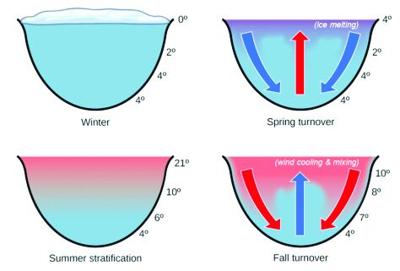
Have you ever leapt off a dock and felt the water suddenly turn colder the deeper you went, only to warm up again when you resurfaced? That cold rush is evidence of thermal stratification, the natural system of layering that happens each summer. Warm, lighter water floats on top, while the cold, dense water settles at the bottom. In between, there’s a middle zone marked by a rapid drop in temperature.
That boundary is called the thermocline, an invisible dividing line between the warm surface and the cold depths. As summer goes on, the surface layer thickens with continued warming, and the thermocline sinks deeper into the lake before fall arrives.
All summer long, Lake Winnipesaukee holds onto these layers. The sun-warmed surface, called the epilimnion, mixes with the air and is full of oxygen. It’s the zone most familiar to us, where swimmers and boaters spend their time and where warm-water fish like bass and sunfish thrive. Colder-water species such as lake trout, on the other hand, stay deeper, often near the thermocline where the water remains cool but still has enough oxygen to support them.
Down below, the hypolimnion stays chilly, dark, and cut off from contact with the surface. In late August, our monitoring showed the deep sites hovering between 7–10 °C (45–50 °F), a sharp contrast to the much warmer surface layers. Between the layers, the metalminon acts like a barrier, slowing down mixing between the top and bottom. By late summer, the separation becomes so strong that oxygen in the deepest waters runs low, a natural signal that the lake is preparing for one of its biggest seasonal resets — lake turnover.
Turnover happens in the fall, usually in October, when the air cools enough that the surface waters become heavier and start to sink. As the winds strengthen and cool weather sets in, the lake is stirred until the layers finally break down. Suddenly, the entire lake is
isothermal, meaning the temperature is the same from top to bottom. At this point the lake can fully mix, carrying oxygen from the surface all the way to the deepest parts. It’s like hitting the refresh button for the ecosystem.
Since April, the Lake Winnipesaukee Alliance has been sampling temperature and dissolved oxygen at 12 of the lake’s deepest sites every month. This long-term monitoring gives us a detailed picture of how the lake changes with the seasons. Our most recent results showed oxygen levels running low in the deepest waters, a normal late-summer pattern in stratified lakes.
While the layers remain strong for now, this depletion signals that the seasonal shift is coming and that turnover is on the horizon. Without these measurements, the changes happening beneath the surface would remain invisible to most of us.
This natural mixing doesn’t happen just once, it’s part of a rhythm that repeats twice a year, in both spring and fall. Lakes like Winnipesaukee that mix twice annually are called dimictic. In late autumn, this turnover carries oxygen from the surface down to the depths, where it sustains aquatic life through the long winter months, when the lake is sealed under ice and no new oxygen can mix in from the air. Turnover is a vital part of the lake’s cycle of renewal, ensuring that life beneath the surface continues to thrive.
So, the next time you dive in and feel that sudden chill, remember it’s more than a shock to your system, its stratification, the layering that sets the stage for turnover each fall. When those layers finally mix, the process of turnover refreshes Lake Winnipesaukee and keeps life thriving below the surface. Our responsibility is to give the lake clean water to work with. By reducing polluted stormwater runoff, sharing best practices, and supporting local lake organizations, we can help keep this cycle strong for generations to come.
•••
Bree Rossiter is the conservation program manager for the Lake Winnipesaukee Alliance. She manages the water quality monitoring program, cyanobacteria monitoring initiatives, the Winni Blue/LakeSmart program, and assists with watershed management planning efforts. Bree can be reached at brossiter@winnipesaukee.org. The Lake Winnipesaukee Alliance is a nonprofit dedicated to protecting the water quality and natural resources of the lake and its watershed. To learn more, visit winnipesaukee.org.


(0) comments
Welcome to the discussion.
Log In
Keep it Clean. Please avoid obscene, vulgar, lewd, racist or sexually-oriented language.
PLEASE TURN OFF YOUR CAPS LOCK.
Don't Threaten. Threats of harming another person will not be tolerated.
Be Truthful. Don't knowingly lie about anyone or anything.
Be Nice. No racism, sexism or any sort of -ism that is degrading to another person.
Be Proactive. Use the 'Report' link on each comment to let us know of abusive posts.
Share with Us. We'd love to hear eyewitness accounts, the history behind an article.