


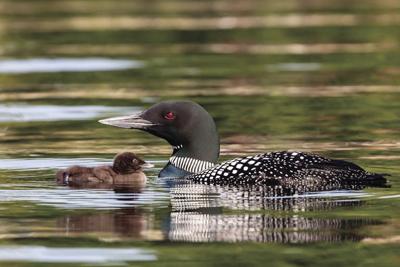
MOULTONBOROUGH — Loon chicks are hatching on lakes around the state, and the Loon Preservation Committee is asking boaters to help protect the threatened loons by maintaining a safe distance during the 4th of July holiday and the remainder of nesting season.
“The close approach of boats can create stress for loon parents, distracting them from caring for and feeding their chicks,” said Harry Vogel, executive director and senior biologist at the Loon Preservation Committee. “It’s a full-time job for two loon parents to raise their chicks over the course of the summer, and we are asking people to make sure they have the space to do that.” While blame is often placed on motorboats, kayaks and canoes also pose a threat to loon families. The Loon Preservation Committee recommends that all boats maintain a distance of at least 150 feet from loons, especially those with chicks.
In addition to distracting adult loons from their parenting duties, boaters driving quickly risk hitting adult loons or chicks, which may cause injury or death. Loon chicks are smaller, more difficult to see on the water, and cannot dive deep or for extended periods of time. “Loon chicks, especially young ones, are much more buoyant than adults, which limits their ability to dive out of the way of fast-approaching boats,” Vogel explained. Loon chicks are likely to be with adults, and the Loon Preservation Committee recommends that boaters slow down whenever they see adult loons and give them a wide berth.
Loons give behavioral cues, including swimming away, vocalizing, craning their necks low, and even thrashing in extreme circumstances to communicate that boaters are too close. Vogel said that if boaters observe any of these behaviors, they should back away. “The best way to observe loons is with a good pair of binoculars, and the best way to photograph them is with a long, telephoto lens,” he said.
The Loon Preservation Committee also urges boaters to maintain no wake speed within 200 feet of shorelines, especially around islands. “Many loons throughout the state are still nesting,” said Vogel. “Because they nest very close to the water’s edge, boat wakes have the potential to flood nests."
To prevent loon deaths from lead poisoning, the Loon Preservation Committee and New Hampshire Fish and Game have teamed up with eight local tackle shops to offer a lead tackle buyback program to help anglers dispose of lead sinkers and jigs, now banned by state law.
Until the initial 2,000 certificates are claimed, anglers can exchange one ounce or more of banned tackle for a $10 gift certificate redeemable at participating shops in Bristol, Effingham, Errol, Holderness, Meredith, New London, Newbury, and Raymond. For full details, visit www.loonsafe.org. Collection receptacles for old lead tackle can also be found at all New Hampshire Fish and Game offices and many transfer stations. To find an interactive map of disposal sites, visit loonsafe.org/shops-and-disposal-sites.
Loons are a threatened species and are protected by state and federal laws from hunting or harassment, including following adults with chicks. Anyone who sees a sick or injured loon should call the Loon Preservation Committee at 603-476-5666. If anyone observes harassment of loons, contact the New Hampshire Fish and Game Department at 603-271-3361 or Marine Patrol at 603-293-2037.


(0) comments
Welcome to the discussion.
Log In
Keep it Clean. Please avoid obscene, vulgar, lewd, racist or sexually-oriented language.
PLEASE TURN OFF YOUR CAPS LOCK.
Don't Threaten. Threats of harming another person will not be tolerated.
Be Truthful. Don't knowingly lie about anyone or anything.
Be Nice. No racism, sexism or any sort of -ism that is degrading to another person.
Be Proactive. Use the 'Report' link on each comment to let us know of abusive posts.
Share with Us. We'd love to hear eyewitness accounts, the history behind an article.