


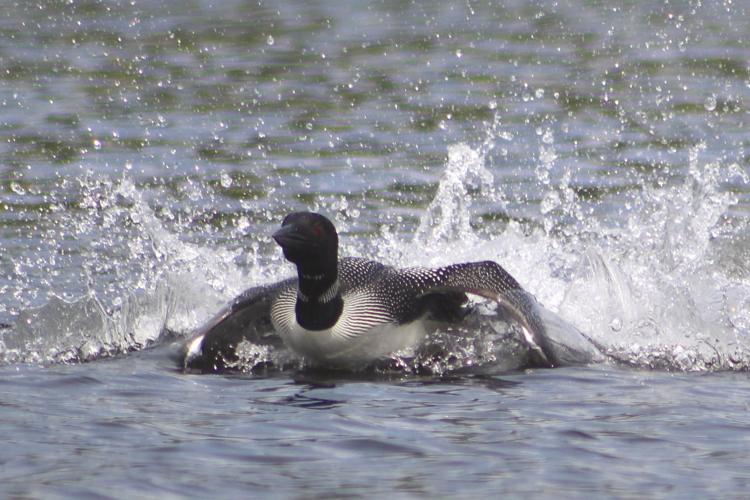
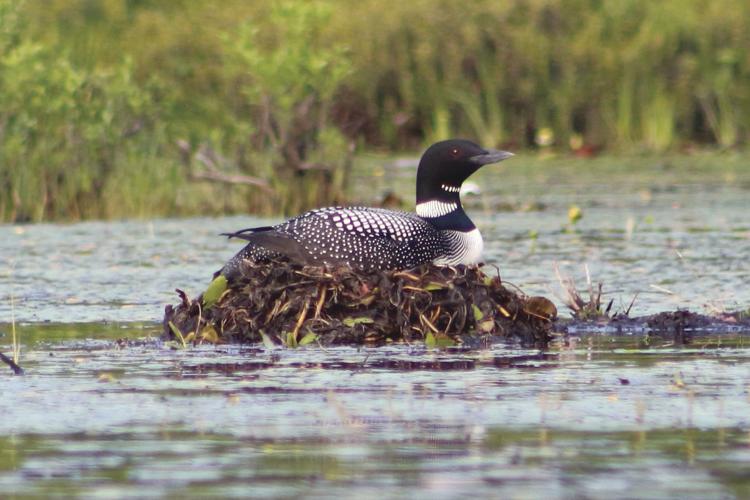
The Common Loon is perhaps New Hampshire’s most iconic bird, with the distinctive appearance and haunting sounds of the loon being recognized widely by residents and visitors alike. The Lakes Region is right at the heart of New Hampshire’s loon territory, and with the ice now out of our local lakes, our loons have returned for the summer to nest and raise their young after spending the winter on the ocean.
One theory is that loons start making daily flights to their preferred nesting lake even before ice-out, checking to see if there is enough open water to be able to land and take off again; this year I started seeing loons fly overhead four days before ice-out on a local lake, and on the very day ice-out was declared, the loons were on the water, so this seems a plausible theory.
We think of loons as majestic, peaceful animals, calling quietly in the evening over a calm body of water – which is accurate most of the time, but these large birds are also highly territorial and will fight relentlessly to defend their own piece of the lake. As a general rule a nesting pair of loons requires at least 50 to 100 acres of clean, fresh water that supports a healthy supply of aquatic life – especially small fish – but also snails, crawfish and leeches. The lake where I do most of my loon watching – Lake Wicwas in Meredith – is a bit over 300 acres, but in the 50 years I’ve been here the lake has never had more than one nesting pair.
Until 2016. In that year a second pair of loons arrived on the lake and apparently the longstanding residents (the female was banded in 2014) hadn’t read the book about not needing the entire 300 acres, and all hell broke loose. That summer consisted of an endless string of battles as the local residents tried to evict the newcomers from the lake. Neither pair of loons nested that year as the battles continued well past nesting season with neither having the time or energy to devote to nest-building.
The following year, two pairs returned again (we can only guess the second pair was the same one) and the battle over territory resumed. Eventually, however, the two pairs seemed to work out a sharing agreement with a dividing line in the lake on either side of which each pair kept to itself. It’s worth noting that the original pair, knowing the lake better, reserved the best fishing and nesting spots for itself, relegating the newcomers to the less desirable territory. By the time all this was worked out it was late in the year with the original pair not nesting until July, a full month later than usual. This nesting was successful – the chick was named “Tardy” – but unfortunately, Tardy met its demise at the talons of a bald eagle.
By 2018 the two pairs seemed have come to an understanding, and after just a bit of interacting to make sure each pair was in its place, both successfully nested and had eggs – two each. It was a hard year for loons though, and none of the chicks survived the summer.
Loon chicks have a myriad of threats to their existence: in addition to the eagles there are snapping turtles, hawks, lead fishing tackle, monofilament fishing lines and power boats to deal with. And that’s after they hatch. Before they hatch the nest must survive more eagle attacks (for the eggs), raccoons and weasels, changing water levels and power boat wakes, both of which can flood a nest.
Both pairs of loons returned to Lake Wicwas last year, both nested, and for the first time since 2014 Lake Wicwas successfully fledged chicks – two of them - both from the long-time resident pair. The second pair nested on their side of the lake again, and although two eggs were incubated, neither hatched. Perhaps this pair is young and still learning – their nest was in a very exposed location and it was a hot July.
This year, one pair is already back on the lake; a second pair has not been observed to date.
According to the Loon Preservation Committee, the loon population in New Hampshire is growing, though very slowly – about 1 percent per year over the past decade, and that’s only due to tremendous work by the Preservation Committee and many dedicated volunteers.
Although our loon population is holding its own at the moment, New Hampshire is at the very southern edge of the loons breeding range which raises another, long-term concern: Increasing environmental temperatures may move the loon’s range north, out of New Hampshire and farther into Canada. In fact, the impact of reduced ice-cover and hotter, wetter summer weather on loon nesting is already showing up in New Hampshire monitoring. Losing one of our most-loved icons would be a great loss for the Lakes Region and it’s all the more reason to support conservation groups such as the Loon Preservation Committee in their effort to protect this impressive bird. If you would like to help protect loons you can contact the Loon Preservation Committee through their website at loon.org, or call them at (603) 476-5666. They would love to hear from you.


(0) comments
Welcome to the discussion.
Log In
Keep it Clean. Please avoid obscene, vulgar, lewd, racist or sexually-oriented language.
PLEASE TURN OFF YOUR CAPS LOCK.
Don't Threaten. Threats of harming another person will not be tolerated.
Be Truthful. Don't knowingly lie about anyone or anything.
Be Nice. No racism, sexism or any sort of -ism that is degrading to another person.
Be Proactive. Use the 'Report' link on each comment to let us know of abusive posts.
Share with Us. We'd love to hear eyewitness accounts, the history behind an article.