


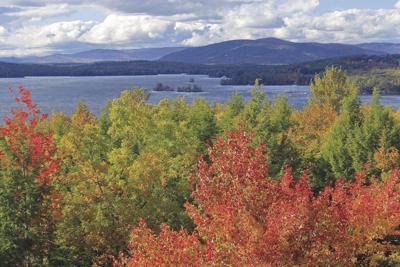
Fall has arrived in the Lakes Region with a chill in the air and color in the trees. Fall is such a beautiful time around Lake Winnipesaukee with the colorful foliage around the lake. However, as all New Englanders know, the foliage is just as short-lived as it is beautiful. The leaves will begin to fall into our yards and we’ll all feel the urge to grab a rake to clear them out, but this year consider leaving the leaves.
What are the benefits of leaving the leaves? Well, fallen leaves are important in maintaining a healthy lawn and serve as habitats, food and nesting material for wildlife. In fact, the majority of butterflies and moths overwinter in the layer of leaves, or “leaf litter” that builds up on the ground. The butterflies use the leaves as a winter cover for protection against the cold weather and predators. For example, luna moths and swallowtail butterflies disguise their cocoons and chrysalis as dried leaves to blend them in with the “real” leaves. Other than butterflies, pollinators such as bumblebees also rely on leaf litter for protection. Mated queens burrow 1-2 inches into the ground to hibernate for the winter and the layer of leaves on the surface help to protect them from the cold conditions. There are many other species of insects that live in the leaves providing food for animals like chipmunks, turtles, birds and amphibians. Thus, not disturbing fallen leaves is important in sustaining the natural web of life.
In addition to being important to wildlife, leaving the leaves benefits your lawn. Leaf litter is essentially free mulch for your yard, which helps create healthy soil by providing valuable organic matter and helps insulate the soil against the cold New England winters. Once the winter thaws and springtime comes around, leaf-covered lawns are some of the first to turn green. Also, there’s a chemical common in maple leaves that helps to discourage the growth of weeds like dandelions and crabgrass.
Another reason to not rake up your leaves is that leaves and other yard debris account for more than 13% of the nation’s solid waste. That’s a whopping 33 million tons per year. So, please leave your leaves where they fall; however, if you find that difficult to do, lightly rake them without disturbing the soil. Instead of bagging them and placing them on the curb, mulch the leaves with your lawnmower and spread them over garden beds, around trees and shrubs, or in other areas of your yard. You should avoid leaving big piles of leaves in your yard, even though it may be tempting to make a giant pile to jump in for the kids. Large piles of leaves in a concentrated area can inhibit grass growth. Instead, use your mower over the leaf-covered grass to break up the leaves into pieces that will help naturally fertilize your lawn. Alternatively, you could build a brush shelter by adding branches, sticks, and leaves into a pile to provide a shelter for native wildlife. Another option is to make compost by combining leaves with grass clippings. Keep this moist and well-mixed over the winter to create nutrient-rich compost for your garden next spring.
The most important thing to remember when it comes to fall lawn maintenance is to not rake the leaves into Lake Winnipesaukee or any water body. Raking leaves into streams, ponds or lakes adds additional nutrients that can negatively impact water quality, providing more food for plant and algae growth, including cyanobacteria. You may wonder about the trees along the shoreline and the leaves that fall into the lake. This is a natural source of nutrients to the lake, and important to the lake’s ecosystem. It is the additional loading of nutrients that creates the water quality problems. If you notice leaves in the lake, it is best to leave them as they are. Avoid raking as raking the bottom disturbs the aquatic life living in and on the lake bottom, and will lead to sediment and phosphorus being re-suspended in the water column, potentially fueling algae blooms. So, try leaving the leaves this season to help Keep Winni Blue.
•••
Jacquelyn Bellefontaine is the conservation outreach manager for the Lake Winnipesaukee Association. She manages communications and outreach initiatives. Jackie can be reached at jbellefontaine@winnipesaukee.org.
The Lake Winnipesaukee Association is a nonprofit dedicated to protecting the water quality and natural resources of the lake and its watershed. To learn more, visit winnipesaukee.org.


(0) comments
Welcome to the discussion.
Log In
Keep it Clean. Please avoid obscene, vulgar, lewd, racist or sexually-oriented language.
PLEASE TURN OFF YOUR CAPS LOCK.
Don't Threaten. Threats of harming another person will not be tolerated.
Be Truthful. Don't knowingly lie about anyone or anything.
Be Nice. No racism, sexism or any sort of -ism that is degrading to another person.
Be Proactive. Use the 'Report' link on each comment to let us know of abusive posts.
Share with Us. We'd love to hear eyewitness accounts, the history behind an article.