




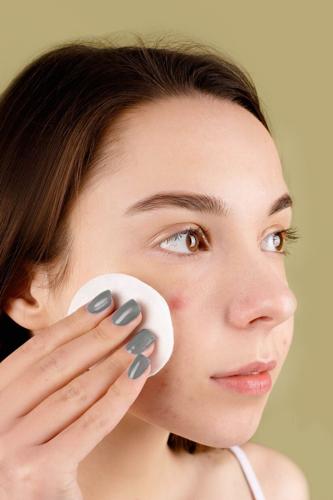


(Photo by cottonbro studio via Pexels)
By Stephen Beech
Overdoing skincare as a teenager can do more harm than good, warns a new report.
Less is often more when it comes to looking after your complexion as an adolescent, according to a leading dermatologist.
More and more teens are using cosmetics intended for adults that contain active ingredients.
But too much skincare as a teenager can be counterproductive and may make things worse, say experts.
A poorly chosen skincare routine as a young person can lead to dry skin, irritation, and even painful or itchy allergic reactions, according to the study.
Dr. Aniko Kovacs says that, in recent years, the skincare habits of children and teenagers have changed dramatically.
Influenced by trends on social media, she said youngsters are now starting to use cosmetics, makeup products, and preparations containing active ingredients at an increasingly younger age.
Kovacs said: "However, it's important to distinguish between cases when a young person actually has a skin problem or when they are treating completely healthy skin.
"Young skin is not yet mature, so it is more sensitive and vulnerable to active ingredients than adult skin."
Kovacs, a dermatologist at Semmelweis University in Budapest, Hungary, says one of the biggest dangers in teenage skincare is overdoing it.
She said young skin does not require a complex routine, but rather "conscious, moderate care" using reliable preparations.

Dr. Aniko Kovas says skincare habits of children today are very different than in the past. (Bálint Barta via SWNS)
Cosmetics sold in Europe undergo strict testing, making them a safer choice than products from unknown sources.


Kovacs said: "If possible, it is worth seeking advice from a dermatologist or pharmacist when selecting the right products."
She says for children who do not have skin problems, such as those aged 10 or 11 - gentle facial cleansing, for example with fragrance-free micellar water, and the use of a sunscreen in the mornings that is suitable for their skin type, are sufficient.
Kovacs said: "Excessive moisturizing at this age can even cause complaints, such as skin inflammation around the mouth.

(Photo by Hanna Pad via Pexels)
"One of the most common mistakes is using anti-acne products with a strong drying effect on healthy or slightly oily skin.
"This can easily lead to dry skin, irritation, and red, itchy, or even painful allergic reactions, known as contact dermatitis."
She says the most common skin problem in adolescence is acne, which usually appears on the face, and in more severe cases, on the back or chest, where there are many sebaceous glands.
Kovacs said: "Treatment is based on regular facial cleansing once or twice a day with a cleanser specifically formulated for oily skin, removing makeup and impurities, followed in the evening by applying acne-fighting creams containing active ingredients, and moisturizing and sun protection in the morning."
The dermatologist warned that "home remedies" circulating on social media and the simultaneous use of multiple strong active ingredients can "significantly worsen" the symptoms.

(Photo by RDNE Stock project via Pexels)
Kovacs said wearing makeup is now routine even among teenagers, but it is important to remove all traces of makeup every day and, whenever possible, avoid using products that are too oily or provide heavy coverage.
"If a child's skin becomes red or inflamed after wearing makeup or using cosmetics, the first step is always to wash off the product.
"In milder cases, soothing creams containing panthenol can help, but if symptoms do not improve, a medical examination is necessary."
She added: "In adolescence, skincare is not a competition: less is often more, and a conscious, age-appropriate routine protects skin health in the long term."




(0) comments
Welcome to the discussion.
Log In
Keep it Clean. Please avoid obscene, vulgar, lewd, racist or sexually-oriented language.
PLEASE TURN OFF YOUR CAPS LOCK.
Don't Threaten. Threats of harming another person will not be tolerated.
Be Truthful. Don't knowingly lie about anyone or anything.
Be Nice. No racism, sexism or any sort of -ism that is degrading to another person.
Be Proactive. Use the 'Report' link on each comment to let us know of abusive posts.
Share with Us. We'd love to hear eyewitness accounts, the history behind an article.