




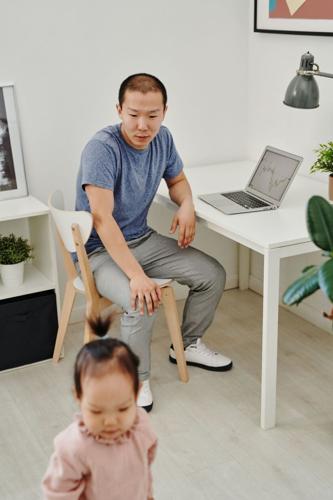

(Photo by Arina Krasnikova via Pexels)
By Lauren Wilkin
New research has found that working from home can damage men's careers more than women's.
The study, led by King's Business School, in London, found evidence of bias against homeworking in both the U.K. and Germany, despite its rapid growth since the pandemic.
And the bias is impacting men, more than women.
The researchers analyzed almost 13,000 assessments of hypothetical candidates made by around 5,300 employed people in the U.K. and Germany during the second half of 2023.
Each participant rated more than one candidate as if making a promotion or appointment decision.

(Photo by Helena Lopes via Pexels)
Candidates described as working from home received lower ratings in both countries, with the penalty significantly greater at three or four days a week than at one or two.
This meant they were more likely to receive lower promotion or appointment ratings than otherwise comparable office-based colleagues and those who spend up to two days a week at home, the study said.
Mothers were penalized least, while fathers and workers without children generally experienced larger declines in ratings.


However, the researchers caution that this should not be interpreted as a straightforward advantage for mothers.
In the U.K., mothers already received relatively low office-based ratings, particularly compared with childless women, so homeworking caused less additional damage.

(Photo by ShotPot via Pexels)
Men, on the other hand, start off at a higher position and therefore have more to lose when working from home, it said.
Researchers say that for HR teams, the findings raise an important distinction between offering flexibility and making it safe to use.
Heejung Chung, professor of work and employment at King's Business School, said: "Flexible working has often been seen as a mothers' issue, but this study shows that fathers also need protection from career penalties when they use it.
"Making flexibility safe and normal for fathers can support mothers' employment while improving outcomes for fathers and children."
The researchers argue that a formal right to request flexible working may not be sufficient if workplace cultures continue to associate physical presence with commitment and productivity.
They note that the experiment measured evaluations of hypothetical candidates rather than actual promotions or employees' careers over time.
Flexible working, they argue, should also be presented as a normal way of working for all employees. Treating it primarily as a policy for mothers or caregivers could reinforce existing assumptions and make fathers more reluctant to use it.


(0) comments
Welcome to the discussion.
Log In
Keep it Clean. Please avoid obscene, vulgar, lewd, racist or sexually-oriented language.
PLEASE TURN OFF YOUR CAPS LOCK.
Don't Threaten. Threats of harming another person will not be tolerated.
Be Truthful. Don't knowingly lie about anyone or anything.
Be Nice. No racism, sexism or any sort of -ism that is degrading to another person.
Be Proactive. Use the 'Report' link on each comment to let us know of abusive posts.
Share with Us. We'd love to hear eyewitness accounts, the history behind an article.