


Jaxen Cole — a social media influencer specializing in motorcycle stunts being tried on two felony counts of fraudulent use of deepfakes — was found not guilty by a jury on both counts in Belknap Superior Court on Monday.
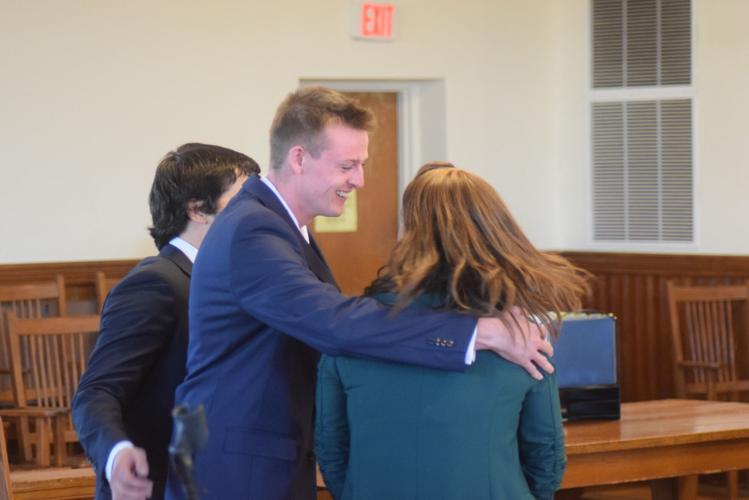
Cole, 22, of Gilford, was visibly excited when the verdicts were read, hugging his attorneys, Allison Ambrose and Kyle Amell, of Wescott Law. A cheer went up in the courtroom from his supporters, which included about a dozen people who listened to testimony throughout the day.
“The jurors made a really good decision,” Cole said. “Justice was served in a positive manner. It was still stressful because, obviously, anything can happen. But it was the right decision.”
This was the first deepfake case brought forward under a novel New Hampshire law, RSA 638:26-a.
Cole was charged with creating, distributing or presenting a likeness in audio of an “identifiable person,” Officer John Skehan of the Laconia Police Department, which constituted a deepfake.
Cole was alleged to have posted a video to his Instagram account, as well as Facebook, showing Skehan’s body camera footage, where the officer's voice had been digitally manipulated into saying “different things than in the original.” The charges alleged Cole committed the act with a purpose “to embarrass, harass, or cause reputational damage” to Skehan, and acted knowingly.
Skehan is now medically retired from the department, following an unrelated incident.
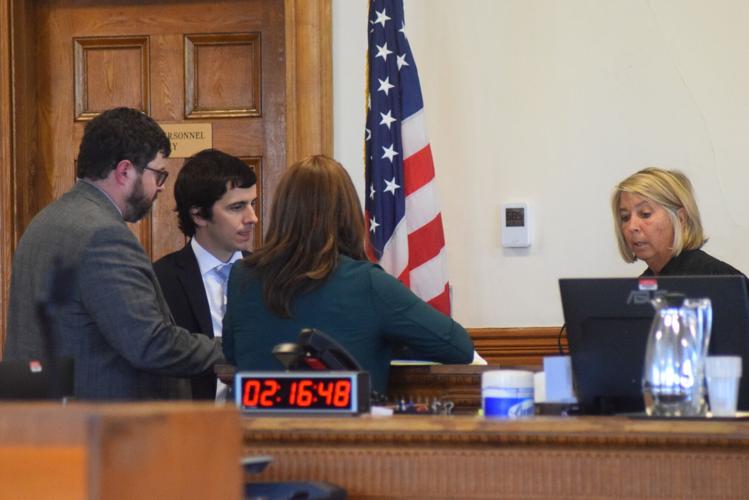
The court heard testimony from Officer Kira Goodheart, as well as Skehan himself, throughout the day, as Judge Jacalyn Colburn presided over the case. After closing arguments ended just before 4 p.m., the jury deliberated for about 40 minutes before coming to a unanimous decision that Cole was not guilty on both counts.
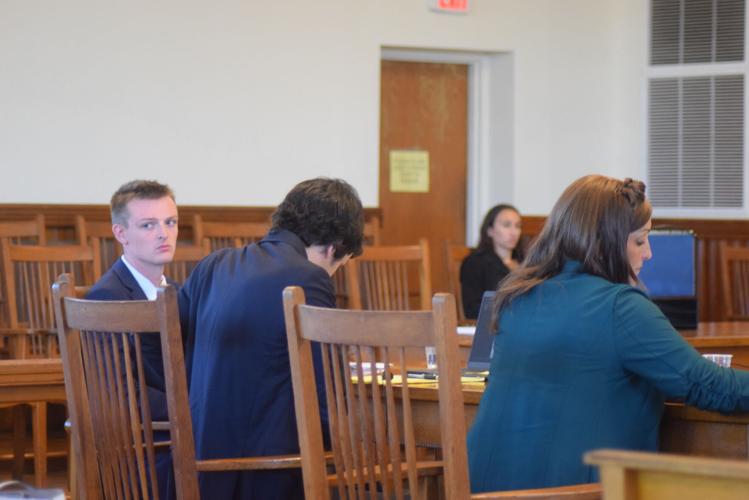
The day started with Cole, dressed in a navy blue suit and black tie, sitting alongside his attorneys, with about 30 people in the audience.
The prosecution was led by Assistant County Attorney Alexander Smeaton, who explained the case to the jury, and told them he needed to prove beyond a reasonable doubt Cole was guilty of the charges. Smeaton said Cole was arrested in 2022, for doing stunts like burnouts, and then in February 2024, he posted 50 minutes of body camera footage he obtained.
A year later, on Valentine’s Day, at 10:46 a.m. on Feb. 14, 2025, Cole posted a 56-second video using the body camera footage, but with Skehan’s voice allegedly altered to praise Cole, and even ask for his autograph.
After the prosecution and defense each went over the evidence, which included clips from the original body camera footage and the video Cole posted last year with the alleged deepfake, Goodheart was cross-examined.
Goodheart told the court she was informed by Capt. Christopher Noyes about the video, which was originally investigated as a misdemeanor criminal defamation case. In the altered video, a voice sounding like Skehan made a number of comments praising Cole, including “Jaxen, you’re the best at what you do. There is no doubt.”
The voice also said he was “dying laughing” at one of Cole's stunts, and wished he could turn the camera off, but it was against policy.
Goodheart said she'd been in contact with Cole, and when finding out about the investigation, Cole asked if “he” was mad. Cole then opted not to speak to her without a lawyer.
Smeaton asked what made her think it was fabricated, and she said she recognized Skehan’s voice, and she didn’t think he made the comments.
The defense noted in cross-examination that while the original, untouched video had aspects where Skehan could be identified, and show the Laconia Police booking room and police cruiser, these were not apparent in the alleged deepfake video.
The defense also said the voice didn’t identify Skehan or Laconia Police by name, but Goodheart said, “everyone has their own unique voice.”
The defense asked if she saw Cole alter the video, and if she knew if it was artificial intelligence, and she said she did not. Ambrose asked if, based on the investigation, there was evidence this was actually to embarrass Skehan, and Goodheart replied, “no.”
Skehan took the stand, telling Smeaton he saw the video after people sent him the link. This included friends and Laconia police who recognized his voice. He said he watched the video, and recognized his own voice, but not what he said at any time.
In the video, Cole questioned whether “this cop” would want to be his valentine. Smeaton asked if he wanted to be Cole's valentine, and Skehan replied he did not. Skehan said he was in “shock and awe,” and was “embarrassed” by the posted video. He also feared being a “laughingstock.”
“I felt that was what the video was doing to me,” he said.
Amell questioned Skehan, and asked if his face was shown, or if there was any identification of him, or the department, in the second video. Skehan said it was only his voice. Amell asked Skehan if he had a specific identifying factor of his voice, such as a lisp or stutter, or whether his voice was high or low. Skehan said he did not, except his voice is a bit lower, which could be subjective.
Amell asked if it would be difficult to replicate his voice, and Skehan said, “I still have a unique voice that only I have.”
Amell said no case had been made on whether there could have been a voice actor, rather than AI or any digital altering of the voice. He said in closing arguments that the prosecution had the chance to use an expert to confirm this, but did not do so.
A key point of the trial was about whether the video was parody or satire, and Ambrose said, “everything points to satire and parody,” and the state didn’t introduce any evidence other than it was embarrassing, and jokes can be harmful.
They stated no forensic evidence or testimony established AI was used, and the defense asked the court to dismiss the case. Smeaton told the judge the jury had plenty of evidence, and asked the defense’s motion to dismiss be denied. Colburn ultimately denied the request for dismissal.
During closing arguments, Amell played a video of the alleged deep fake again for the jurors. He said they may think it was funny, not funny, immature, or unnecessary. The question was not whether someone was embarrassed, he said, but whether the state could prove it was purposeful and, without a reasonable doubt, a deepfake was created.
“In the absence of doubt, innocence is assumed,” Amell said.
Amell said it was clearly a joke, not subtle or hidden. He also said there was no proof AI was used, or that Cole consciously tried to embarrass or harass Skehan. He said, “the answer is, the proof is not there.”
“Over the course of the last few hours, the state has failed to meet its burden,” Amell said.
Afterward, Cole was all smiles. After the verdict, Cole spoke about the trial, and what was going through his mind.
“I got the best defense I could; I got Allison Ambrose from Wescott Law,” Cole said. “So, I wasn’t too nervous about the defense. I was just nervous, because jurors can ultimately make a decision, even if the defense is great.”
He felt confident in coming away clear, and said there was a weight lifted from his back, after facing two serious charges.
“Two felonies that could have had a really negative outcome,” Cole said. “It feels good to have that off my back, and to be innocent, even though I was innocent the whole time.”


(0) comments
Welcome to the discussion.
Log In
Keep it Clean. Please avoid obscene, vulgar, lewd, racist or sexually-oriented language.
PLEASE TURN OFF YOUR CAPS LOCK.
Don't Threaten. Threats of harming another person will not be tolerated.
Be Truthful. Don't knowingly lie about anyone or anything.
Be Nice. No racism, sexism or any sort of -ism that is degrading to another person.
Be Proactive. Use the 'Report' link on each comment to let us know of abusive posts.
Share with Us. We'd love to hear eyewitness accounts, the history behind an article.