


(MILWAUKEE) Summer is here – the perfect time to take a walk on a beach. But doing so is not always as simple as it might sound.
In Wisconsin, for instance, a legal case has stretched for months over whether Paul Florsheim may keep walking on a Lake Michigan beach he has walked for over 50 years.
In July 2025, Florsheim, a retired professor of public health at the university where we work, got a ticket for trespassing on a beach. The person who owns the land adjacent to the sand says the beach is a private backyard. The judge found Florsheim guilty, but Florsheim has appealed.
The case has sparked widespread discussion around the Great Lakes and raises a question hotly debated in many of the country’s coastal communities: Who is allowed on which beaches?
We are water law and policy researchers studying shoreline access in the Great Lakes region and beyond. Research shows there are many physical and psychological benefits to visiting waterside spaces. But our center’s research has found that getting to the water’s edge isn’t as straightforward as it might seem – or as many people might like.
An ancient right in modern times
A legal principle known as the public trust doctrine establishes people’s rights to use certain lands and waters.
The concept originated in Roman law and was carried through English common law into the laws of Britain’s American colonies, and on to the rest of the United States. It is well settled federal law that as states joined the union, the U.S. government transferred to those states the ownership of navigable waters and the beds beneath them, to be held in trust for all the people.
The division between those public trust areas and private land is usually set at what is called the “ordinary high-water mark,” or “mean high tide line.” That designation refers to a specific location on the shore established by a discernible line, often based on debris buildup or vegetation growth, on the land side of the point at which the water contacts the shore.
Historically, public trust rights included the “right of passage” on foot over land below the ordinary high-water mark. However, the specific rules for any given location are a patchwork established by states along the U.S. seashores, the Great Lakes and smaller bodies of water. And in some states, there’s no clear legal answer to whether beach walking is allowed.
Legislatures or courts have not consistently addressed beach walking below the high tide line on the oceans. California’s Constitution and Coastal Act strongly protect public access in this zone, while Massachusetts and Maine, because they were carved out of the Massachusetts Bay Colony, say even land to the low tide line can be privately owned.
Only three of the eight Great Lakes states have taken up the issue – Indiana, Michigan and New York. All have uniformly recognized the legal right to walk on Great Lakes beaches below the high-water mark.
But that leaves a lot of states – and a lot of beaches – without clear guidance on the matter.
A long-running dispute
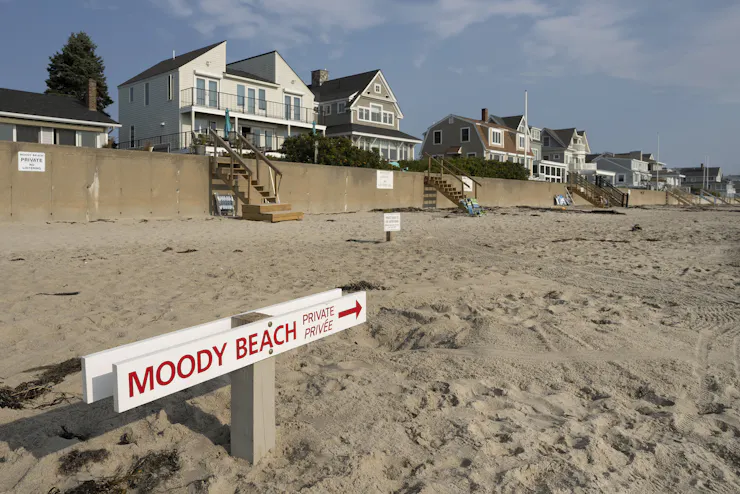
In the southern Maine coastal community of Wells, there is a yearslong fight between people who want to walk on the beach and people who claim to own it.
In 1989, the Maine Supreme Court ruled that shorefront property extends beyond the mean high tide line, all the way to the mean low tide line, and that the only public activities allowed between the tide lines are “fishing, fowling, and navigation” – not walking.
In 2021, local residents filed a lawsuit asking courts to change that ruling, to declare that the area between the low tide and high tide lines should be held in trust for the people’s use – including walking and running. The case is still in litigation today, with some parties to the case saying they want to take it to the U.S. Supreme Court.
But in the meantime, the property owners are standing their ground. In 2023, they laid a line of seaweed marking what they said was the public-private boundary. The following year, they erected “no trespassing,” “private beach,” and “no loitering” signs and called police on people they said were on private property.


Barring access
There are other ways people are excluded from walking on beaches, even in states with clear protections for public access. If they can’t even get to the sand – or rising waters mean there’s no beach at all – they can’t enjoy walking on it.
In some places, developers install seawalls to protect their land against rising waters. But those walls tend to cut off beach access and can even cause more erosion.
North Carolina, California, New Jersey and Florida have responded by enacting laws to protect public access to beaches when developers request erosion-control structures. But state agencies have ended up in court defending state protections against private property owners and developers.
And in Michigan, where the state Supreme Court has said the public can walk on Great Lakes beaches, some Lake Michigan shoreline property owners are building miles of seawalls and rock barriers. Those new structures may fight erosion, but they also are either built on what used to be beaches or are private structures that are hard to climb over to reach the sand.
Some property owners block beach access by closing roads leading to the sand, as one California property owner illegally did by locking two gates for years, according to a series of rulings by the state’s coastal commission. In June 2026, a Milwaukee TV station reported that one Wisconsin property owner had roped off a stretch of Lake Michigan shoreline historically accessed by the public and erected multiple “no trespassing” signs and a mounted trail camera to monitor activity.
Some local governments restrict beach access by allowing only local residents to park close to beaches or selling beach-access points to private developers.
In some places, such as Forest Park, Illinois, and Norwalk, Connecticut, local governments have rules requiring nonresidents to pay to park or use the beach.
Taking a different approach
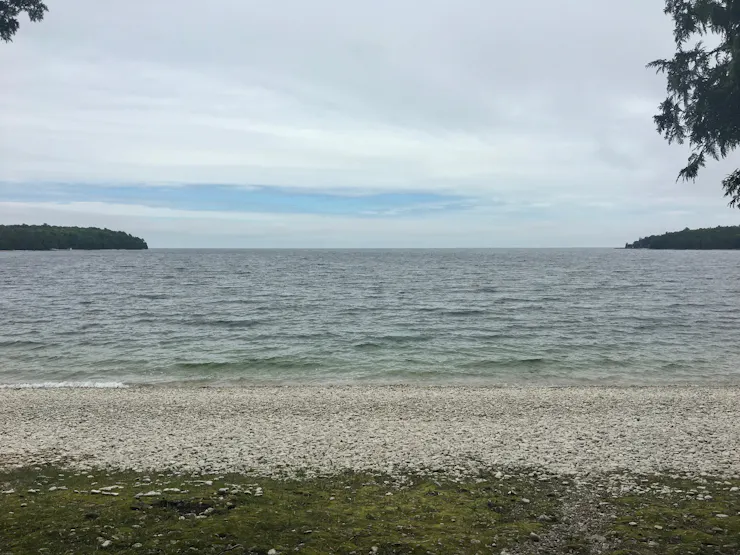
Some communities are taking matters into their own hands to protect public access. For example, a group of municipalities in Door County, Wisconsin, have invested more than $26 million to acquire over 2,700 feet of Lake Michigan shoreline and 128 acres of waterfront land for public use.
The effort was spurred in part by fears that private development would restrict public access and use of the shoreline. But this is an unusual approach: About 80% of the U.S. Great Lakes coastal uplands are privately owned, and other municipalities are seeking commercial shoreline development rather than public use.
Public access to those Door County beaches is protected, but the Florsheim case will decide – for the first time in the state – whether the public may walk on as much as 800 miles of Wisconsin’s Great Lakes beaches. Yet because of other efforts to block access to the water itself, that is just one aspect of the legal questions about who can actually get sand between their toes.
This article is republished from The Conversation, a nonprofit, independent news organization bringing you facts and trustworthy analysis to help you make sense of our complex world. It was written by: Melissa Scanlan, University of Wisconsin-Milwaukee and Will Matuska, University of Wisconsin-Milwaukee
Read more:
- The beach wasn’t always a vacation destination ‑ for the ancient Greeks, it was a scary place
- ‘Blue’ space: Access to water features can boost city dwellers’ mental health
- Dig safely when building sandcastles and tunnels this summer – collapsing sand holes can cause suffocation and even death
Melissa Scanlan is the founder of Midwest Environmental Advocates, the organization that represents Paul Florsheim in his beach walking lawsuit. She no longer works for the organization and does not serve on its board of directors.
Will Matuska does not work for, consult, own shares in or receive funding from any company or organization that would benefit from this article, and has disclosed no relevant affiliations beyond their academic appointment.


(0) comments
Welcome to the discussion.
Log In
Keep it Clean. Please avoid obscene, vulgar, lewd, racist or sexually-oriented language.
PLEASE TURN OFF YOUR CAPS LOCK.
Don't Threaten. Threats of harming another person will not be tolerated.
Be Truthful. Don't knowingly lie about anyone or anything.
Be Nice. No racism, sexism or any sort of -ism that is degrading to another person.
Be Proactive. Use the 'Report' link on each comment to let us know of abusive posts.
Share with Us. We'd love to hear eyewitness accounts, the history behind an article.